Product Design Using Artificial Intelligence
Contents
- What is this document, anyway?
- General Best Practices for Designers using AI
- Ethical Concerns with using AI
- Articles, Blogs, Media
- Basic Large Language Models (LLMs)
- Prompt ‘Engineering’
- Design Process
- Background research
- Pricing Research
- Scientific Research
- Parsing public data sets
- Client & Market research
- Product Management
- User Research
- Persona generation
- Empathy Network Map
- Strategy & Documentation
- Usability Testing
- Mood Boards
- AI Image Generation
- AI Product Design Best Practices
- Design System Support
- UX Design
- Coding apps with LLM help
- Generative 3D Models
- https://develop3d.com/ai/ai-in-product-development/
- AI Structural Design
- AI Packaging Design
- AI Photo Editing & Graphic Design
- Generative Music
- Generative Video
- Product Photo Placement
- Case Study: Capturing photos for classic furniture design
- Case Study: Designing a playful home speaker
- Approach
- Class Work Expectations
- Project Focus
- Industry Examples
Written for Pratt Institute Industrial Design Senior Design Studio Class, 2025
What is this document, anyway?
This document was written to support my Pratt Industrial Design Senior Capstone Studio class, “Designing with AI”. I am not an expert, but perhaps my explorations may be useful to other designers.
This document is a summary of research into how AI tools may be practically useful to the individual designer in 2025. AI tools are rapidly changing and there is a fair amount of hype, fear, and BS that may obscure the actual utility.
As we are focused on AI for the individual designer, we’ll limit commentary on AI’s impact to society, employment, and the environment to what a designer can personally take responsibility for. In particular, I recommend Ted Chiang’s excellent thought (paraphrased) “Most fears about A.I. are fears about capitalism.”
If designers don’t embrace AI, the world “will be designed without them” AirBnb founder Brian Chesky
(Why do we think the owner of a company that employs designers would have this opinion?)
General Best Practices for Designers using AI
“AI tools should not be thought of as an all-knowing expert, but rather as a highly motivated intern who often gets things wrong.”
It can also be very helpful as a co-pilot. Ask it to review work and suggest concerns. AI can be used to improve your process for example to help you ask better questions
- “How can I…”
- “What are some typical concerns with…”
- “As a (user persona), what problems do I have with …”
Please keep in mind: AIs exude confidence, but they don’t actually know if what they output is correct. Like the age-old arguments of “high fidelity designs vs wireframes”, we have to be very careful to communicate with our partners and clients what our actual confidence is when we present a design or mockup.
Risks & Issues
There are a number of issues with AI that will be discussed in the class.
- Online, where the models were trained, is really not the same as real life.
- There is so much hype around AI, we risk falling for false advertising, especially as AI itself is great at lying. AI has replaced crypto and VR as the focus of grifters. Be careful.
- AI and Large Language models are very clever statistical presentations, which means they are generally returning the best AVERAGE answer. This is often the truth, but not always!
- “AI design tools easily provide many mediocre answers, but a good designer is hired to provide THE innovative answer.”
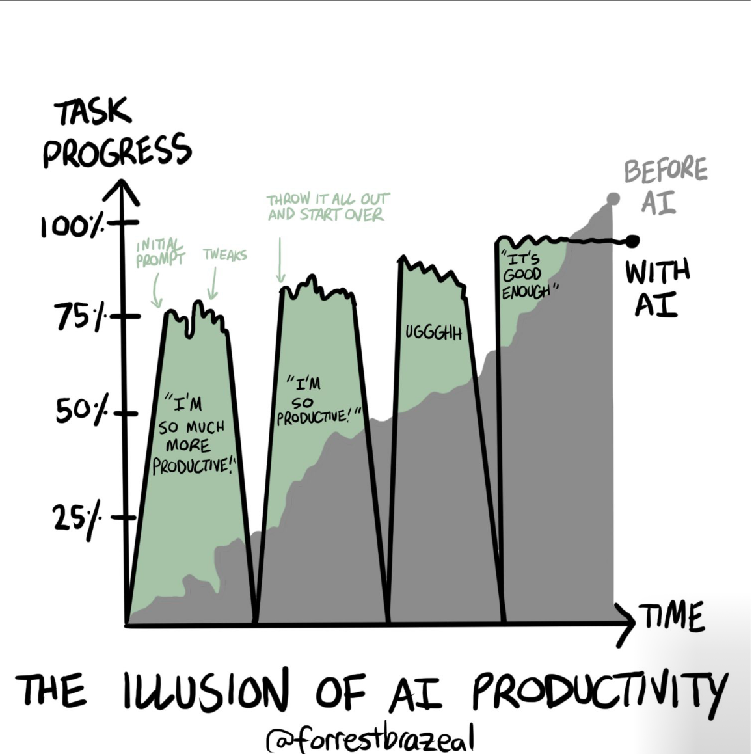
- AI generates answers but the operator has to have a firm vision to avoid accepting a “good enough” answer and quietly becoming a mindless operator.
- The AI tools are “fearless but clueless”. It is essential that the human designer maintain focus to drive the design intention. If the designer shifts into a passive passenger role, they risk the “Moses illusion”, accepting answers without questioning the question.
- AI always provides an answer, but the operator has to know enough to know if it actually makes sense. An answer can be correct, but useless for reasons outside the scope.
- Often “Good Design” is more of a process of balancing independent trade offs (Speed vs Cost) than a single “Right” answer.
- AIs are extremely powerful at making demos, but difficult to adopt into a workflow. You will often see AI demos start with a blank page, but blank pages are rare in design. Usually one is dealing with previous branding, design system, technology, etc. This is easier for people, but integrating these factors is much harder for AIs. Demos leave this out for a reason.
- AIs are “Non Deterministic”: They do not follow a repeatable set of instructions every time. This makes them very difficult to employ for critical processes, which are required to be extensively tested.
Ethical Concerns with using AI
AI tools in design raise questions about giving credit where it’s due. If AI helps create a design, should the AI be mentioned? This gets tricky because AI learns from existing artwork and designs, which means it might copy parts of other people’s work without asking permission. It’s like if someone copied parts of different paintings to make a new one - who should get credit for the final piece?
While AI design tools make it easier for anyone to create professional-looking work, this could put some designers out of jobs. There’s also worry about AI copying the biases it sees in its training data. For example, if AIs use content from one culture or group of people, it might make designs that leave out or misrepresent other groups.
When designers rely too heavily on AI, they might lose important skills and become too dependent on computers to do the creative work. Just like using a calculator too much might make someone forget how to do math by hand, overusing AI in design could make designers less skilled at their craft. AIs work best to help already skilled designers be more productive.
Bias embedded in AI models
When looking at any AI image generator, there are certain trends that are obvious. Namely that people like creating fantasy creatures and people. Often they have exaggerated sexual characteristics in the style of video games. In many cases, the AIs were trained on fantasy images, which may have led to the case study where an AI made a woman’s photo more risqué.
Bias is usually more subtle than this, so one must be especially careful. This is an “unknown unknown” situation, where one doesn’t know what one doesn’t know. Challenge yourself to include more perspectives and test, test, test.
Bias exists in humans as well. Interestingly, one can use AI tools to check our own work.
Searching for “bias” in https://chatgpt.com/gpts has custom GPTs that look for bias in one’s research, for example leading questions.
Ecological Impact
It’s bad.
The Staggering Ecological Impacts of Computation and the Cloud
Impact on Employment
I managed a number of design teams (from 50 to 300+ designers & researchers), and there were never enough people to do all the work. We created templates to expand the ability for designers. If you can hire the designer, junior or senior, I would always recommend it.
As an example, if you can afford a dedicated user researcher, do it! Having a distinct role with the inquisitive mindset can create a learning culture. My biggest concern with AI customer research is that the tough questions don’t get asked. Mind you, this happens on teams with researchers also! Apple, famous for design, launched several products that flopped due to lack of customer interest.
Personal Ethical & Legal Implications
Plagiarism is bad, AI plagiarism is just as bad. Don’t do it! Also, the tools to ‘reverse image search’ are good and getting better. https://www.aiornot.com/
Never upload information that competitors or non-employees at your company shouldn’t know. This includes:
- Personally Identifiable Information about your customers (names, birthdays, addresses, etc).
- Secret information about your company (employees names).
- Anything you think you should not talk openly about regarding users, your employer’s or client’s business, products, future developments.
Once you upload it, assume it is there forever.
Your company may have signed a non-disclosure document, which is enforced in your employment contract. Even if no one is hurt, the company and you may be liable for legal damages. When in doubt, ask!
Articles, Blogs, Media
- The spontaneous emergence of “a sense of beauty” in untrained deep neural networks.
- https://designwithai.substack.com Xinran Ma
- Say Hello to Sentient Design by Josh Clark
- AI and the Next Chapter of UX Josh Clark Talk
- How Machines Learned to Discover Drugs
- https://www.dezeen.com/2023/11/20/airbnb-founder-brian-chesky-artificial-intelligence-interview/
- Integrating A.I. into design process Core77 Forum
- https://boards.core77.com/t/ai-is-pumping-ideas-now/82526
- Design Cinema - Episode 110 - What AI Cannot Do
- https://daydastudio.substack.com Hector Rodriguez
- https://www.dbreunig.com/2024/10/18/the-3-ai-use-cases-gods-interns-and-cogs.html Nice framing of how AI can be defined and used
- https://www.stephengates.com/HOW_Deisign_2024.pdf - good presentation of tools
- The Essentials Of Midjourney For Industrial Designers Online Class
- https://rosenfeldmedia.com/dwai-2024-program conference
- https://www.springboard.com/blog/data-science/ux-design-prompts/
AI Basics
Basic Large Language Models (LLMs)
LLMs are the most well known AI tools:
- ChatGPT.com
- Claude.ai
- https://aistudio.google.com/gallery
- Many others
- Otter.ai transcribes audio & meetings (Note: you will remember more if you take notes! )
- Zoom business summary (Note: you will remember more if you take notes! )
- Remember to try “Query Quilting”: Ask the same question to multiple AIs. You can even have an LLM summarize and synthesize the results. There are tools to do this automatically like openrouter.ai
I have no strong opinion and expect to change these over time. I pay for Claude as humans I know recommended it. It has a “project” concept to load a bunch of documents to focus the discussion. This is handy, for example, if writing a long thesis, doing a senior studio capstone project, etc
These are probably the most important AI tools for a designer. Designers, as a real existing job, have the same busy work and paperwork as any other job. Tasks like writing proposals, answering RFPs, take up time needed for the actual design work. Ask any practicing designer and they will say they have to fight for time to do actual design work. So, on a personal level, use every tool to be productive! Xinran Ma has an excellent write up on automating one example of a tedious workflow.
LLMs are excellent to help with writing, especially as designers often struggle with the writing arts. They can:
- Help you get started. The “Terror of the Blank Page” is real and it affects everyone.
- Provide structure. LLMs have digested lots of examples and will provide bland examples. They are comparable to taking templates off the internet.
- One must be careful not to just use the AI work as generated. We can all tell when you use a LLM to write an email. You should expect to rewrite 80% of the text to what you really mean.
LLMs are excellent summarizers of text, for example taking a 50 page guide for a government research grant. Never simply take output, ask again for clarification. Then, after completing your document, have it compare your document to the original RFP. It can be very helpful to ask open-ended questions like “what have I left out?”
LLMs are also good as research aids. They are endlessly patient. You can ask dumb questions without losing social status with your peers or annoying your professor.
Ask it to ask you questions! “As a purchasing agent of a large consumer packaging goods company, what questions would you have about this proposal?” Ask it to interview you. “Pretend to be the editor of an industrial design magazine interviewing me for a design award. What 5 questions would you have about this product? Please ask a challenging follow up question.” The LLM doesn’t “know” secret things, but the exercises will force you to confront blind spots and weak justifications.
Ideally you are collaborating with a close partner who knows everything you are doing and has infinite time and interest to discuss your ideas. Many designers, unfortunately, work in isolation. LLMs can not approach the creativity of a real person, but they can be a tireless tool you can use to develop your ideas. This mimics the common scenario when we describe our problem to another person, and come up with the answer before they even speak.
“Create your own Frenemy”. Your ideas will be seen in the cold light of reality eventually. You can improve them, look for blind spots, and even check your own biases. When stuck or lost, use it to shake up your thinking. The 1974 card set Oblique Strategies created by Brian Eno and Peter Schmidt has a similar function. It asked ambiguous questions like, “Honor thy error as a hidden intention”, “Remove specifics and convert to ambiguities”, or “Only one element of each kind”. Again, the LLM doesn’t know everything, but you can use it to challenge and improve your thinking.
In my experience, design students don’t challenge their own work enough. This is natural: every creative process is an exercise in vulnerability. The counter risk to a young designer is that they “fall in love” with their creation. It may indeed be a rational strategy to overlook flaws in order to have the confidence to continue, but it is even a better strategy to get feedback early.
Designers often wait to show their work until it is too late to fix a problem obvious to others.
User testing is essential for good design, but a key aspect of running a test is it takes it out of the social / status context. One is not arguing with a friend or peer over whose idea is better. LLMs have no social status and work in private. Use them to challenge and polish your ideas.
And please, please: use the original AI: spell-check your work. Spelling errors make people think you are sloppy and they rarely tell you.
Prompt ‘Engineering’
Like all tools, LLMs take some skill to use effectively. Asking short generic questions with no follow up questions will give you banal & useless responses.
From Xinran Ma’s Design with AI free guide
Goal
- Specify your request.
- e.g. [What you want to ChatGPT to accomplish]
- e.g. You need to design a user interface for a meal planning mobile application aimed at busy families. The app should feature an intuitive dashboard that allows users to quickly access their weekly meal plans, grocery lists, and favorite recipes. The interface should include interactive elements such as drag-and-drop functionality for rearranging meals and a visual calendar to display meal schedules. Give me 3 layout options.
Context
- Provide enough detail.
- e.g. [Why you need this task done]
- e.g. You are working with the product manager in this early design phase. The short-term business goal is to increase engagement with an intuitive interface and explore monetization though partnerships. Busy families face time constraints, leading to unhealthy eating habits. Current meal planning apps are complex and inefficient with un-intuitive interfaces, causing frustration.
(Optional) Persona
- Assign ChatGPT a persona.
- e.g. Act as [persona]. [Some details about character and specific expertise]
- e.g. Act as a seasoned product designer. You are renowned for your exceptional design thinking and your ability to create high-quality designs that seamlessly meet both business objectives and user needs.
(Optional) Desired response
- Explain how the response should look like.
- [Format] e.g. Walk through instructions step-by-step. Step 1: … Step 2: …
- [Format] e.g. Provide your response in a tabular format.
- [Format] e.g. Provide your response in a list of bullet points.
- [Tone and Style] e.g. Provide your response in a formal, or conversational, or persuasive tone.
- [Tone and Style] e.g. Use clear, concise, and simple language.
- [Output length] e.g. Limit your response within “2 paragraphs” or “100 words”.
- Give an example for ChatGPT to reference. Ask it to reference the format, tone and style, etc.
- e.g. Provide the response in a tabular format. Here is an example of the format—use it as a reference.
(Optional) Audience
- Include needs, pain points, interests, or anything else that is important.
- e.g. You need to present the ideas to the CTO of the company. While she has extensive technical knowledge, she is less familiar with this specific product and the user needs associated with it. Therefore, it is essential to provide her with clear and concise context to ensure she fully understands the findings.
(Optional) Tell ChatGPT to ask you questions to refine the prompt
Rectangle
Before you give me the answer, ask me everything you need to know to give me the best result possible. **
Ask for help with your prompt!
A clever hack From Brett Littlefield
I want you to become my prompt engineer. Your goal is to help me craft the best possible prompt for my needs. This prompt will be used by you, ChatGPT. You will follow the following processes.
1. Your first response will ask me what the prompt should be about. I will provide my answer, but we will need to improve it through continual iterations by going through the next steps.
2. Based on my input, you will generate 2 sections. a) Revised prompt (provide your rewritten prompt. it should be clear, concise, and easily understood by you), b) Questions (ask any relevant questions pertaining to what additional information is needed from me to improve the prompt).
3. We will continue this iterative process with me providing additional information to you and you updating the prompt in the Revised prompt section until I say we are done.
Tips
“Query Quilting”: Ask the same question to multiple AIs with tool like openrouter.ai
Or https://www.nailedit.ai/
AI Tools for Designers Reference
This section is organized along the typical design process, from research through testing.
Design Process
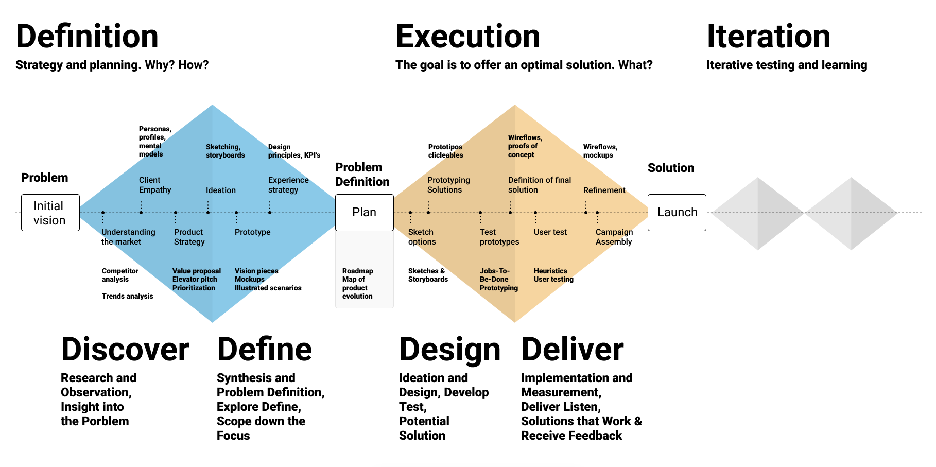
LOTS of Diagrams to convey some intangible ideas and best practices
https://www.uxbeginner.com/ux-design-processes/
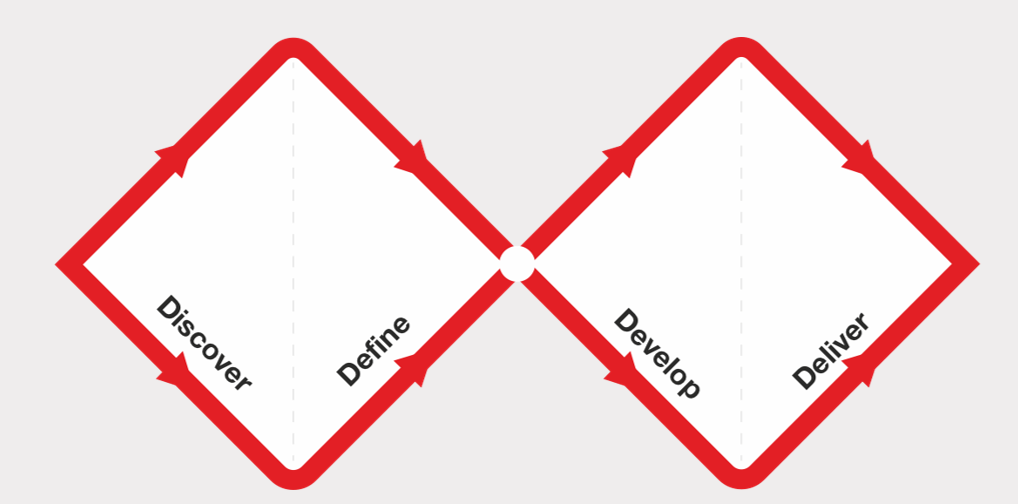
https://www.designcouncil.org.uk/our-resources/the-double-diamond/
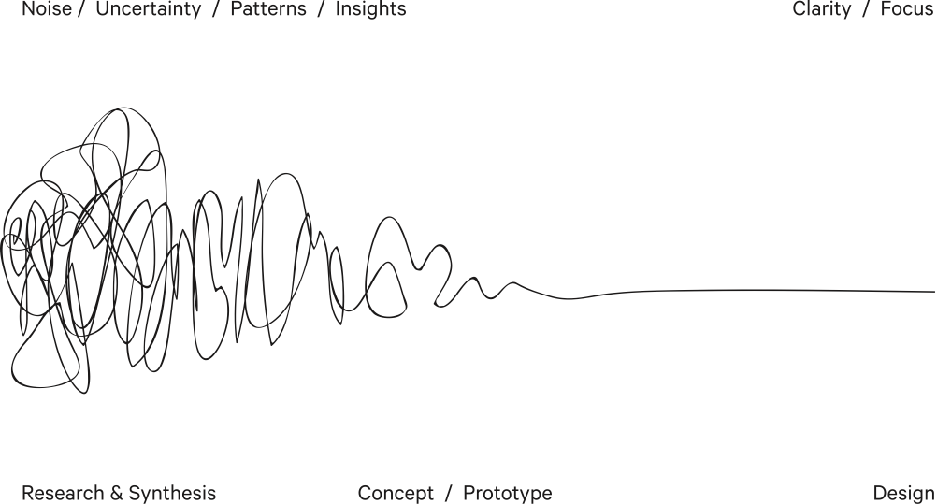
https://thedesignsquiggle.com/about
Hypothetical Design Process
Areas AI can potentially help are highlighted in blue
- Initial Consultation
- Gather Requirements
- Write Proposal
- Contract Signing
- Project Kickoff
- Stakeholder interviews
- Competitor & Trends analysis
- Discovery questionnaire
- Design brief
- Jobs-To-Be-Done definition
- Value proposition
- Design goals, KPI’s
- User research
- User interviews
- User personas
- User stories
- Mental models
- Journey mapping
- Ideation
- Concept Sketching
- Mood Boards
- Storyboarding
- Mid design
- Information architecture
- Wireframes
- UX copywriting
- Review with Subject Matter Expert
- Design Refinement
- “High Fidelity” mockups
- Prototypes
- User Testing
- Client Review
- Launch Preparation
- Marketing design
- Product documentation
- Staff training
- Project Completion (?)
- Final Client Review
- Development of Project
- Engineering
- Post engineering design revisions
- QA / Safety
- post-QA design revisions
- Real life testing
- Surveys
- Analytics
- Physical product returns analysis
- Online ratings and reviews
- Post project work
- Follow-up and Support
- Invoice and Payment
Background research
This is a less visible but very important tool for designers. Designers are often the least knowledgeable person to a project team, especially if at a design consultancy. IMHO, this is a good thing because this is what most users are actually like. (Not like the experts on the project team, who can even see into the future of the product.)
When you as a designer start to learn about the subject, you have the gift of the “beginner’s mind”. However it is ESSENTIAL to capture your learning process before you “know too much”
- Perplexity.ai The differentiator is it shows the links to the original web page sources.
- Globe.engineer is an interesting product that curates visual resources together. Sort of like the very old Yahoo.com, when it was hand edited (!)
Pricing Research
For designers and product managers, pricing is an essential research question
- https://www.qualtrics.com/experience-management/product/how-to-run-pricing-study/
- https://www.surveymonkey.com/market-research/resources/pricing-research/
- https://en.m.wikipedia.org/wiki/Van_Westendorp%27s_Price_Sensitivity_Meter
- https://www.momtestbook.com - good advice for entrepreneurs to validate their business ideas
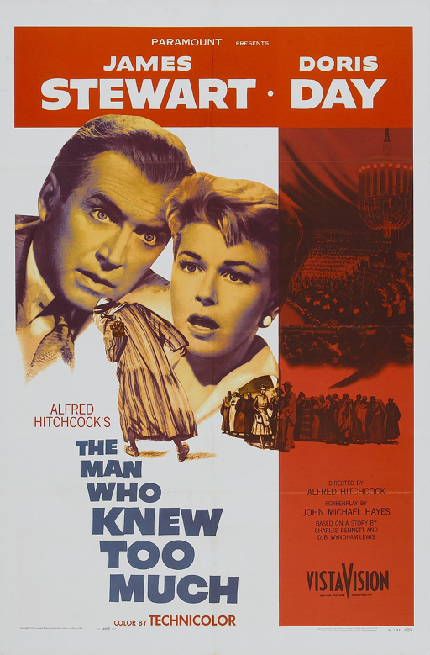
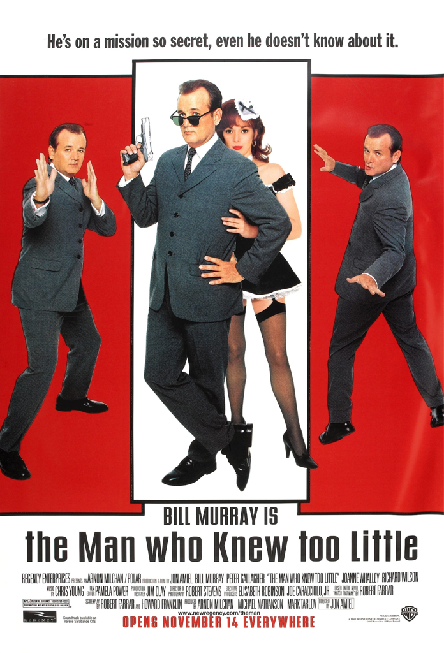
The Choice is Yours
Scientific Research
- https://scispace.com/ “access 287M+ papers, analyze papers, and draft content with citations.”
- http://elicit.com/
- https://scite.ai/
- https://consensus.app
Parsing public data sets
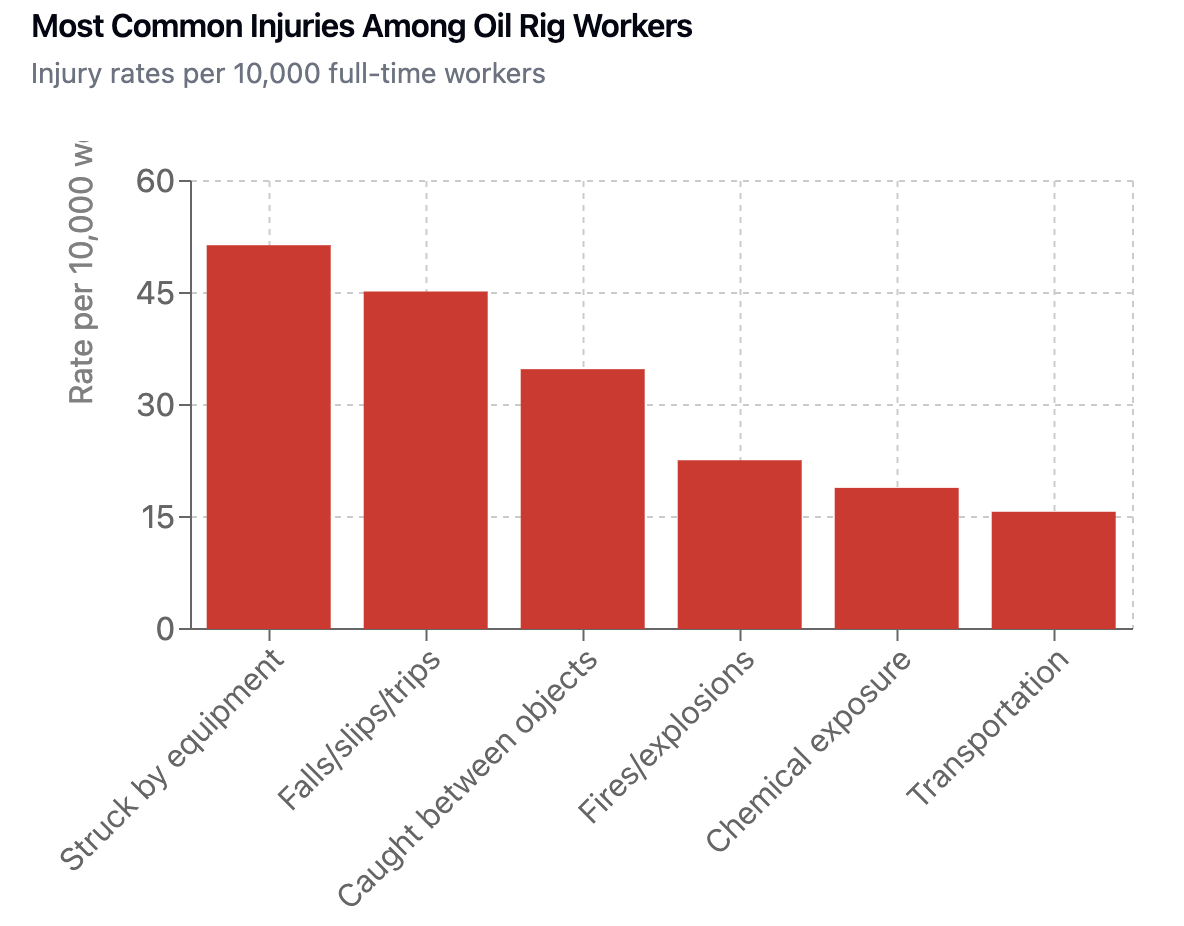
Chat apps like Claude can help you learn what you didn’t know existed. By asking general questions and asking the AI for suggestions, one can discover public data sets
Here is a query as an example
Can you analyze occupational hazards for oil rig workers, focusing particularly on struck-by accidents? Please include:
- A data visualization showing injury rates for different types of accidents
- A detailed breakdown of struck-by accidents including real case examples
- Use BLS and OSHA data for the statistics
- Include both the numerical data and anecdotal evidence from incident reports
Other public data sources
- https://fred.stlouisfed.org/ - economic data
- https://www.kaggle.com/datasets/miroslavsabo/young-people-survey/data
- https://www.tableau.com/learn/articles/free-public-data-sets
- https://www.kaggle.com/datasets
- https://datasetsearch.research.google.com/
- https://data.world/
Client & Market research
- https://gummysearch.com/product/ -search reddit for product
- https://outscraper.com/amazon-reviews-scraper/ - get amazon reviews
- https://outscraper.com/app-store-reviews-scraper-guide/ - app store reviews
Interesting guide for designers designing for AI
Creating Design Resources to Scaffold the Ideation of AI Concepts
Product Management
Product managers are not much discussed in design school, but have a large role in a design project.
A Product Manager operates as the strategic bridge between physical product development, manufacturing realities, and market demands, distinctly separate from industrial designers, engineers, and manufacturing specialists.
While industrial designers focus on the aesthetic, ergonomic, and functional aspects of physical products, and engineers handle technical specifications and feasibility, and manufacturing specialists optimize production processes, the Product Manager orchestrates the entire product lifecycle from conception to market.
They balance cost constraints, material selections, manufacturing capabilities, and market requirements while managing the product roadmap, making critical decisions about features, materials, and production methods. They translate market research and user feedback into physical product requirements, coordinate with suppliers and manufacturers, ensure regulatory compliance, and maintain the delicate balance between design innovation, manufacturing scalability, and business profitability across the entire development process.
Books
https://rosenfeldmedia.com/books/product-management-for-ux-people/
https://www.amazon.com/Value-Proposition-Design-Customers-Strategyzer/dp/1118968050
https://open.substack.com/pub/buildinghardware/p/why-we-need-hw-pms
Tools
https://www.aigents.pm/agent/product-trio
User Research
Research Methods
Qualitative- asking people what they think (surveys, interviews)
Quantitative - measuring what they do (user metrics. A/B tests)
BOTH are important
Research Articles
https://www.nngroup.com/articles/quantitative-research-study-guide/
Research Case Studies
I note with empathy that many designers struggle with quantitative analysis. AI tools can help, but one has to be super careful to check their work as they can make conceptual errors that are not obvious to the unwary. Ask it to explain step by step. Sometimes the tools will make small computer programs to calculate a figure.
https://www.smashingmagazine.com/2025/02/human-centered-design-ai-assisted-usability-testing/
AI Tools
- Caitlin Sullivan’s excellent list of research tools
- https://aiCustomerResearch.com
- UXaudit.io is a tool that uses AI to analyze user behavior and identify usability problems
- Attention Insight is a tool that uses AI to allegedly predict how users will interact with a design
- https://www.reddit.com/r/UXResearch
- AI in UX Research: Benefit or Detriment? [Expert Roundup]
Caitlin Sullivan recommended for surveys:
User Research Participants
Getting your user base is often the hardest part of user research. Luckily there are companies with millions of people who have signed up to answer surveys
- https://www.usertesting.com/platform/audience-solutions
- https://www.surveymonkey.com/collect/audience/calculator/preview/
- https://www.userfeel.com/userfeel-tester-panel
###
User Testing Prep
Usability Test Planning is a surprising amount of work. In my teams, I always invested in dedicated researchers, but there were never enough people to do all the work. We created templates to expand the ability for designers to support the researchers. If you can afford a dedicated researcher, do it! Having a distinct role with the inquisitive mindset can create a learning culture. My biggest concern with AI customer research is that the tough questions don’t get asked. Mind you, this happens on teams with researchers also!
Caitlin Sullivan shares this prompts:
Create a complete test protocol.
“You’re a usability testing wizard for [specific domain]. Write a test plan for [feature or tool], including 5 tasks and follow-up questions that uncover insights about [outcome, e.g., ease of navigation or user confidence].”
Measuring UX Metrics like confidence, trust or delight
“I need 3 ways to measure how [confident/delighted/other feeling] users feel when using [specific feature] in a user test. Keep them quick, actionable, easy to analyze and compare in many tests over time.”
Identifying pain points in the design
“Help me create a test to uncover the most frustrating parts of [feature/use case/product]. Include realistic tasks that trigger the user to walk through a use case they have actually experienced before. Add questions I can ask to reveal their pain points throughout the test.”
AI User Interview analysis
In user research, the user interviews need to be summarized and integrated into insights. This has long been a tremendous amount of work - a 30 minute interview could take another hour to transcribe and analyze.
One way to practice this is download a podcast interview, transcribe it, and upload to a LLM to summarize and highlight. Caitlin Sullivan suggests
“Analyze the podcast transcript and extract all the key actions and decisions discussed by the interviewee. Generate a user journey of the actions and decisions made in the order they occurred.”
AI Moderated User Interviews
I am extremely skeptical of AI “agent”moderation, which can fall into the ‘uncanny valley’. Often it is best to just use a survey, if you don’t have the time to interview people
However, some tools might be a bit more like a text chat with follow up questions. New, but could be interesting!
However, do NOT use it for emotionally charged topics, or even following up with, for example, customers who cancelled your service.
Managing Customer Feedback / interviews
Prioritizing or even identifying themes from interviews is essential, but effortful. One common method uses sticky notes, real or virtual, to quickly move the notes into groups
Manual: Sticky Notes
Caitlin Sullivan suggests using the Miro tool, which has an AI sticky note generator in its whiteboard app. Write a prompt like “create individual sticky notes for each of the following paragraphs” and paste the quotes. You could also start with the “Cluster by keywords”
AI Summarization Tools
Note you can do a lot with transcribing your recordings and summarizing with a basic LLM tool.
These offer more features
- https://www.userology.co
- qoqo.ai
- https://dovetail.com
- https://listenlabs.ai
- https://www.getreveal.ai
Persona generation
User researchers employ personas as archetypal representations of user groups to help teams build empathy and maintain user-centered focus throughout the design process. These fictional characters, built from aggregated research data, serve as concrete reference points that teams can repeatedly consult when making design decisions.
However, personas can be problematic when they oversimplify complex user behaviors, reinforce stereotypes, or become outdated without regular validation against new research. Teams may also fall into the trap of treating personas as definitive truth rather than as tools for generating insights, leading them to miss important edge cases or emerging user needs that don’t fit neatly into their established persona framework. Perhaps most dangerously, poorly constructed personas based on assumptions rather than real research data can mislead teams and result in design decisions that fail to address actual user needs.
Articles
- Stop using user personas, and start talking to people
- https://uxdesign.cc/tagged/user-personas
- Old essay by me How to make personas useful (and it’s not stock photos)
- Personas — Training Wheels
Tools
- QoQo.ai - AI generated UX personas, (free if used in Figma)
- https://www.delve.ai/ai-persona-generator
Synthetic Personas
Synthetic personas are an odd concept as ALL personas are synthetic. That’s the point of personas. The new risk of AI personas you can ask questions to may mislead by not prioritizing the user data. They are more convincing, so we need to be more careful!
- https://www.syntheticusers.com/use-cases/effective-product-discovery-with-synthetic-users (free trial)
- Synthetic Users: If, When, and How to Use AI-Generated “Research”
- Are Synthetic Personas the New Normal of User Research?
Empathy Network Map
An “Empathy Network Map” is a term I use to describe a diagram / document that lists all involved parties, what their role is, and most importantly how they subjectively view the situation.
For example, if designing a child stroller, there might be a
- Child
- Primary parent
- Secondary
- Grandparent (who buys the stroller)
- Kindergarten school teacher (who is annoyed by huge strollers)
If the child loves the stroller, but the primary parent does not, is it well designed?
If everyone loves the stroller but the teacher tells parents not to bring the large stroller to school, so the stroller sits unused in the basement, is it a good design?
- https://www.figma.com/templates/social-network-diagram/
- https://www.nngroup.com/articles/empathy-mapping/
- https://www.nngroup.com/articles/scenario-mapping-personas/
- https://en.wikipedia.org/wiki/Social_network_analysis
Strategy & Documentation
This is an essential step where designers can show that they are not mere stylists.
Diagram maker https://www.napkin.ai/
Usability Testing
https://digital.gov/topics/usability/
Mood Boards
In the “before times”, designers would create “mood boards” highlighting materials, forms, styles often by cutting things out of magazines and pasting onto a board as a way of communicating the intangible ‘mood’ they wanted the design to deliver. By contrasting, say a warm wood board with a cool chrome board, they could ‘lock down’ the style direction with the client before sprinting many hours going in the wrong direction. These boards were often notable for unexpected or unusual combinations.
Exercise:
- Generate some images with Midjourney
- Export and import to Photoshop Beta
- Photoshop “extend background” tool
Prompt:
“A nostalgic design moodboard highlighting retro product styling, featuring a charming blend of vintage color palettes, classic typography, mid-century patterns, and iconic product silhouettes that evoke a sense of warm familiarity and timeless elegance --ar 16:9”
“moodboard for BMW interior style --ar 16:9”
Pintrest.com operates much like a mood board for normal people.
https://www.pinterest.com/search/pins/?q=timberframe\&rs=typed
https://www.pinterest.com/search/pins/?q=knurled%20aluminum\&rs=typed
It would be interesting if the visual arts increases in importance as fuel for creative exploration
https://www.thisiscolossal.com/2025/01/ceramic-brussels-art-fair/
AI Image Generation
These generative image generation tools are often focused on making ‘pictures’, which can overlap with designing ‘a thing in a picture’, but there are many nuances.
See detailed exploration of these tools
Additional tools
- recraft.ai
- DALL-E chatgpt.com
- Stable Diffusion
- Adobe tools
- aiomnigen.com “Consistent AI Image Generator”
- https://www.topazlabs.com/gigapixel Image upscaler for production quality images
- magnific.ai Image upscaler for production quality images
AI Product Design Best Practices
Generative AI visualizers are excellent at quickly mocking up style color, texture variations with forms and environments. This enables a new exploration of ‘pre-design’, like previsualization in film; these are easy and cheap ways to evaluate and explore ideas.
Sketching
When starting a project, Generative AI can be helpful to explore more ideas easily, which will enable you to explore further. These are not going to be the final design, more like sketching.
In the “before times”, a client or designer might sketch an idea on a cocktail napkin as a basis to start a design. Starting with the same sketch, one can quickly visualize some ideas. As always, the real risk here is having the best idea diverted by a ‘good enough idea”.
The real design work is, as always, in developing the sketch to a real product. Industrial Design Studios are already getting briefs with AI “pre-visuals” from clients. This workflow is likely to become more common and Industrial designers will likely need more sophisticated skills to translate and manage these images.
Illustrator to Midjourney workflow
NewArc.ai AI Sketch to Image Generator Turn your drawings into images
- Create rough shapes as an underlay: e.g. use Image Trace tool, then manipulate to your liking
- Export and input: Use the underlay as input for Midjourney’s Edit feature.
- Retexture: Apply various style reference images and prompts to achieve different results.
- Upscale: Finalize the design by upscaling in Magnific.
AI Image Generation for Industrial Design
After some exploration, I believe AI is unlikely to replace Industrial Designers in the near term. (I do think photography, illustration, and copywriting will be affected more, but primarily in the most generic use cases, where I’m not sure many professionals are working today.)
The generative AI tools like Midjourney & Ideogram are useful in a new role, somewhere between mood boards and sketching. On a recent project, I started with a design based on the engineered components. Spending an hour running different prompts showed me other ideas that challenged my thinking. This can be useful for shaking up your preconceptions. Elvis Costello said “Ninety percent of pop music is trying to copy something and getting it wrong.”
BUT designers don’t get paid for creating mood boards; this is a service profession. They get paid to narrow infinite potential answers to the one best answer. It takes taste, and an understanding of the physical world, costs, ergonomics, etc. We are VERY far from automating that.
AI tools work best from a ‘blank slate’, where all the materials come from their training (aka other people’s work). They struggle to build upon a previous work or object, e.g. a cover to a grill, because that requires understanding the object. They are very useful for styling, but designers rarely start from the blank slate - usually there is specified technology, previous generations of products, company brand, etc.
This is why the image generators are so useful for illustration and for fanciful industrial design, like Sci-Fi movie props - the stuff doesn’t have to work, but also the aesthetic resets our critical measurement into a ‘fiction’ setting. We “suspend disbelief”
AI tools designed for designers
See sections below
- Midjourney.com
- Krea.ai
- ideogram.ai
- vizcom.ai sketches into renders and 3d models
Concerns & Risks
AI is “Fearless, but Clueless” - It doesn’t self edit, which is often a problem in early ideation.
It is important not to get stuck in “Analysis Paralysis” with the many many options. This is the key skill to learn when using AI,
“Think of [Midjourney] as the designer you always invite to a brainstorm - not because they give you the right idea, but because their seed of an idea sends you on a path towards the right solution. … If you already have a design in CAD, Midjourney is not the right tool… But it can open you up to new possibilities” -An Improbable Future
The key thing to note is you can’t tell AI directly what to do, it doesn’t “understand” objects, it just makes pixels. In a sense, you are like an Art director standing over the shoulder of an intern on their first day. You can’t touch the keyboard and mouse, so you have to use verbal dexterity.” This is hard for many designers.
AI is making images: based on other images. It is trying to create an “average” image, so it will fight you on innovative ideas. It is great on aesthetic ideation & general styling.
“The problem with Al is that if it outputs your idea, then your concept must already exist out there somewhere already… Double check this with a Reverse Image Search” link
Insight: AI is NOT the right tool if you have an exact idea in mind. Go in with an open mind. Designing with AI is “like rolling dice”, if you will only accept 12, there is only one roll that gets it. Other numbers, like 7 can be hit multiple ways, increasing your likelihood to win.
Use Chat GPT to produce more complex prompts for Midjourney
Use image weighting if you are close to what you want, otherwise the AI will thoughtlessly move away from it.
Remember that AI can’t think or reason - it can’t do function, only styling. A simple product like a home humidifier that essentially needs to be styled is a suitable use case. And indeed, you can find hundreds already posted on midjourney site
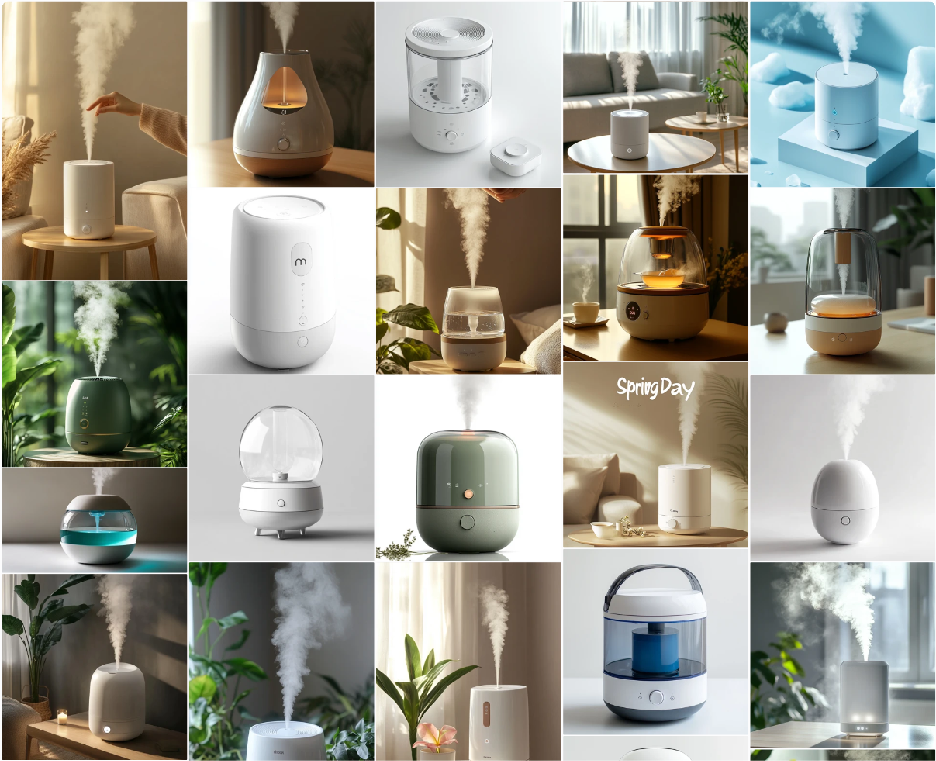
Even though the images look “realistic”, it isn’t actually designed yet. AI images are like a hand sketch, Most of a designer’s work happens after the concept
Midjourney for Industrial Design
Set Up
A quick note on starting with Midjourney. It is accessed via a chat app, discord. Takes a little getting used to. You enter commands in the chat app and it responds with images, and a UI you can click on. Tip: You can scroll up to old images to restart over from there.
Basic Process:
- Generate a large number of variations
- Select examples that speak to your vision
- Do variations on these
- Identify the design details
- Take further in your design process
Links
- How to Midjourney for Product Design (Pro Tips!)
- AI for Product Design & Rendering
- How to Use Midjourney V6 for Ultra Realistic Product Photography
- Furniture Design Using A.I. - Unique designs with Midjourney prompts and other A.I. Tools.
- 35+ Best Midjourney Prompts For Interior Design with AI
- “Project Wander” Case Study by Hector Rodriguez & Gregory Aper
- Student Videos at NUS Division of Industrial Design
- https://open.substack.com/pub/daydastudio/p/designer-ai-worflows-aixc-63
/imagine
This is the basic image creation command
/imagine Main Subject, Composition, Medium, Environment
For example, compare these basic prompts
/imagine speaker, front view, photograph, natural lighting, white background
With
/imagine matte white conic Apple speaker, front view, photograph, natural lighting, white background
with
/imagine matte white conic Sony speaker, front view, photograph, natural lighting, white background
Camera angles to try:
- Front and side views
- Aerial views
- Macro views - does depth of field
- Wide angle shot
- Corner detail view
You can use “photograph”, but also consider “pencil sketch”, “concept sketch”, or “copic marker sketch” to get different output, perhaps to indicate how resolved this design is.
Midjourney prioritizes words in the beginning of the prompt
You may not need filler words like “in the”
Vary by region allows you to add text prompts to change an area of the image
Zooming and panning show more of the environment, typically not the subject
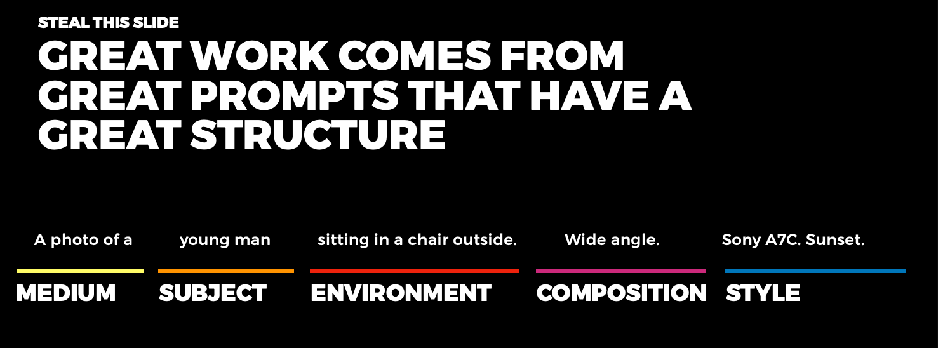
Hector Rodriguez suggests thinking of designing with Midjourney as “a Science Experiment” Try things, keep notes, make variations.
He suggests utilizing variations on structured prompts for feedback loops & results The IMAGE LCP Method (IMAGE, MODEL, ATTRIBUTES, GUIDANCE, ENVIRONMENT, LIGHTS, CAMERA, PARAMETERS)
Example Prompt
“Hand tool modern design, isolated background --chaos 10 --ar 1:1”
Midjourney prompt parameters affect the output.
https://docs.midjourney.com/docs/parameter-list
“Power Words” “There are certain words that just carry more weight in a prompt. Words that clearly show up in the visual output. In this case that word is “knurled”. Whenever you run into one of those Power Words, save them as they’ll be useful down the road.” Link
gravel bicycle frame, head tube close-up, Knurled aesthetic, premium paint job, Nikon D850 DSLR 4k --iw 1 --c 50 --s 500 --ar 4:3
Generate a lot, then look for what works. Keep a log!! You can use a “permutation list” to generate more items
(portable projector, smart thermostat, electric toothbrush, digital camera, backpack, desk lamp, coffee maker, ebike), pastel colors, modern design, isolated background --chaos 10 --ar t1 --style raw --sref 54794752 --stylize (50, 500) --v 6.1 Link
Use Remix and Vary by Region to fix parts of an image
Upscale
Regenerate variations on the most interesting, then Upscale the best of those
Image Weighting
(Text prompt vs Image) Default is 1 (equal), can go from 0-2
Iterate on an image
Exercise: Prompt for modern [item] concept.
Pick a style image,
<style reference image> modern [choose your item], product design, contemporary materials, isolated white background --c 10 --ar 1:1 --s 10 --sw {50, 100, 250, 500, 750}
/Blend
/Blend merges 2-5 images together, but you lose the ability to add text commands
It is the same as using multiple Image Prompts with /imagine, with a easy interface: you just drag/upload pictures and go
Midjourney /imagine gives very basic objects, so use the blend tool to “blend’ 2 objects User photoshop to eliminate unwanted detail and backgrounds. Keep the layouts, aspect ratio, and perspectives the same for best effect.
https://midlibrary.io/midguide/how-to-blend-images-together-with-midjourney-ai
Image Prompts
/blend’s interface doesn’t allow a text part in the prompt. /imagine with image URLs does
To mix multiple images, take existing ones, “open in browser” get url then type “ /imagine [url1] [url2] some art direction”
Midjourney is NOT an image editor, so it doesn’t ‘want’ to, for example, just convert a photo to a pencil sketch, without changing details.
Here is an example of an original image used in prompting.
/imagine https://cdn.midjourney.com/6936de78-a9e9-4d6d-b7d2-db1f728b3851/0_1.png pencil sketch of a white, modern speaker with a cone and sphere shape, product photography, on a table, against a white background, in a studio setting with lighting
Original 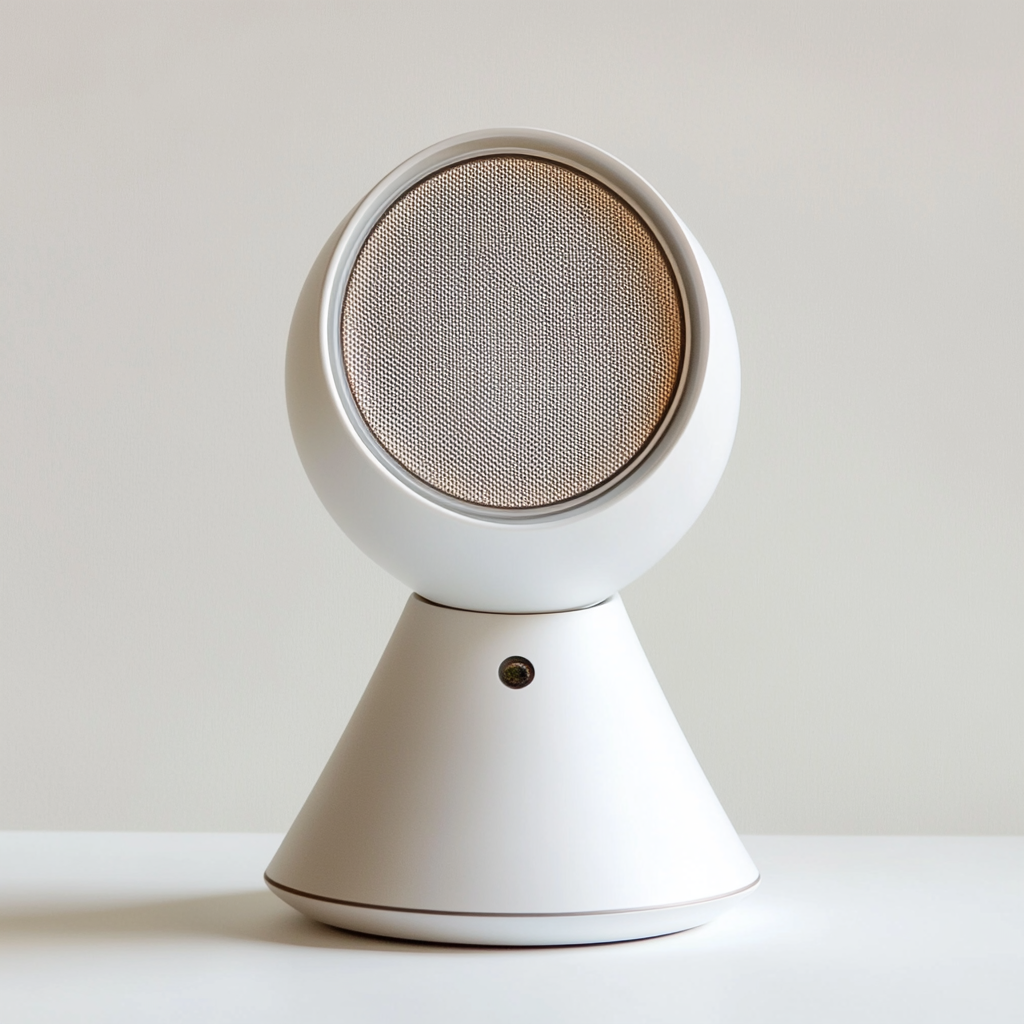 Image weight 1
 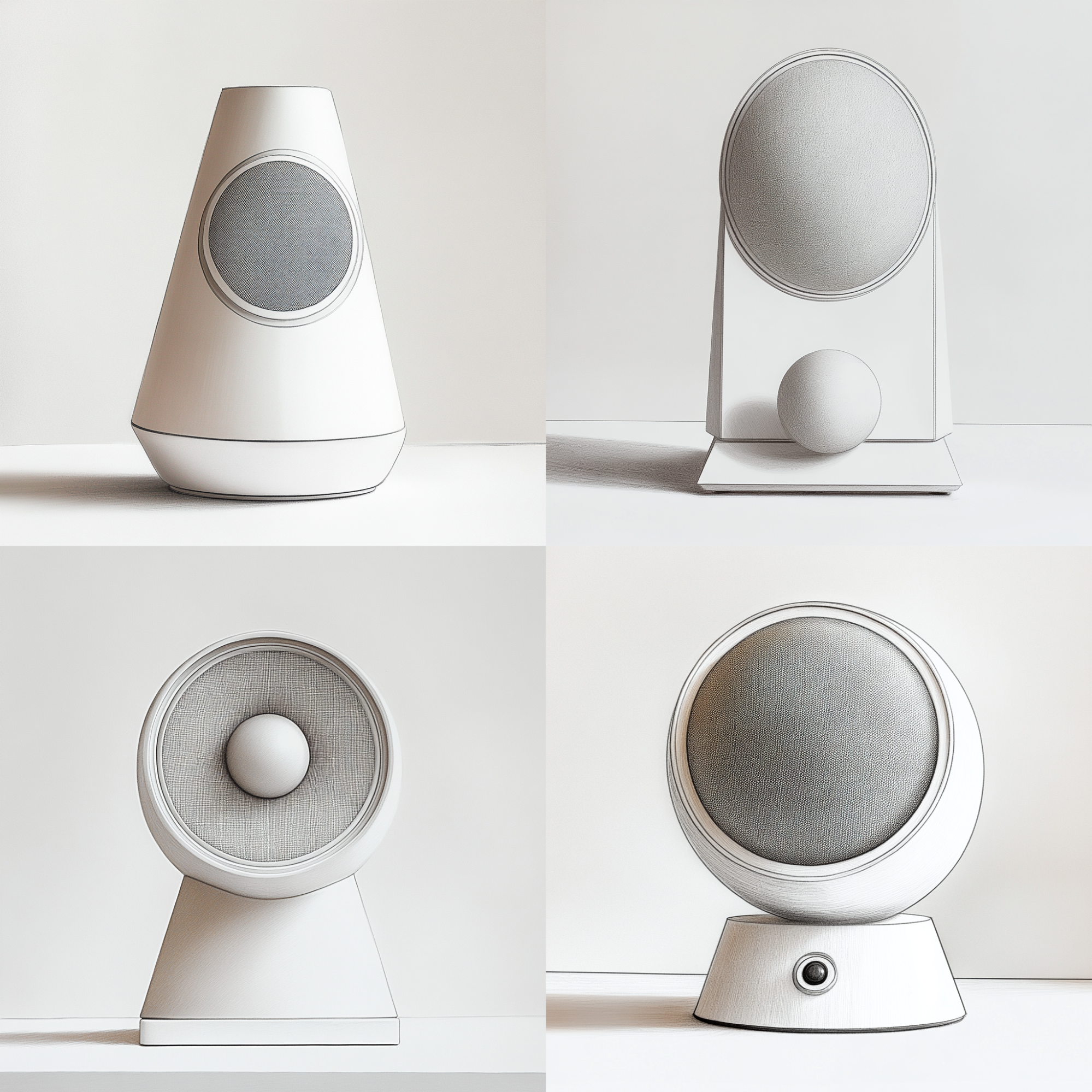 Image weight 2
 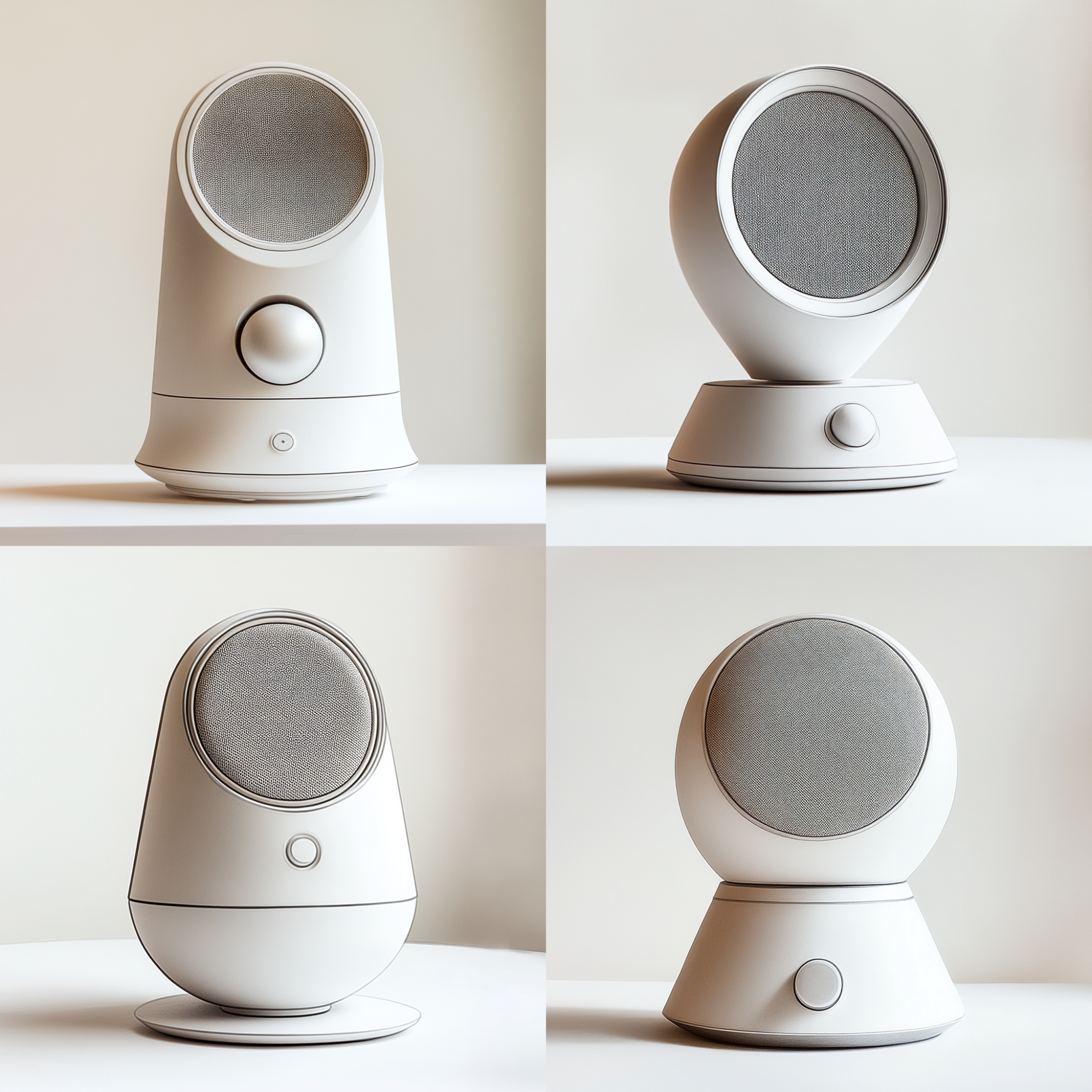 Image weight 3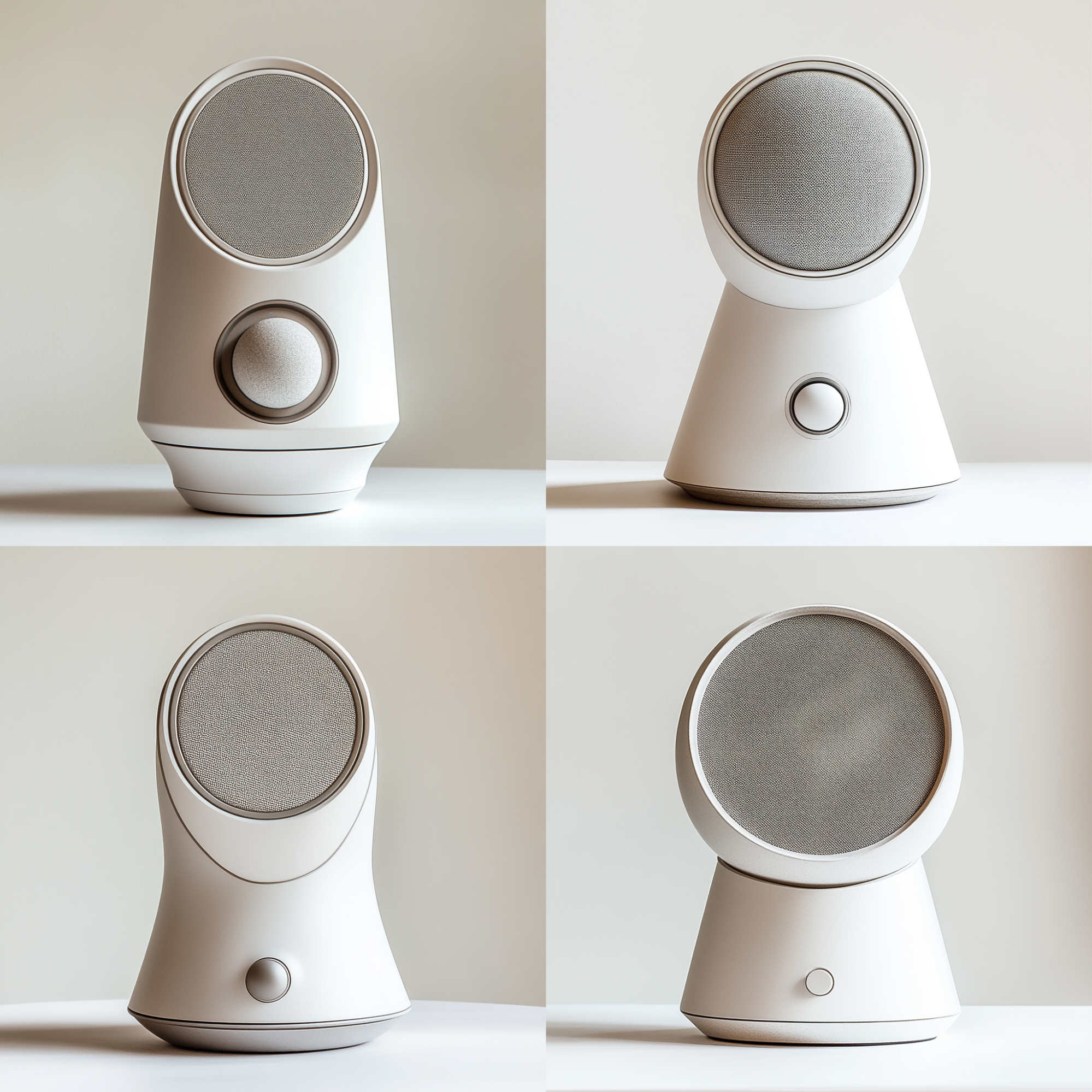
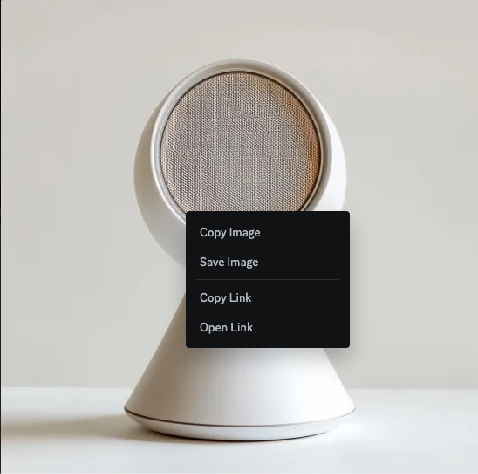
How do you get your own images in? Just Drag image onto the Discord window, hit return it will upload. Then you can click on it and ‘copy link’
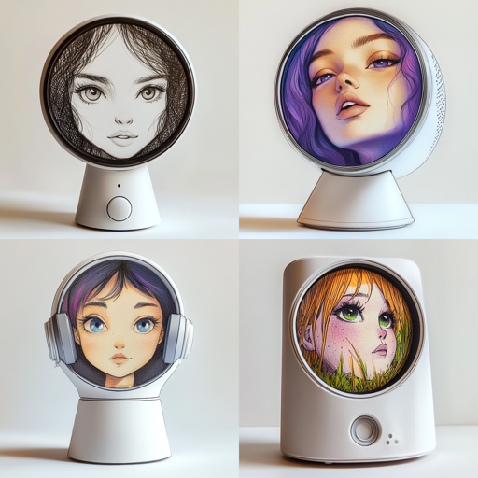
One needs to restate something like the original prompt, or mid journey will do weird things like add faces.
/Describe
How do you revisit the prompt that made the first image that you liked? Ask midjourney to describe that image
/describe https://cdn.midjourney.com/6936de78-a9e9-4d6d-b7d2-db1f728b3851/0_1.png
Which produced these options
- A small white speaker with a cone and sphere design on top, product photography, on a table, in the style of Bauhaus and minimalism, on a solid background, product shot, high resolution.
- A white, modern speaker with a cone and sphere shape, product photography, on a table, against a white background, in a studio setting with lighting.
- Design of a retro minimalist speaker with a circular screen and cone base in a white color, designed in the style of Dieter Rams.
- Design of a small speaker with a round body and cone base in a white color, designed in the style of Dieter Rams. The background is simple to highlight the product. The product photography features studio lighting, high resolution, and highly detailed imagery.
Example of Image Prompt
These two images
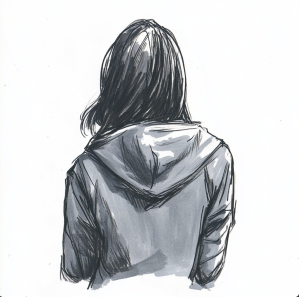
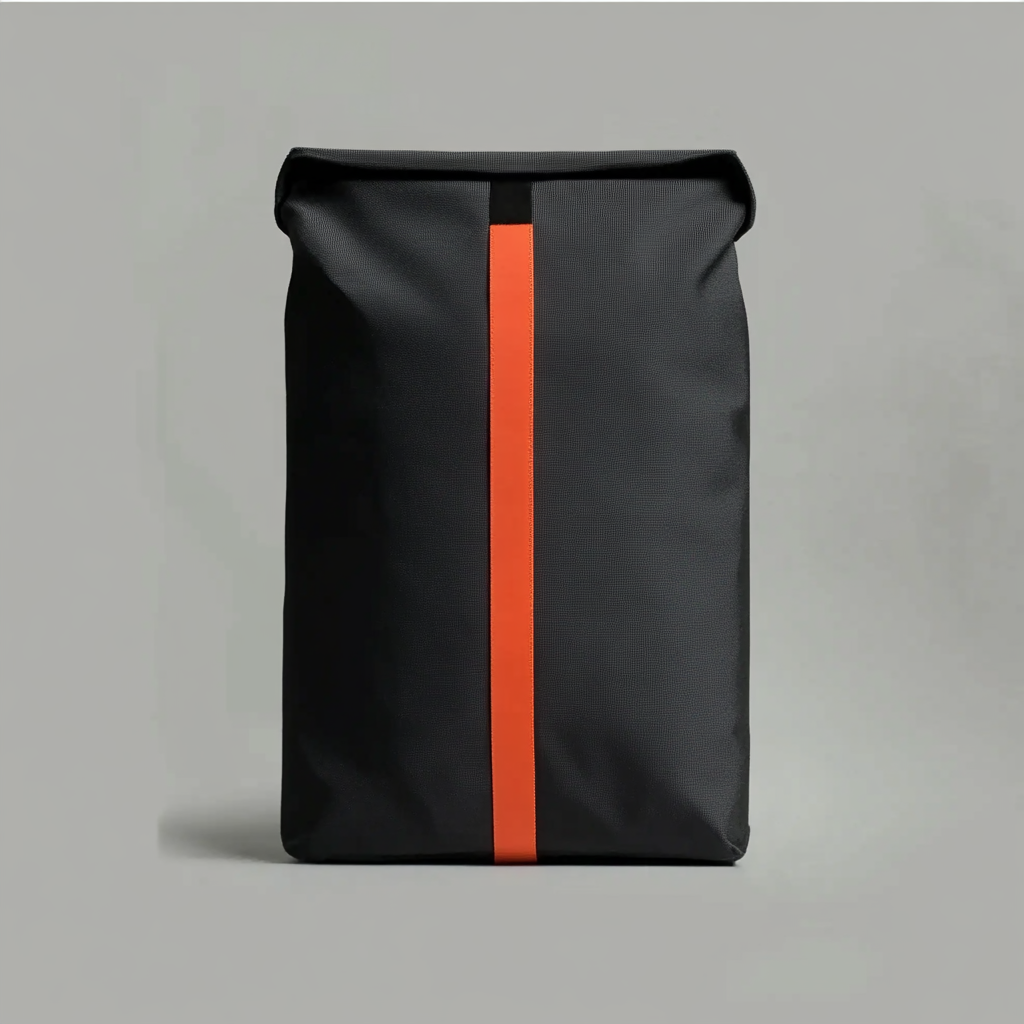
With prompt
young woman wearing a gray hoodie with a black rolltop nylon backpack with orange strap, wide angle view, photograph, evening light, worn outdoors on a hiker pacific northwest sequoia forest --style raw --w 1000 --s 150 --iw .75 --c 10
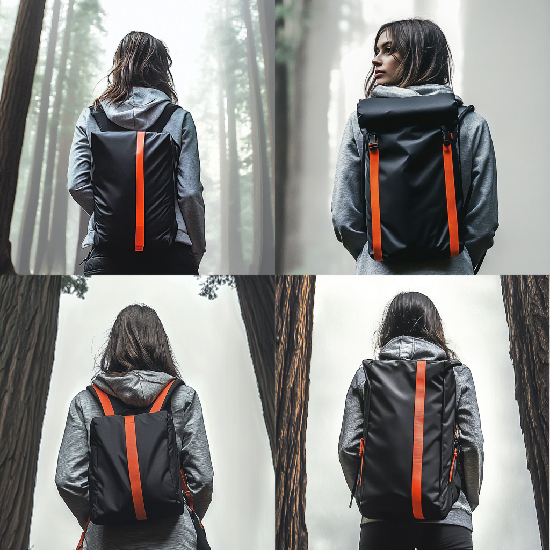
Remix
Remix is a setting that shows a text entry field to enable adding text prompts, which can enable more precise control.
For example, starting with
yellow square shape SONY game device ergonomic, front view, photograph, natural light, floating in a pink gradient background
Then upscaling, then Vary(region)
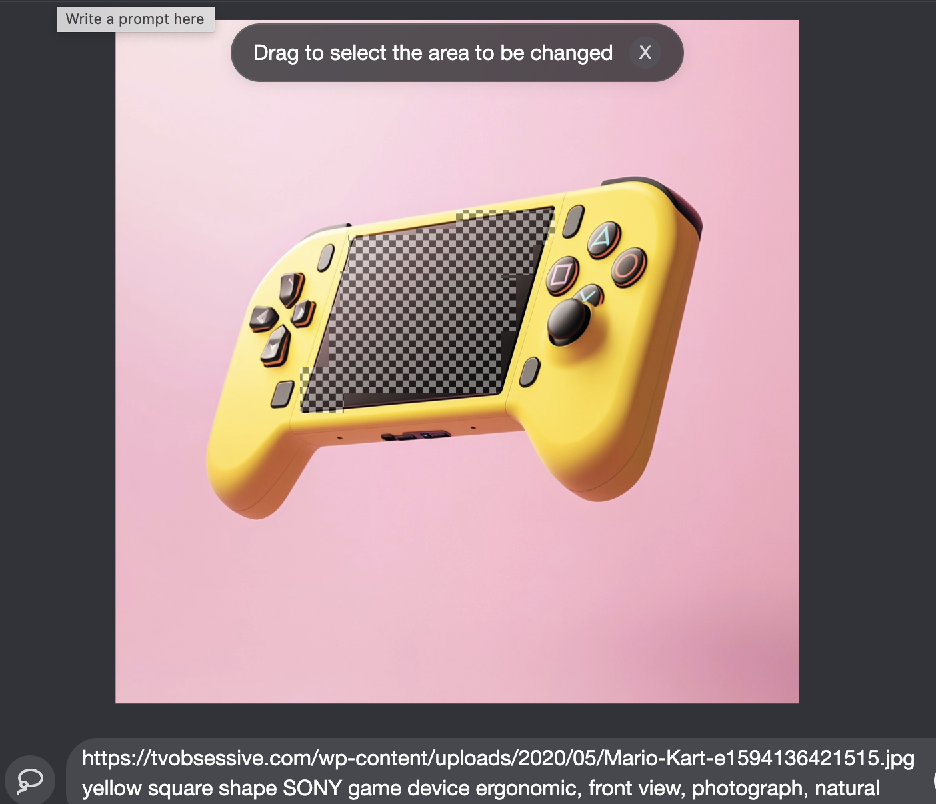
I selected the area of the screen
Note the URL of the mario kart image from the web
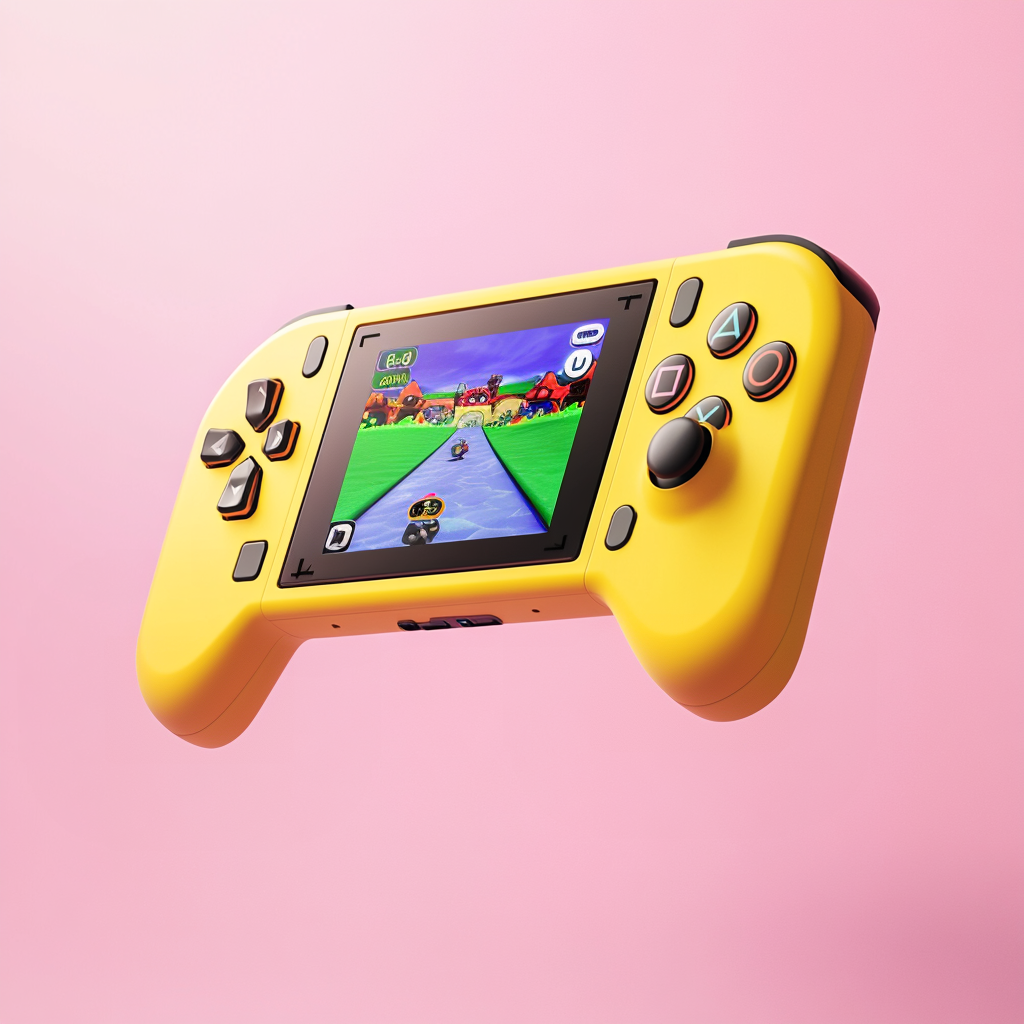
Note that this isn’t a direct insert, but an ‘interpretation’ of the image
Midjourney Parameters
https://docs.midjourney.com/docs/parameter-list
Stylize
The –stylize parameter (0-1000) with less adherence to midjourney’s literal interpretation of your prompt, higher values are more pronounced styling. Playing with it can make interesting design ideas, but can also lose the accuracy of textures and materials. Low weighting of image prompt and high style value may override the camera view, for example.
Weird
—-weird parameter (0-3000) does just what it says!
Chaos
-—chaos (0-100) Adds more variation between the 4 different images
Seed
-—seed (number) is a way to store a current style, useful to use a repeatable starting point.
If you like an image and want to store it, in Discord, in the upper right corner of the message from Midjourney Bot with the image, click the gray emoji icon and pick the envelope emoji.
(yes, this sounds like UX malpractice!)

The midjourney bot will text you the prompt and seed, which you can reuse in the - - seed parameter
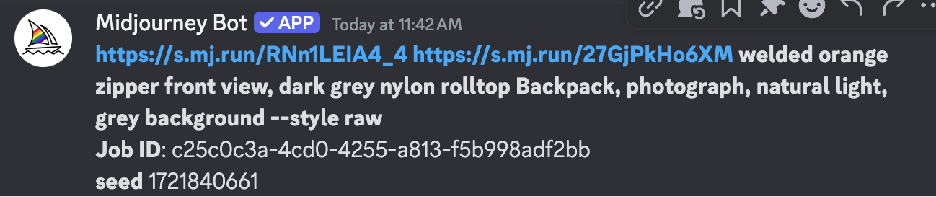
You can also just pick a - - seed number and then re-use it through the exploration as you make small changes to the prompt language, e.g. change material and color
Style Reference
Midjourney’s SREF codes hold style attributes. There is no master list, there are billions. Save ones that you find.
You can also point - - sref at an image or two
{img1} {img2} young woman wearing a gray hoodie with a black rolltop nylon backpack with orange strap, wide angle view, photograph, evening light, worn outdoors on a hiker --style raw --w 1000 --s 150 --iw .75 --c 10 --seed 200 --sref {img 3}
Style weight --sw (0 to 1000) to weight the style reference image
-–sref random will pick a random sref code, which perhaps might be useful to try new things?
Final Thoughts
Product Generation with AI tools is a lot of work. Be efficient.
Navigation is important as you can get overwhelmed by all the images and lose the ‘jewels’.
Use the Midjourney Image Gallery https://www.midjourney.com/archive
In Discord, it can be hard to find an old image in the chat interfacer. In the App, upper right corner, click Inbox > Mentions to see an old image. Click Jump to go to back the prompt so you can edit, upscale, etc
Make sure you are not going too deep in a rabbit hole. If you are fighting midjourney to do something specific, it may be time to switch to CAD.
Reverse Image Inspiration
In the https://www.midjourney.com/archive , select one of your images, click Magnifying glass to see similar art by other people. You may be shocked and inspired by all the other designers’ work!
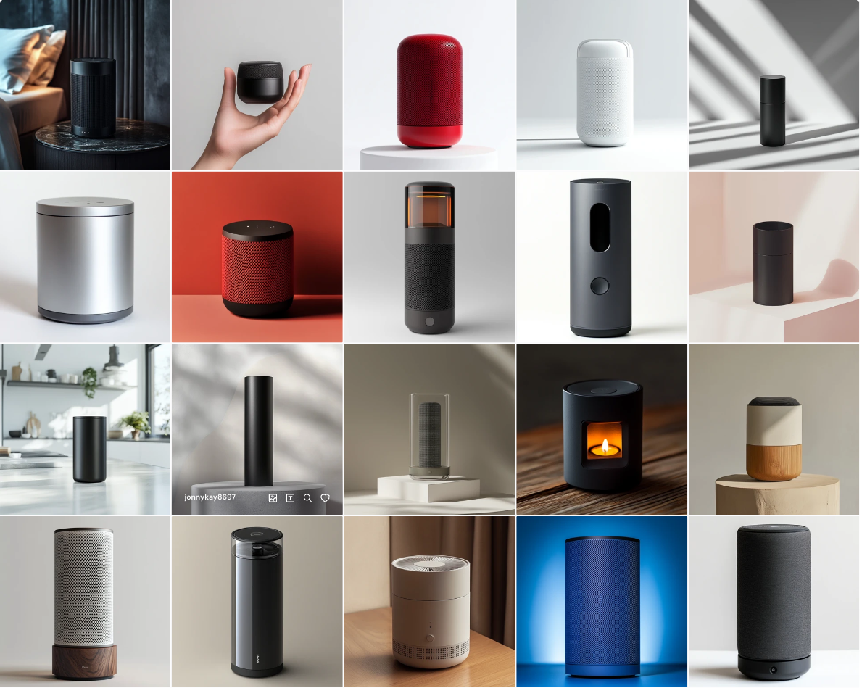
###
Krea.ai for Industrial Design
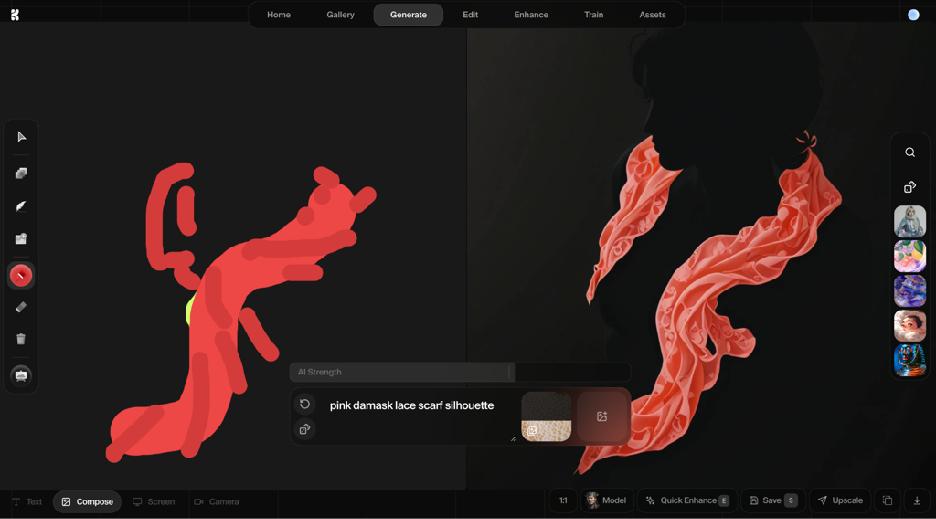
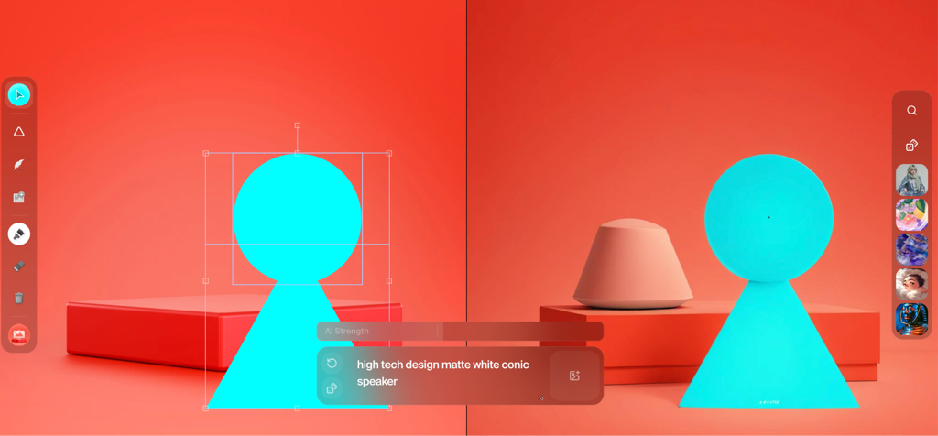
Krea.ai has a fascinating 2 pane UX design, where you sketch, upload images, and fiddle with the dials to make images in real time.
Krea to iterate on styles of a soap dispenser
AI in Design: Combining Rhino3D with Krea for Concept Rendering
Ideogram.ai for Industrial Design
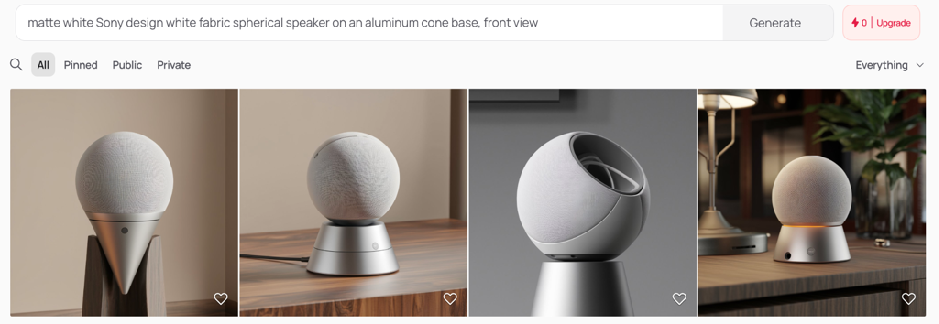
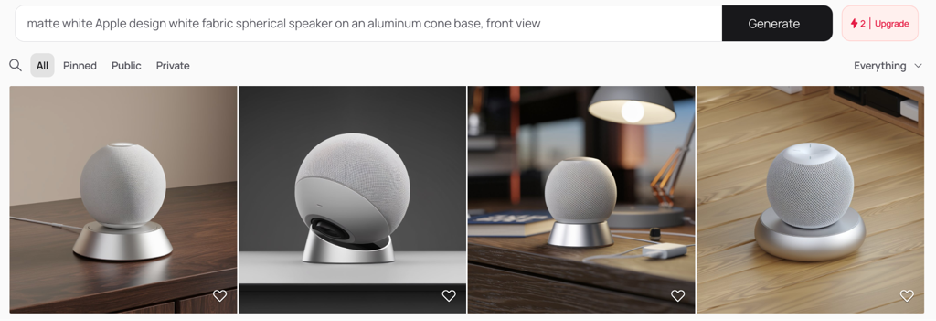
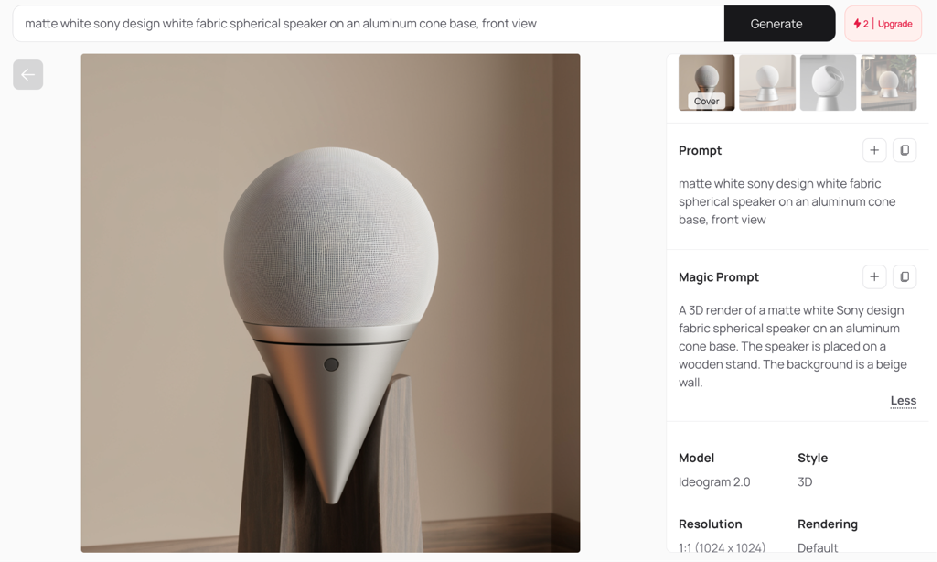
ideogram.ai seems to work similar to and perhaps better than Midjourney for product design. It has a ‘magic prompt’ feature that expands your prompt with more text. It has a 3D mode that may be better for Designers. Seems to do text better than most. Tutorial AI Text Design Styles
Interesting Canvas editing tool https://about.ideogram.ai/canvas
Interesting option for placing a 3D rendering in a product image
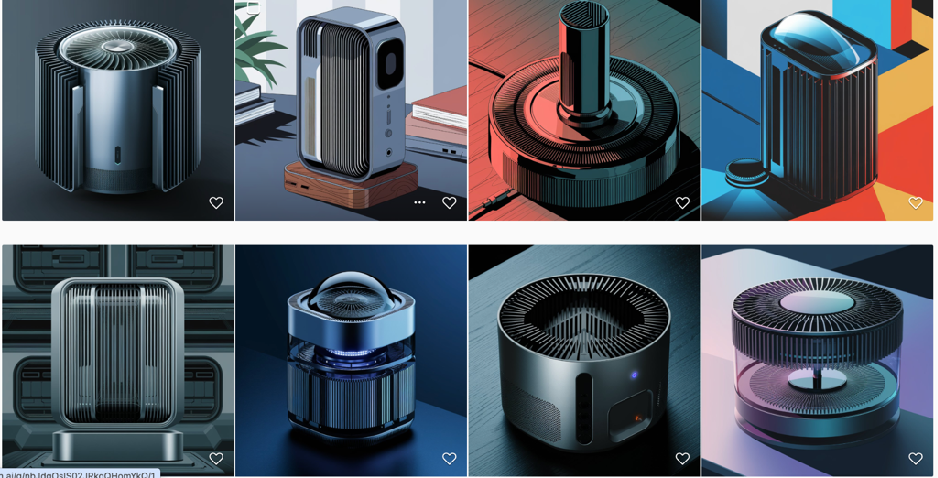
Prompt
futuristic cylindrical desktop device covered in vertical heat sink fins on a back isolated background
vizcom.ai for Industrial Design
Possibly most interesting tool for product designers.
https://www.vizcom.ai/overview
This seems like the tool with the most amount of control - you can do layers of sketching to make a classic rendering and interpret into photos and models. Also turns sketches into renders and 3d models
- Product Design & Rendering - Vizcom Beginner Tutorial
- Handheld sander power tool device design process
- https://www.youtube.com/watch?v=wgSMcFtBGOc
- Vizcom For Car Design
- https://docs.vizcom.ai/
Newarc.ai
Another tool for designers. Turns sketches to images https://www.newarc.ai/
Design System Support
In any large design team, it is important to align aesthetics and speed up design with “design systems”, templates and styles. Design Systems can be powerful time savers for design teams, but also quite tedious to keep up to date. Often a few designers will be solely working on the system. Digital design systems can be powerful when implemented in UI code,
AI tools can be very powerful in generating variations of a set of designs. At the simplest level, they can use a few photos to generate a color palette. Figma has many plugins for these needs.
Caitlin Sullivan suggests that eventually we will be cataloging AI prompts to get similar results across the team
UX Design
To be blunt, I don’t see any way for AI tools to design UIs. Can mock up individual screens, but this is essentially the same as using the many free UI templates or styles. Most of the work of application design is figuring out what and how the app should work.
Like all templated generation tools, AI UI generation makes the first step easier, but 99% of real design is in iteration and refinement.
“Text to UI Tools”
- https://www.figma.com/blog/introducing-figma-ai/
- https://creatie.ai
- https://motiff.com
- AI Design Battle: Top 5 AI UI Design Tools Face Off The Output as a figma board
- Figma Plugin AI Design Copilot: Text to UI Generator
- Figma Plugin Wireframe Designer
Motiff
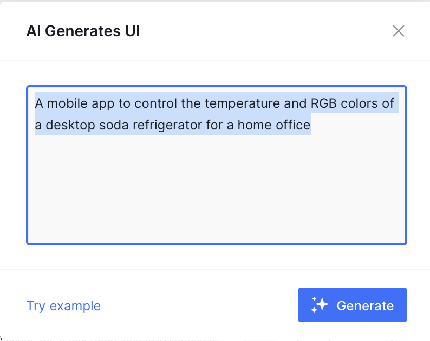
Motiff.com is an interesting and clever clone of Figma with some AI features. It uses AI to fill out content, layout, and generate pages. Demo page Motiff AI Playground, It worked, which is neat, but I am not sure I would switch from Figma to use it.

Creatie.ai
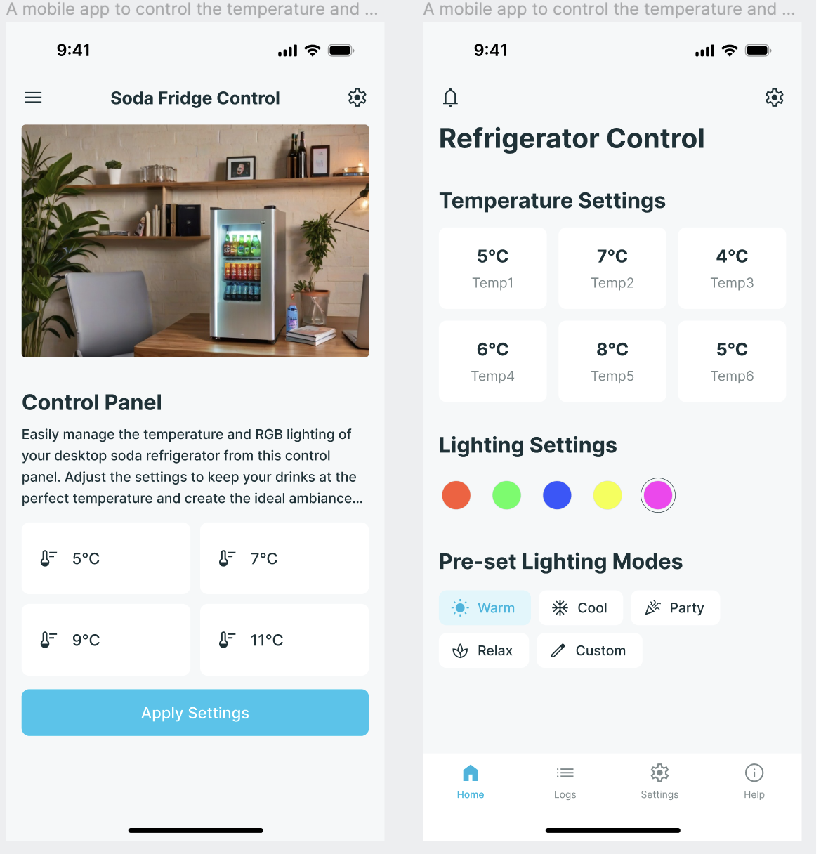
Similar clone of Figma with AI features, with perhaps fewer features than Motiff. It did suggest three options for the Generative UI, which was helpful. Stylized icon generation, including to SVG, is very nice Link to example UI. But still not enough to warrant changing from Figma to an unproven app.
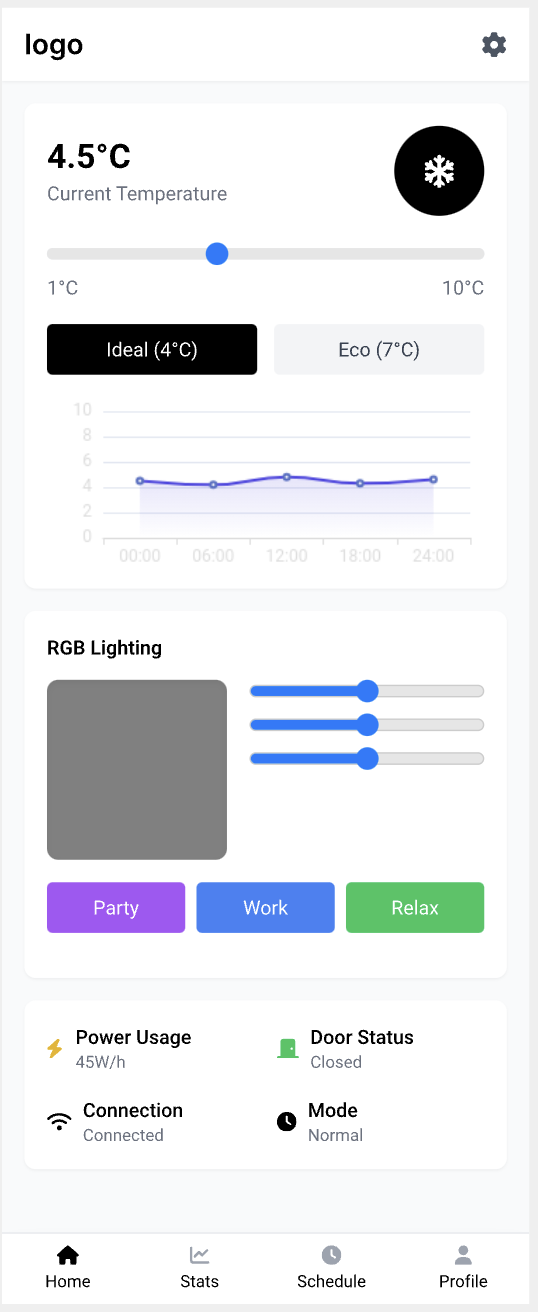
Handy Figma utilities
- html.to.design Import a site to figma (Figma plugin)
- UX Pilot’s Figma plugin -
- QoQo.ai - AI generated UX personas, journey mapping, sitemap, and copywriting figma plugin
- Cube GPT: AI Assistant for your UIUX design work. “Improve/continue/translate/shorter/longer text for filling content in designs.”
- https://www.figma.com/community/plugin/746656816456492537/avatars-generator
Coding apps with LLM help
Perhaps because coding is a form of language, LLMs are shockingly good at writing sample apps. One can ask it to make and app and iteratively change things like adding icons, functionality, etc. It loads the app in a window and you can even publish it to others. Here is an example prompt that Claude was able to use to create a clickable UI. Note that it doesn’t store information in a database, so it is not a real app. Link
Create a React scorecard component with these specifications:
- Four criteria with icons and weighted points:
- Speed & Efficiency (10 points) with a lightning bolt icon
- Eco-aesthetic appeal (20 points) with a palette icon
- Dark Mode Implementation (15 points) with a moon icon
- Design Intelligence (20 points) with a brain icon
- Five tools to evaluate: Fingerr, Journarr, Hunterrr, Sighterr, Namberr
- Layout features:
- Table format with criteria in rows and tools in columns
- Criteria names with icons aligned left, points displayed underneath
- Plus/minus buttons that increment by 1 between 0 and full points for each criterion
- Total row showing sums for each tool
- Max points column on the right
- Visual design:
- Background gradient from very light blue (blue-50) to medium light blue (blue-200)
- Dark blue icons (text-blue-800)
- Clean, modern UI using shadcn/ui components
- Technical features:
- LocalStorage for temporary data persistence
- Responsive design for different screen sizes
- Automatic total calculation
- Tool names in column headers
Please create this as a React artifact with all necessary imports and styling.
Bolt AI app creator (with back end)
Interesting guide: https://designwithai.substack.com/p/how-to-turn-an-idea-into-a-prototype
Bolt is an AI-powered programming tool to turn text prompts into full-stack applications. It is based on StackBlitz, a browser-based development platform, so I don’t need to set up things on my local computer.”
Replit
V0
https://v0.dev/ - From a famous front end coding group
Notes
https://designwithai.substack.com/p/i-ran-the-same-prompt-through-three-ai-prototyping-tools
Interesting comments from a software engineer who tried to just use a LLM tool https://nsavage.substack.com/p/when-ai-promises-speed-but-delivers
- Embrace Incrementalism, but Keep Perspective
- While breaking down problems is valuable, maintain awareness of the overall goal
- Don’t let small successes blind you to larger inefficiencies
- Combat Tunnel Vision
- The mantra “I’m almost there, Claude will get me there” led to hours of unproductive work
- Taking breaks and approaching problems with fresh eyes is crucial
- LLMs are useless if you don’t understand the context
- AI can be worse than useless when you don’t understand the underlying technologies
- I needed to learn Docker properly; once I did, deployment issues became manageable
- It was giving me mostly correct answers, but I couldn’t solve the remaining bit myself
- AI solutions need verification and understanding, not just blind acceptance
Generative 3D Models
Text, photos to 3D models. (Mostly appear to be poor quality so far from a CAD perspective, perhaps best for video game assets, at this point.)
Image from Midjourney 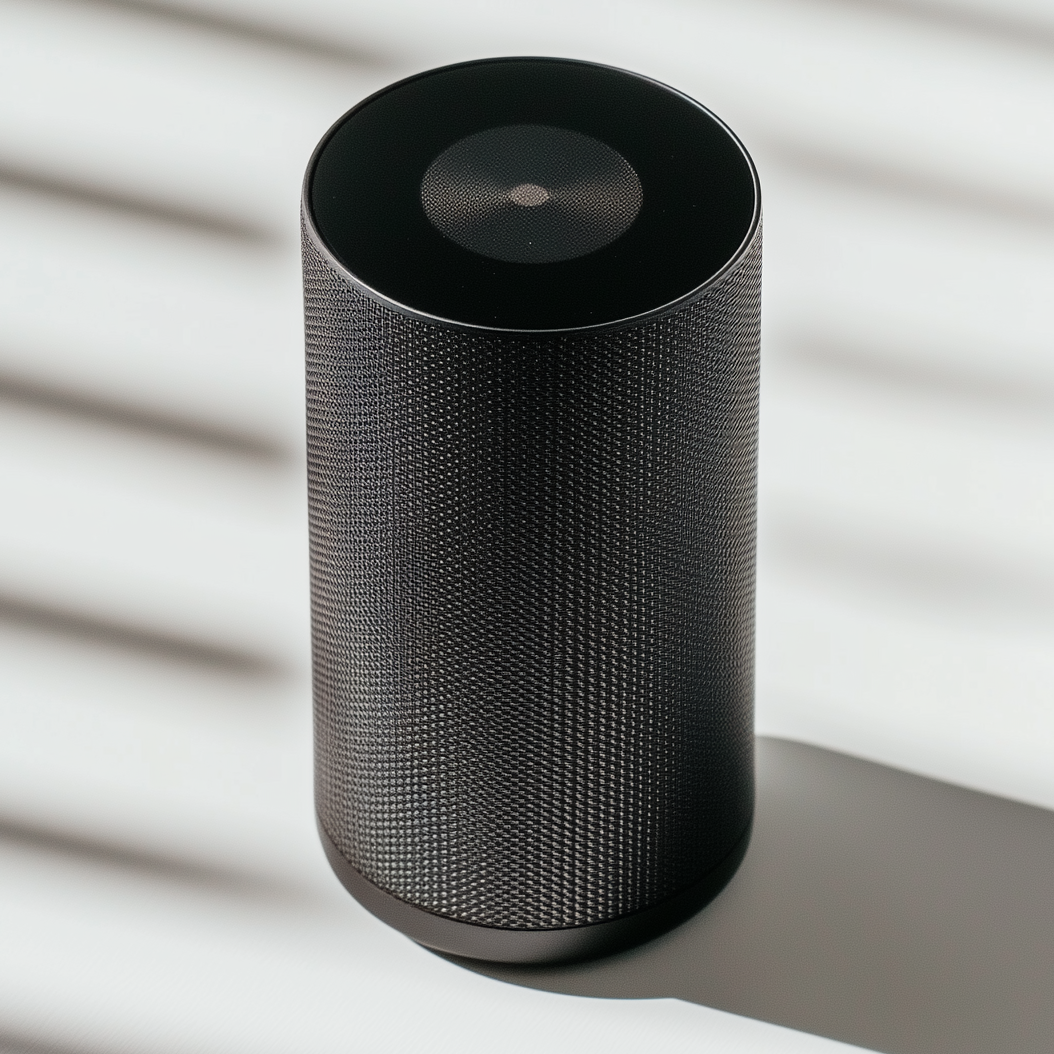 3d Model from trellis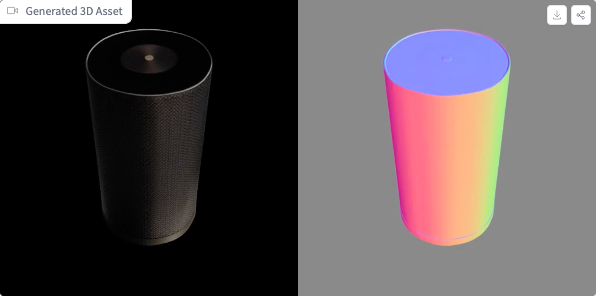
Tools
- https://www.blendergpt.org/
- https://www.sloyd.ai
- https://trellis3d.github.io/
- https://stability.ai/stable-3d
- https://www.meshy.ai
- vizcom.ai sketches into renders and 3d models
- https://www.adamcad.com
Articles
- AI 3D models for Industrial Design - January 2025
-
https://develop3d.com/ai/ai-in-product-development/
- Good discussion https://www.linkedin.com/posts/hrodriguez1_starting-off-the-year-with-text-to-cad-activity-7280685483389558787-v323/
- Blender Tutorial – How to Use AI to Create 3D Models (ChatGPT and Blender)
- https://www.reddit.com/r/SmartAI_Tools/comments/1be03qr/best_ai_3d_model_generators_in_2024/
Alleged “no-CAD 3D design” (I am skeptical that this could work for the reasons stated above).
AI Structural Design
This “AI” CAD feature has been around for a while, but is worth exploring as a designer. The basic idea is to describe the forces on an object and optimize it’s structure to make the lightest, strongest form. Often it makes oddly beautiful bone-like forms.
Fusion 360
https://www.autodesk.com/design-make/articles/generative-design-in-manufacturing
https://www.autodesk.com/learn/ondemand/collection/generative-design-with-fusion
It might be fun to create a generative CAD Design challenge
- Design and 3D print the lightest weight structure that will support yourself for 60 seconds in a fingertip plank. The structure must hold your 10 finger tips at least 6 inches above the floor and hold an egg directly below each fingertip. The winning design will have the lowest ratio of part weight to user weight.
- Design and 3D print the lightest weight structure that will protect 2 eggs from a fall of 3 meters onto a concrete floor.
AI Packaging Design
AI Photo Editing & Graphic Design
- https://www.canva.com/logos/ -Canva is a very popular design tool for non-designers who need designs, like social media managers. These templates are more of a threat to designer jobs than AI, IMHO
- https://www.recraft.ai/ -“ai for pro designers. Premium image generation and editing tool”
- https://www.fotor.com/ e.g. background removal, Social media Logos and templates. Etc
Generative Music
I have little to offer, but very interesting
- https://suno.com/ - consumer music making app
- Old School Generative Music
Generative Video
AI Video is less developed than image generation, but can be shockingly good.
- https://openai.com/index/sora/
- https://stability.ai/stable-video
- https://www.heygen.com/
- https://app.synthesia.io/
- AI video hallucinations as an art form
Product Photo Placement
Designers have often needed to fake their product in a realistic location/ environment/ background. Tools like Keyshot are widely used.
If you have a generative image that you love, or a 3D rendering, it can be more convenient to place it in another image, e.g. to move it from a white background to a table.
Photoshop (beta) has generative AI features that can 1) remove a background, but also create a background image to put the object in.
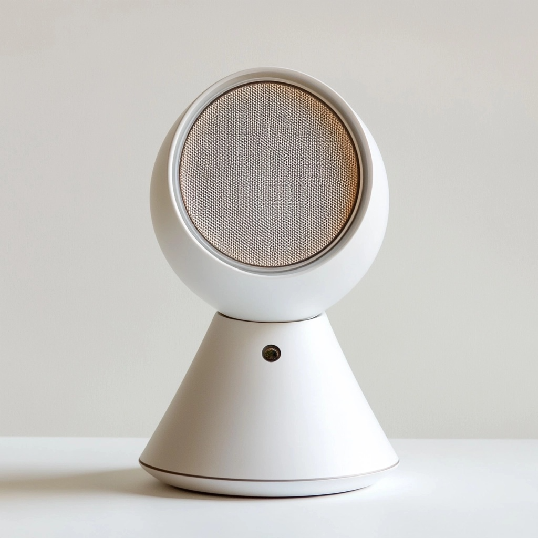
Add the image you created. Use “select subject” then “generate background”, for example this prompt
a live edge mahogany dining table with a fruit bowl, macro view, morning light, photographic
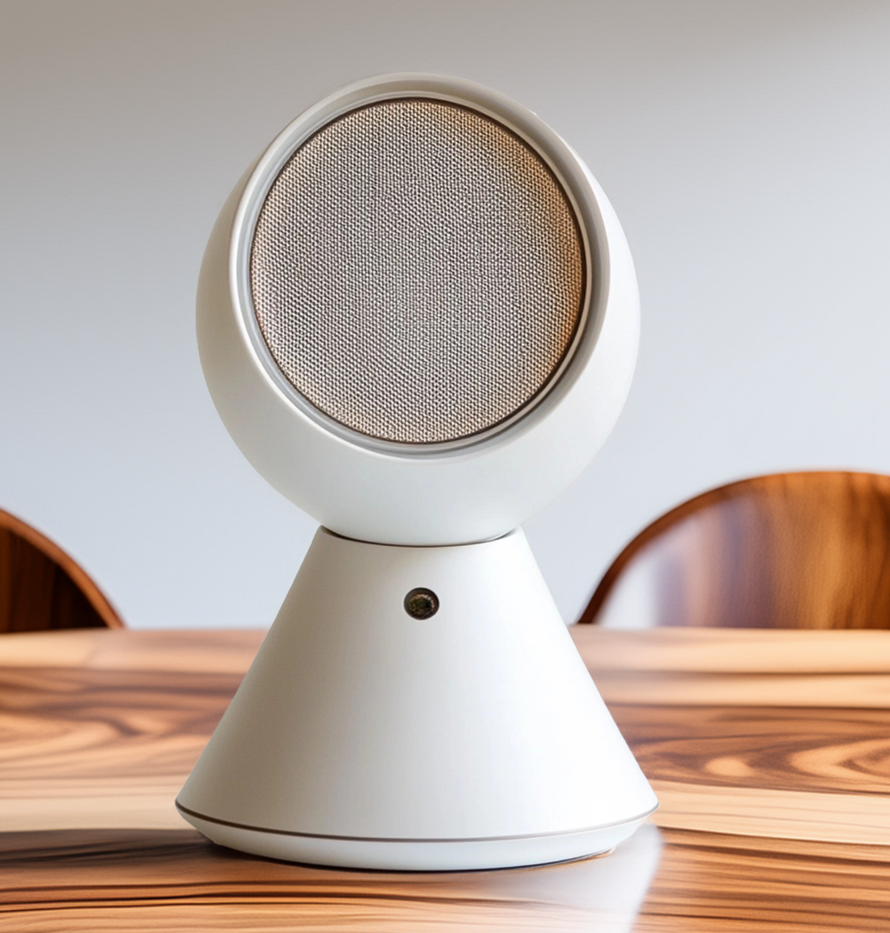
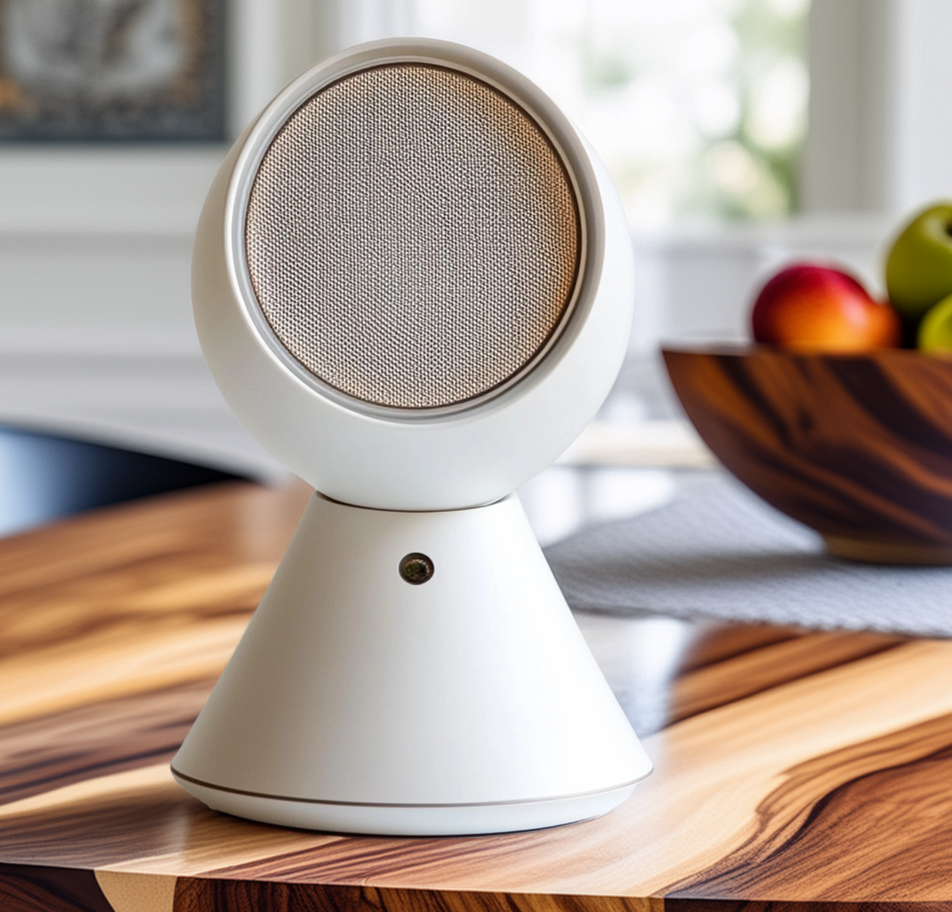
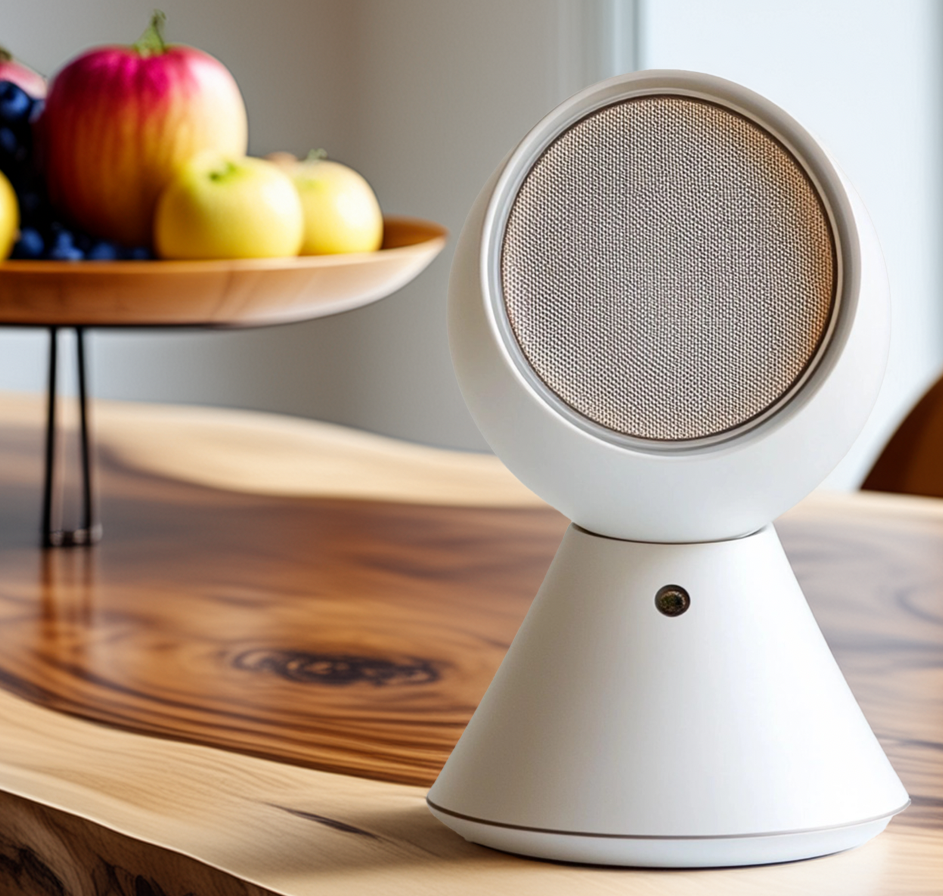
Note the reflection and shadow on the table. Very cool!
- Adobe also has https://helpx.adobe.com/substance-3d.html (Beta) to place 3D models into photos.
- https://www.recraft.ai/mockup-generator
- https://www.figma.com/community/plugin/817043359134136295/mockup-plugin-devices-mockups-print-mockups-ai-mockups
- https://placeit.net/mockups/iphone Old school, but effective
- https://placeit.net/videos/app-demos?f_tags=With%20People
Designing with AI Case Studies
Case Study: Capturing photos for classic furniture design
Michael Sarno is a furniture designer and founder of Studio Marenzo, as well as a Professor at Pratt Industrial Design. Below is a case study of his first first AI experiment.
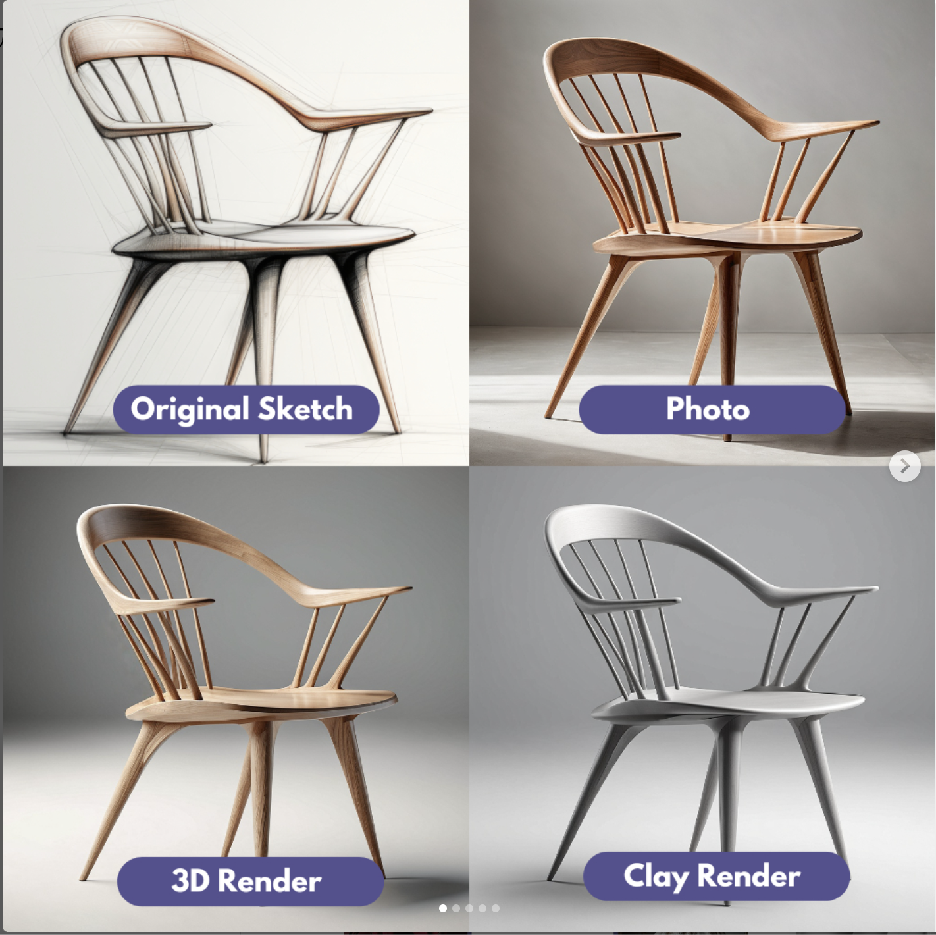
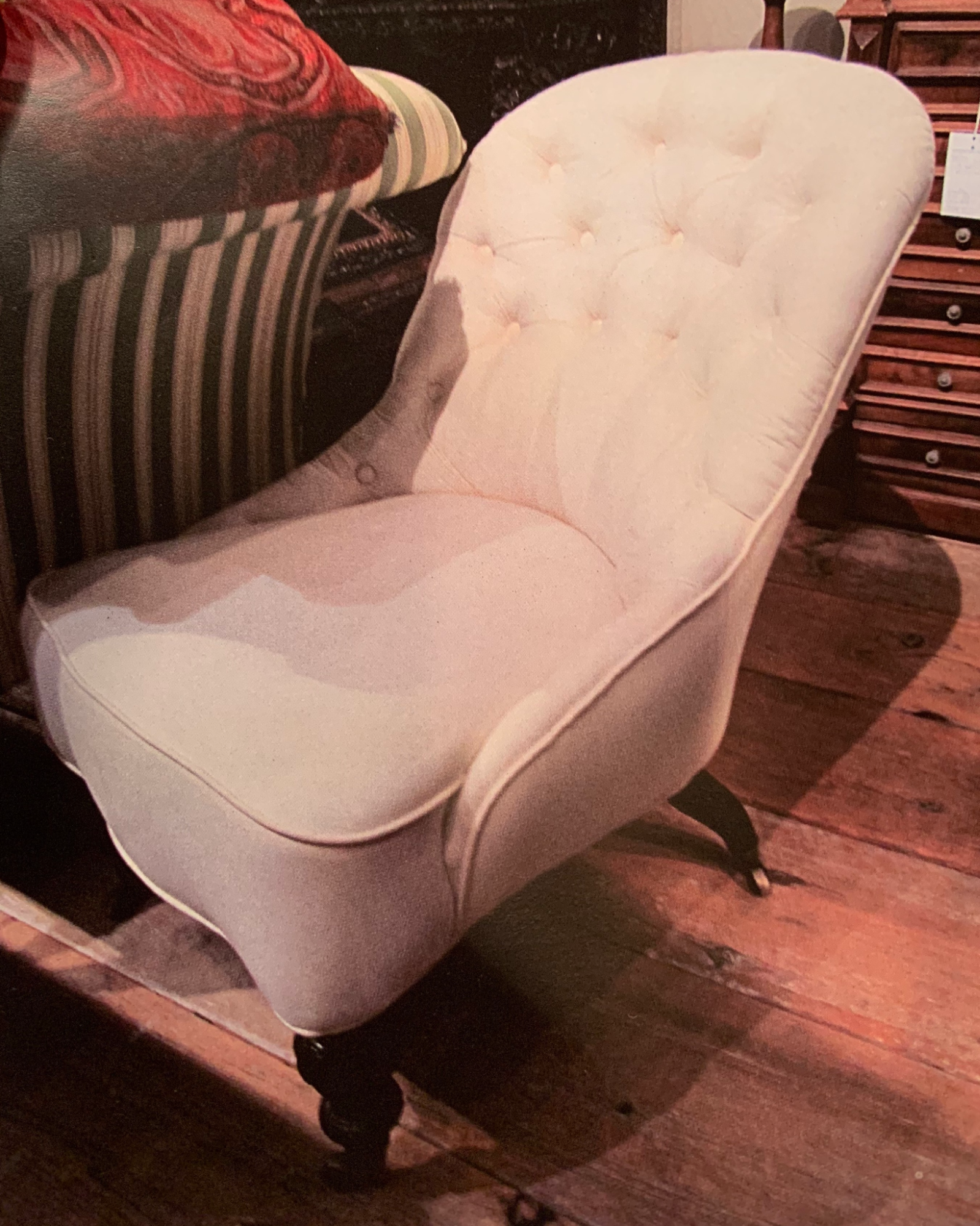
In his design consulting practice, he was working on a classic chair design, when he saw an opportunity to use AI as a jumping off point for ideation. He found an antique chair in a vintage shop with details he liked (left image). He uploaded the image to ChatGTP and proceeded to refine the style with text commands in DALL-E (middle image) to get the tufted detail and legs he wanted (right image). After agreeing with the client on the direction, he proceeded in the traditional detailed furniture design process.
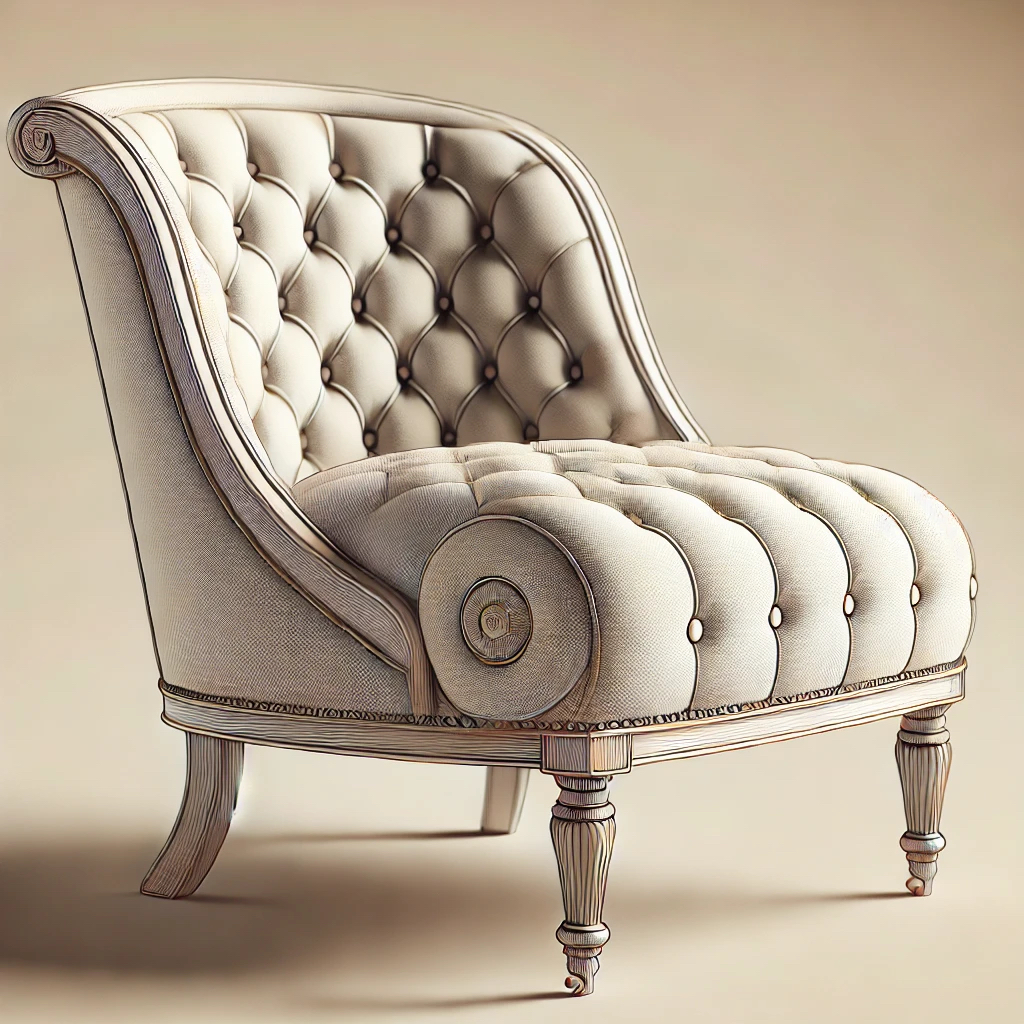

Case Study: working with AI Design Briefs
Peter Ragonetti, designer and professor at Pratt ID writes a useful case study
https://www.linkedin.com/pulse/turning-ai-visions-real-world-products-look-peter-peter-ragonetti-razec
Case Study: Designing a playful home speaker
As a demonstration of techniques, let’s imagine that we are a product designer at a consumer electronics company, who is tasked with sketching new ideas for a countertop or table top home speaker.
Claude will help us with a design brief
Design a modern audio speaker that embodies minimalist elegance through an unusual form factor. The overall aesthetic should blur the line between functional audio equipment and contemporary sculpture, with careful attention to proportion, surface finish, and the interplay of light and shadow on the curved surfaces.
Image exploration
In Midjourney, using a prompt:
A small white speaker with a cone and sphere design on top, product photography, on a table, in the style of Bauhaus and minimalism, on a solid background, product shot, high resolution.
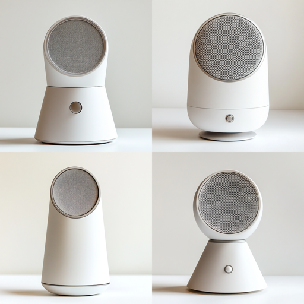
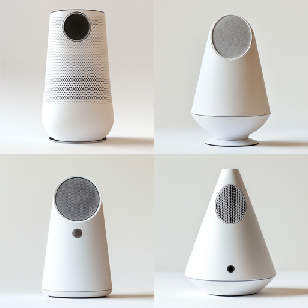
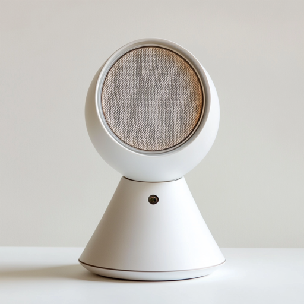
To mix it up, try other colors or materials
Slim matte black powder coated aluminum conic design speaker, front view, photograph, natural lighting, white background
Or
slim matte black knurled aluminum conic Apple speaker, front view, photograph, natural lighting, white background
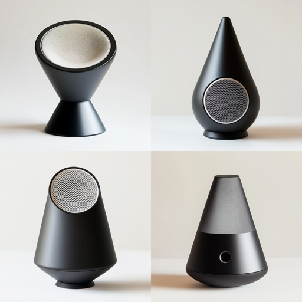
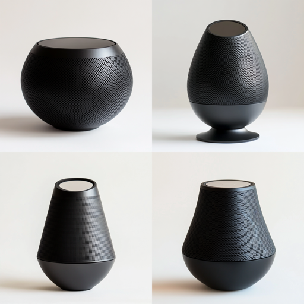
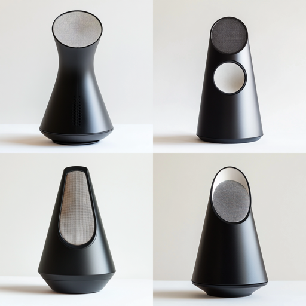
This is interesting, let’s do variations
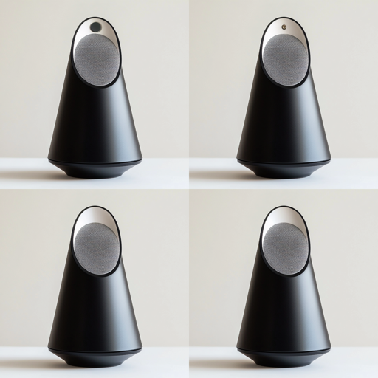
What is the metal thing? No idea but maybe “honor thy error as hidden intention”
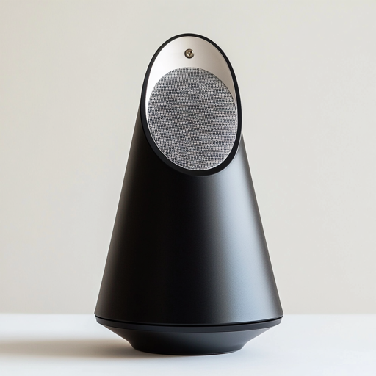
Variations in vizcom.ai
Sleek metallic black cone-shaped speaker with an inset off white white oval with a loose knit gray textured circular fabric speaker cover and a shiny chrome metallic button centered above the speaker, the base is a separate piece that slopes inward to a smaller circular foot. Overall it looks like a minimalist design interpretation of a black and white nun’s habit mixed with a penguin.
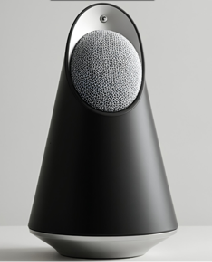
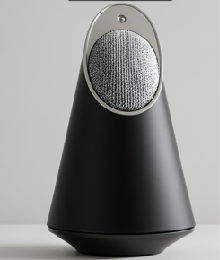
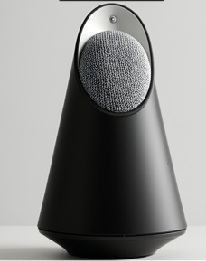
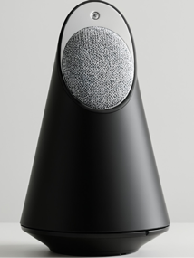
The silver base is interesting, let’s update that
Sleek metallic black cone-shaped speaker with an inset curved off white white oval with a flat circular loose knit gray textured fabric speaker cover and a shiny chrome metallic button centered above the speaker, the base is a separate piece brushed aluminum that slopes inward to a smaller circular foot. Overall it looks like a minimalist design interpretation of a black and white nun’s habit mixed with a penguin.
Modelling in Fusion 360
OK, we are kind of done with AI for the moment. Let’s do CAD
We have an image, but what is its size, shape? Image makers don’t ‘think’, so you have to explore this. Illustrator can give us some rough proportions
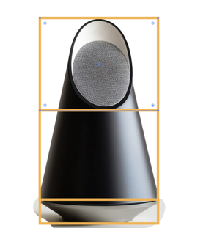
3D Model
One thing to notice is that it wasn’t actually possible to make the image above in 3D, Midjourney images don’t have to obey real world physics!
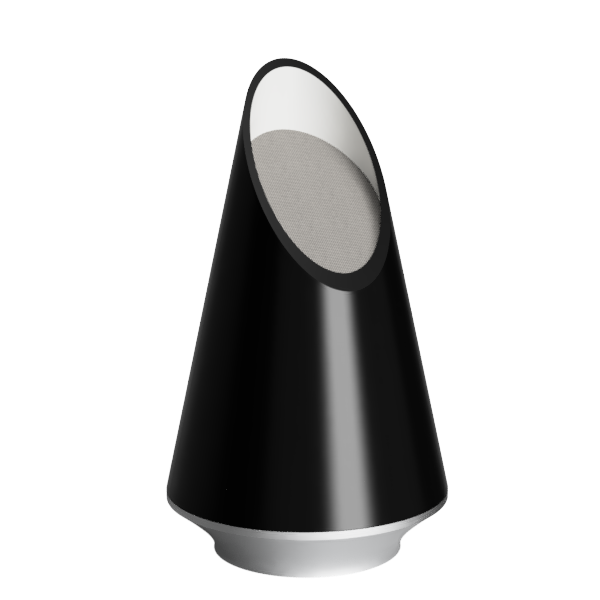
a “monk” direction came out of it. Let’s hold this for later.
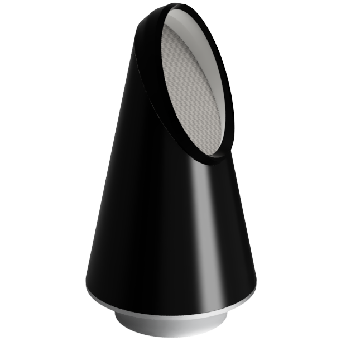
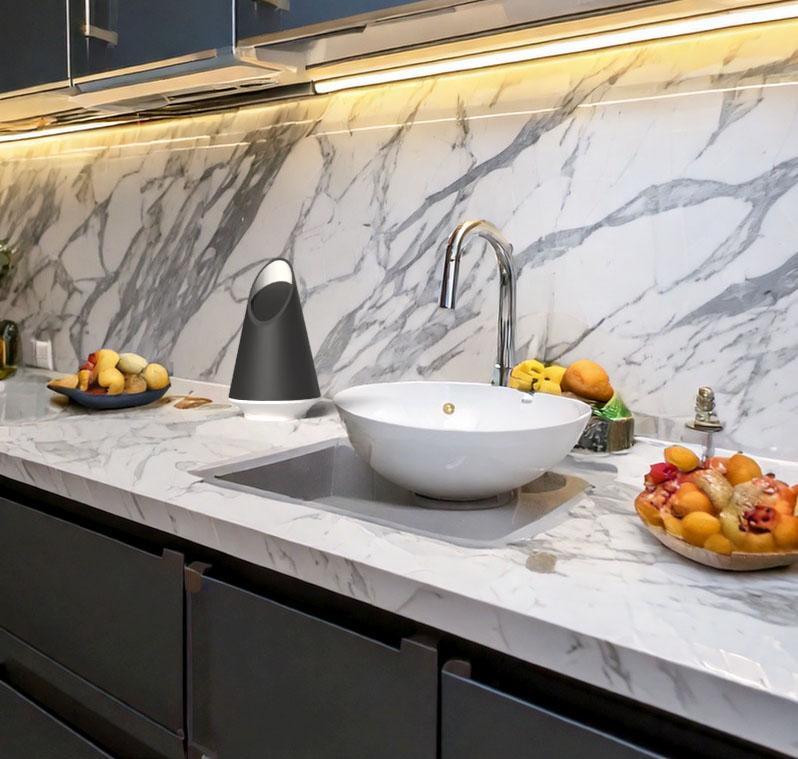
In Adobe Substance 3D Stager, one can generate a background scene:
an elegant modern white marble kitchen countertop with a sink and a fruit bowl in a well lit modern kitchen with gray cabinets
Then, import the .obj file, place the image and render

Marketing
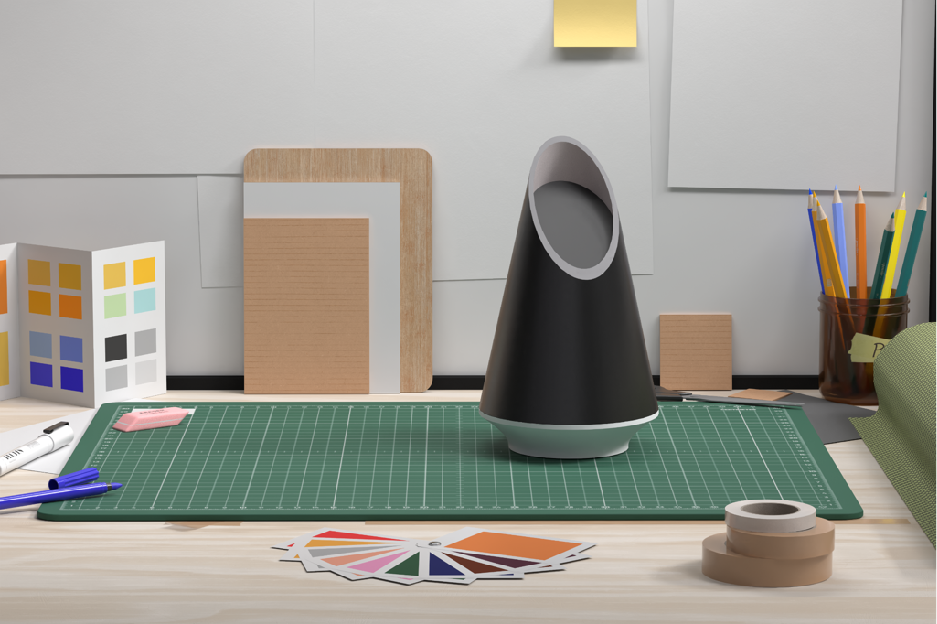
Claude.ai thinks “This image shows a sleek, modern speaker or audio device with a distinctive conical design. It has a matte black body that tapers upward from a silver/gray base. The top is cut at an angle, revealing what appears to be a gray speaker mesh or grille. The design is minimal and elegant, with clean lines and a contemporary aesthetic. The shape is reminiscent of a truncated cone or pyramid, and the contrast between the black body and silver accents gives it a sophisticated look. The device appears to be designed for both visual appeal and acoustic functionality, likely meant to project sound from the angled top portion. The overall build seems high-end, with careful attention to materials and finish quality. Without context of scale, it could be anywhere from a small desktop speaker to a larger floor-standing unit, though based on its proportions it’s likely meant for tabletop use.”
Claude suggested a number of product names, including
CANTO Strengths:
- Short, memorable, elegant
- Musical connection (from Italian/Latin “to sing”)
- Unique in audio market
- Works well internationally
- Strong potential for logo design with the ‘O’ echoing speaker shape
- Could extend to a product line (Canto Studio, Canto Mini, etc.) Marketing positioning: Premium, artistic, refined
Class Overview
AI is not coming to take your job, but designers who use AI are. The class explores how today’s cutting edge AI tools are changing what it means to design, for better and worse. Properly harnessed, AI enables designers to ask better questions rather than simply generate answers.
Approach
The class will focus on distinguishing the hype from the promise of AI. Students will navigate what it means to design when one can generate hundreds of mediocre ideas, and learn how to integrate the best into coherent experiences. We will identify techniques that work, rather than specific tech products that will become outdated. Students will survey the impact of AI tools in medicine, science, and engineering. We will analyze concepts of AI in art, literature, film, and games, and challenge the ethical assumptions embedded in the tools. Experts in product design, user experience, research, and marketing will share the techniques they use today to develop products.
Class Work Expectations
The student will be responsible for designing an entire product experience, from Product/Market Analysis, Physical Prototyping, User Research, Marketing, Instructional Design, Packaging, and a digital user interface to manage or support the device or experience. The final product will include a full scale 3D “looks like” model and a “works like” prototype that demonstrates a key aspect of your design (It should be strong enough that ID View visitors can touch it.)
Project Focus
Your assignment is to research and develop a professional tool that assists a person doing hard, dirty, or dangerous physical jobs, from home healthcare aides, mine safety, disaster response, search & rescue, battlefield nursing, industrial maintenance on deep sea windmills. The goal is not full automation, but assistive technology for the workers who need it most.
Industry Examples
Examples include Self driving cars, Nursing bed transfers, Rufus shingle robot, Dusty drywall bot, Shaper Origin, Festool Exoactive, Autonomous Mining
John Deere unveils new autonomous vehicles at CES
Lots of new ways to cut labor costs, no mention of repairability
Autonomy
Productive and efficient farming operations for the next generation of growers. Using technology to help farmers do more with less.
Sustainable mining solutions
We are driving development and adoption of mining and excavation solutions for automation, digitalization and electrification, all of which increase productivity and sustainability.
Shaper Origin
Handheld Precision Routing
Bring digital precision to the craft of woodworking. Work hands on with unparalleled accuracy, flexibility and efficiency.
ExoActive
With the new ExoActive, Festool presents its first active exoskeleton
Exoskeleton EXO 18 HPC 4,0 I-Plus ExoActive
https://www.archetypeai.io/ - Physical AI https://www.archetypeai.io/blog/physical-ai-beyond-robotics
https://apptronik.com/apollo -humanoid robots for manufacturing