Mechanical Wonderland -The Clark Collection of Mechanical Movements
Contents
My 2025 project, Mechanical Library was inspired by the exhibit in the Museum of Science, Boston. It had very little documentation online, so I went on a merry chase through historical records to document its story, resulting in the wikipedia page and an Online Exhibit, connecting for the first time, the exhibit photos and text.
The exhibit shows a positive vision of creativity in the public sphere. If you have the time to explore the following text, you will encounter words written over the past 150 years by engineers, machinists, hobbyists, and educators. They each took a small step forward, building on each other’s work. The optimism is inspiring, or even ecstatic, as shown by this review of the 1933 World’s Fair.
Intro
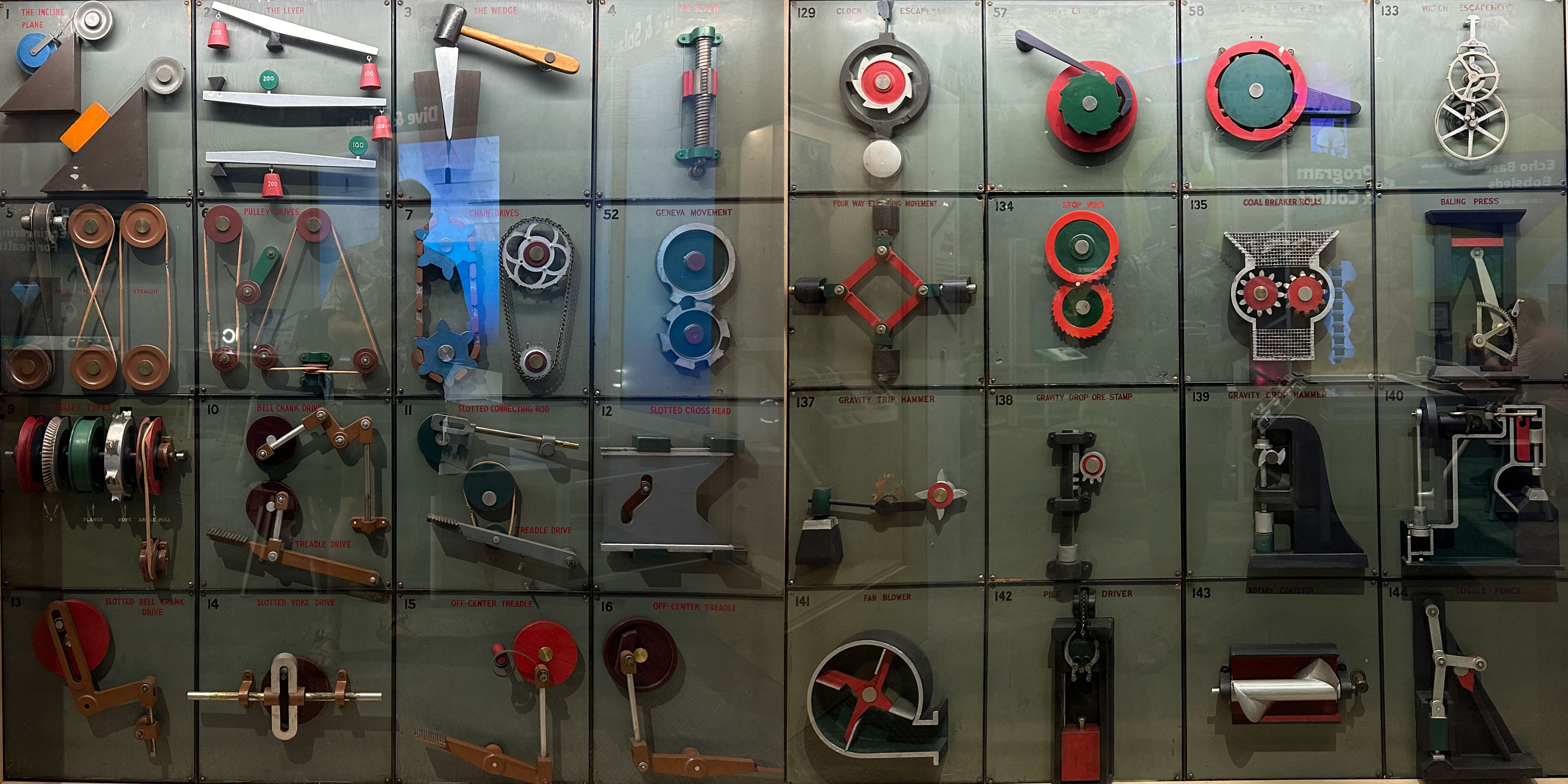
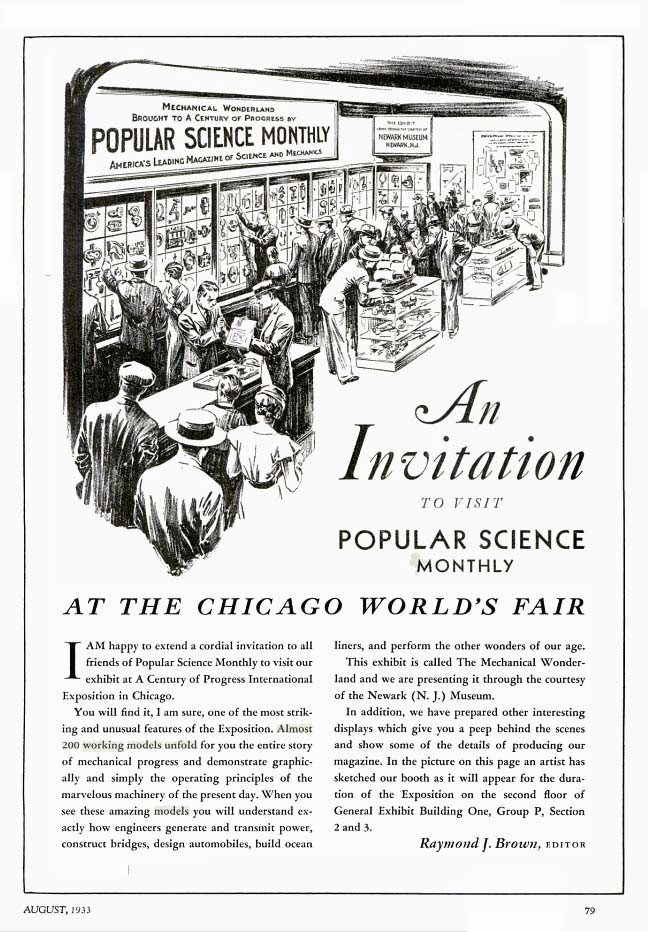
The Clark Collection of Mechanical Movements is a museum exhibit at the Museum of Science (Boston) made in the 1920s that shows over a hundred different mechanisms, including gears and models of machines. This exhibit and a copy were displayed at the Museum of Peaceful Arts, Newark Museum, and the 1934 Chicago World’s Fair, titled “A Century of Progress”.
This exhibit has inspired many inventors, engineers, and projects, including Mechanical Library project. Sadly, it was not readily available online. This research aims to honor the creative work and to inspire new generations. The various historical photos and news clippings below depict interesting people and a fascinating time of optimism for the future, during two of the darkest periods in American history, the Civil War and Great Depression.
History
W.M. (William Milton) Clark (1862/9 -?), of South Orange, NJ, a self-described "hobbyist", "through the help of the '507 Mechanical Movements', acquired the foundation for a mechanical education, without schooling in the regular way."14 The exhibit, originally titled "Mechanical Wonderland," was made over "20 years" by Mr. Clark in the early 1900s and displayed in the Boys' Department of a New York department store.8
Inspiration
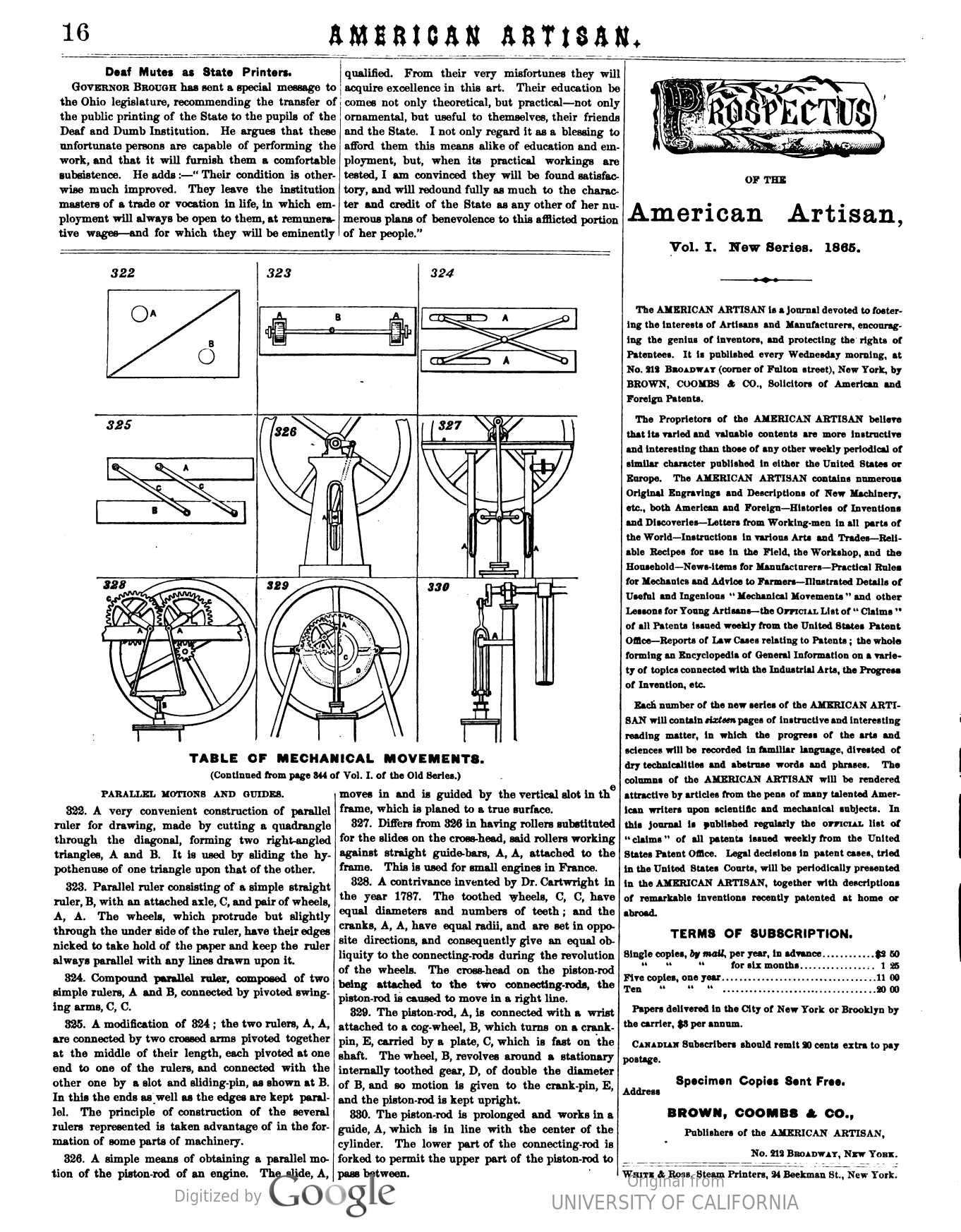
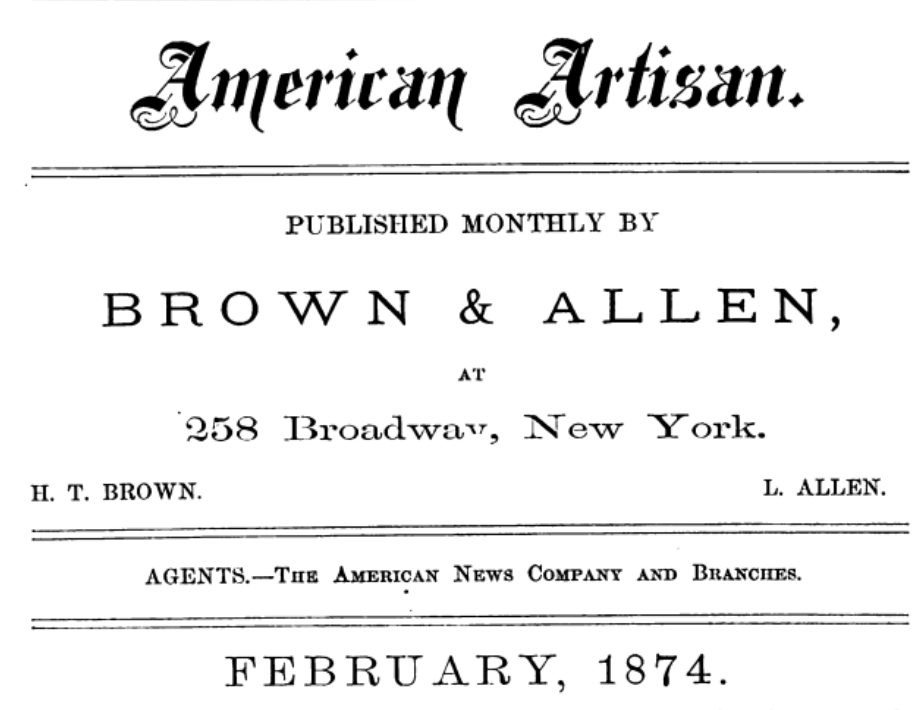
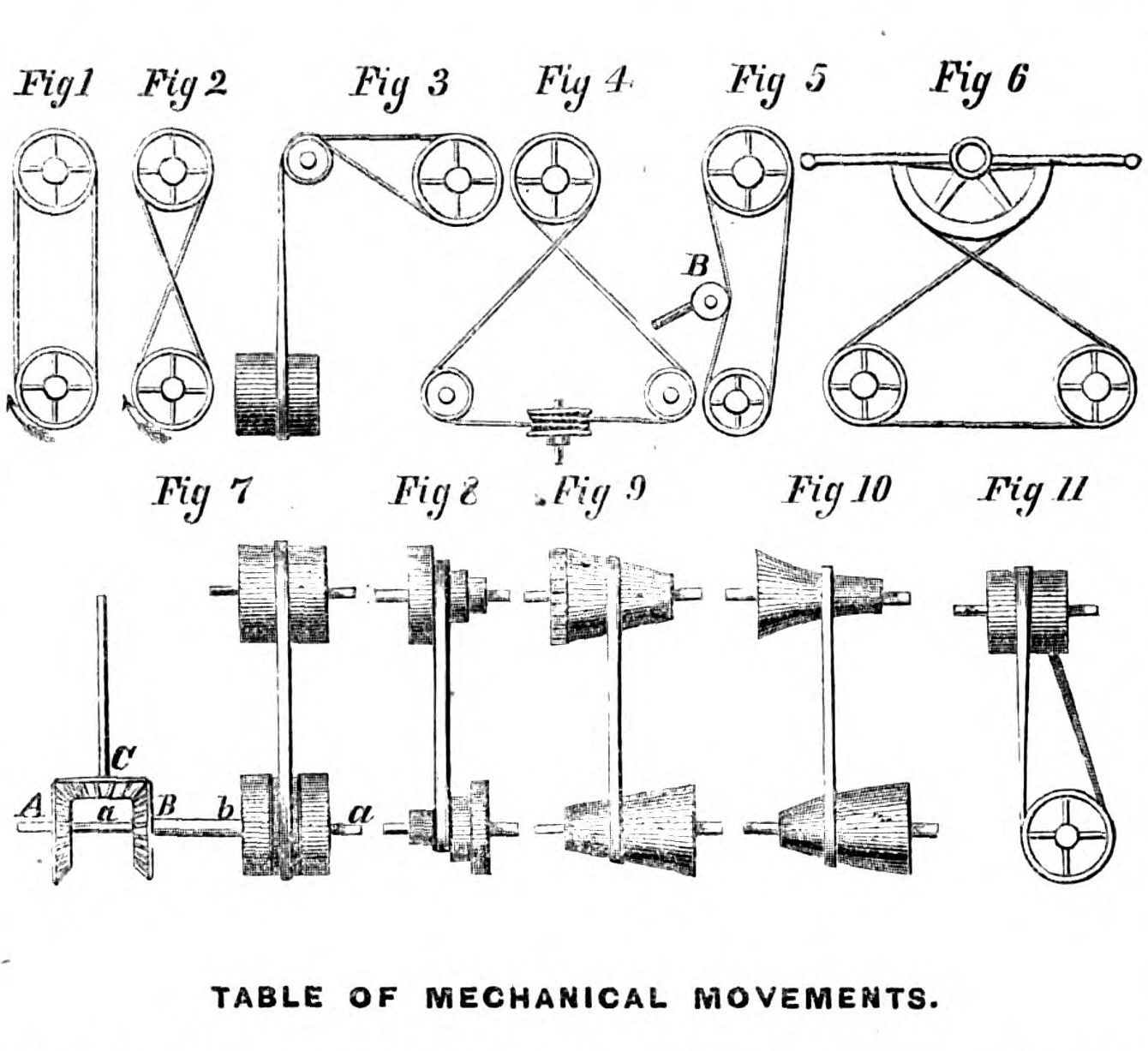
The exhibits were inspired by "illustrations and descriptions originally published in 1864 in a weekly series in the "American Artisan,"2 a weekly publication edited by Mr. Henry T. Brown, a prominent patent attorney."1 The magazine, not to be confused with later magazines with the same name, covered new inventions and patents in Civil War-era America.
In 1868, Henry T. Brown published the series as the book Five Hundred and Seven Mechanical Movements 3. This book has been widely inspirational to engineers and inventors to the present day.
Clark Collection
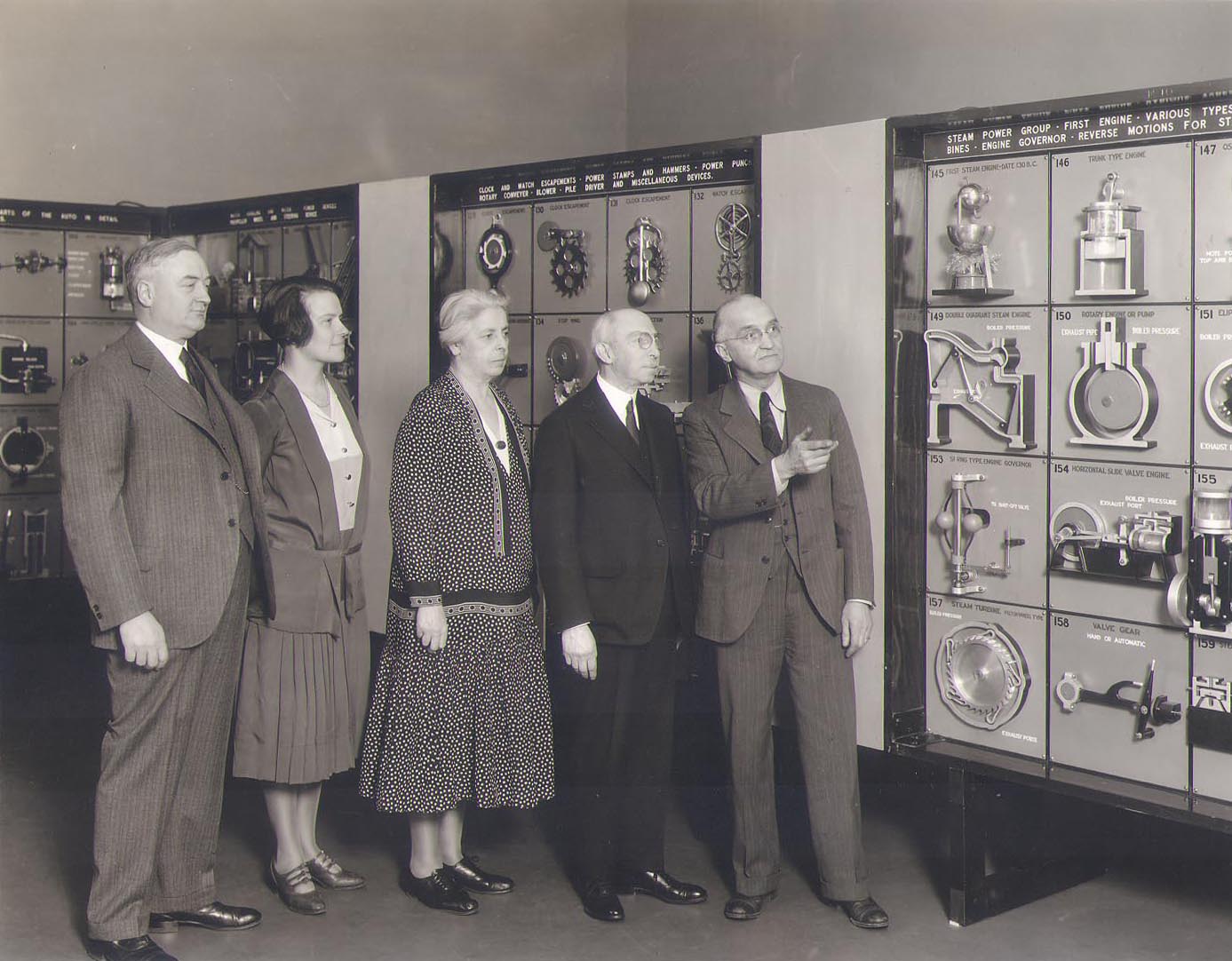
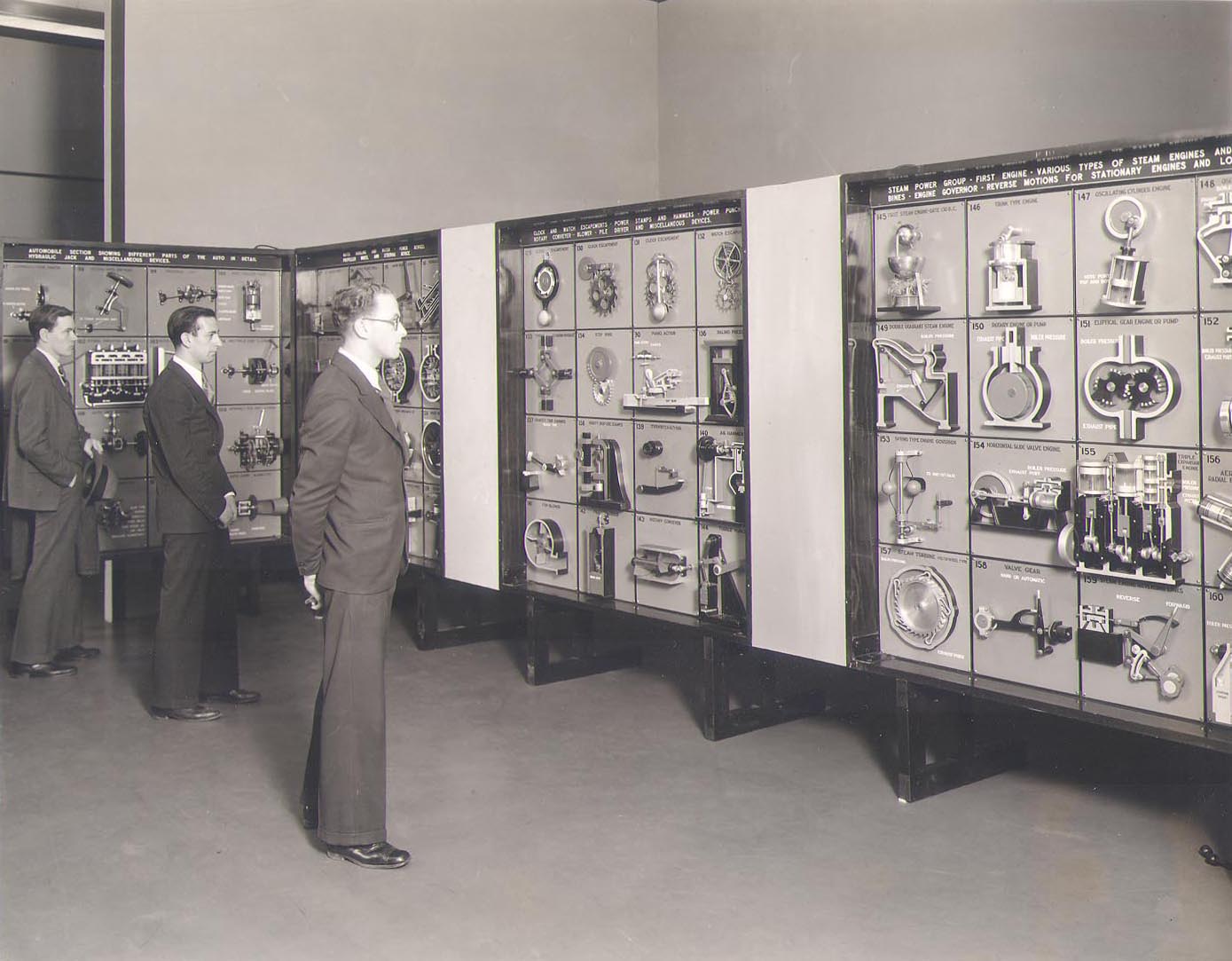
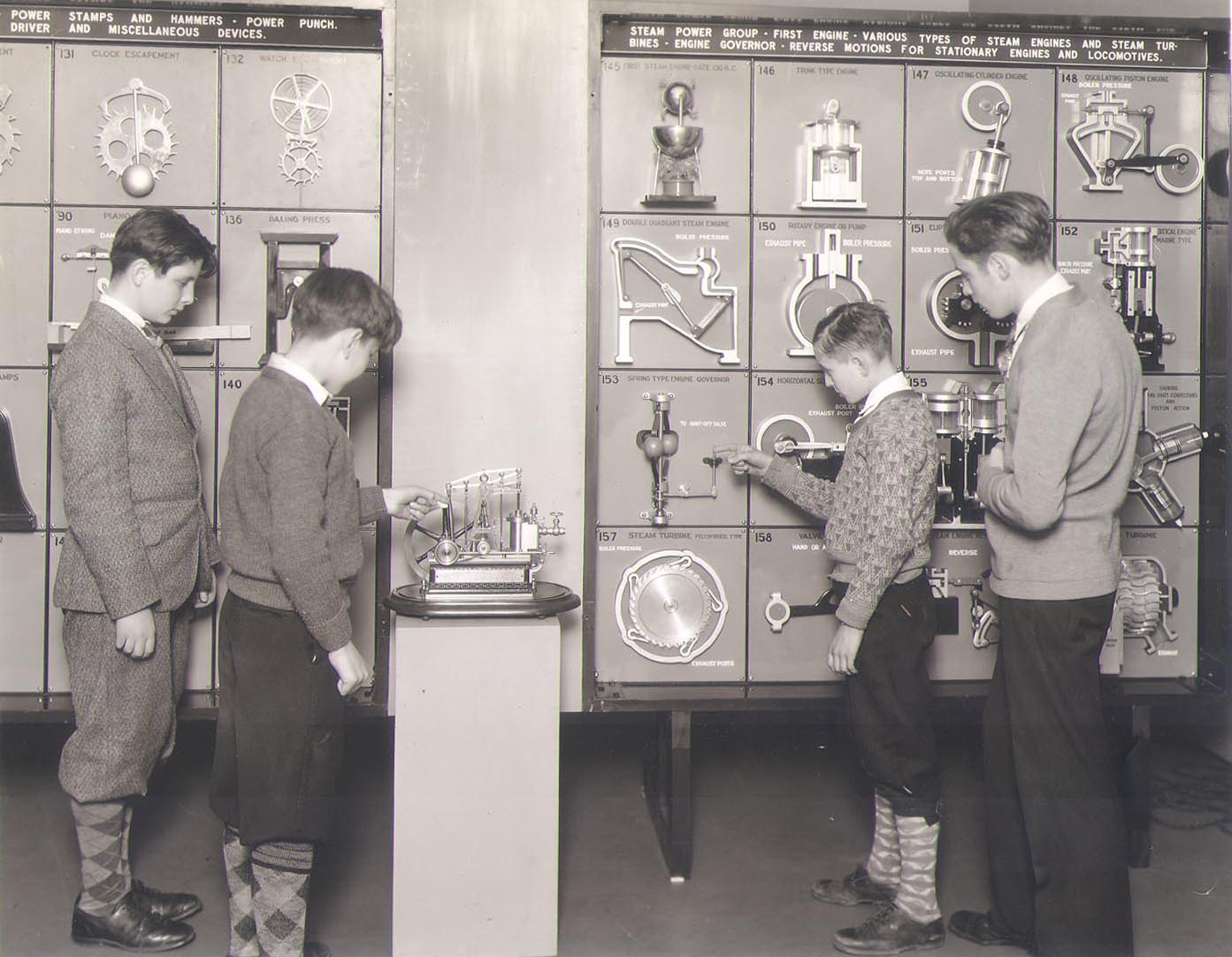
In the 1920s, over 135,000 people saw the "Mechanical Wonderland" in the Grand Central Palace in New York City in a one week period. 14 In 1928, the "Mechanical Wonderland" exhibit was displayed at the Museums of the Peaceful Arts and received press coverage5 6 7 8 9 At some point in the early 1930s, the Museum of the Peaceful Arts closed, and elements were inherited by the new New York Museum of Science and Industry 24. In the 1940s, the museum closed and at some point the Mechanical Wonderland exhibit was installed in the Museum of Science, Boston under the name the Clark Collection of Mechanical Movements.
Newark Collection
In the late 1920s, John Cotton Dana, the founder and first director of the Newark Museum in New Jersey, expressed interest in collecting the exhibit. Dana led the Newark Museum to expand its collection to include contemporary American commercial products as folk art as well as factory-made products. Dana was quoted as saying, “A great department store, easily reached, open at all hours, is more like a good museum of art than any of the museums we have yet established”.22
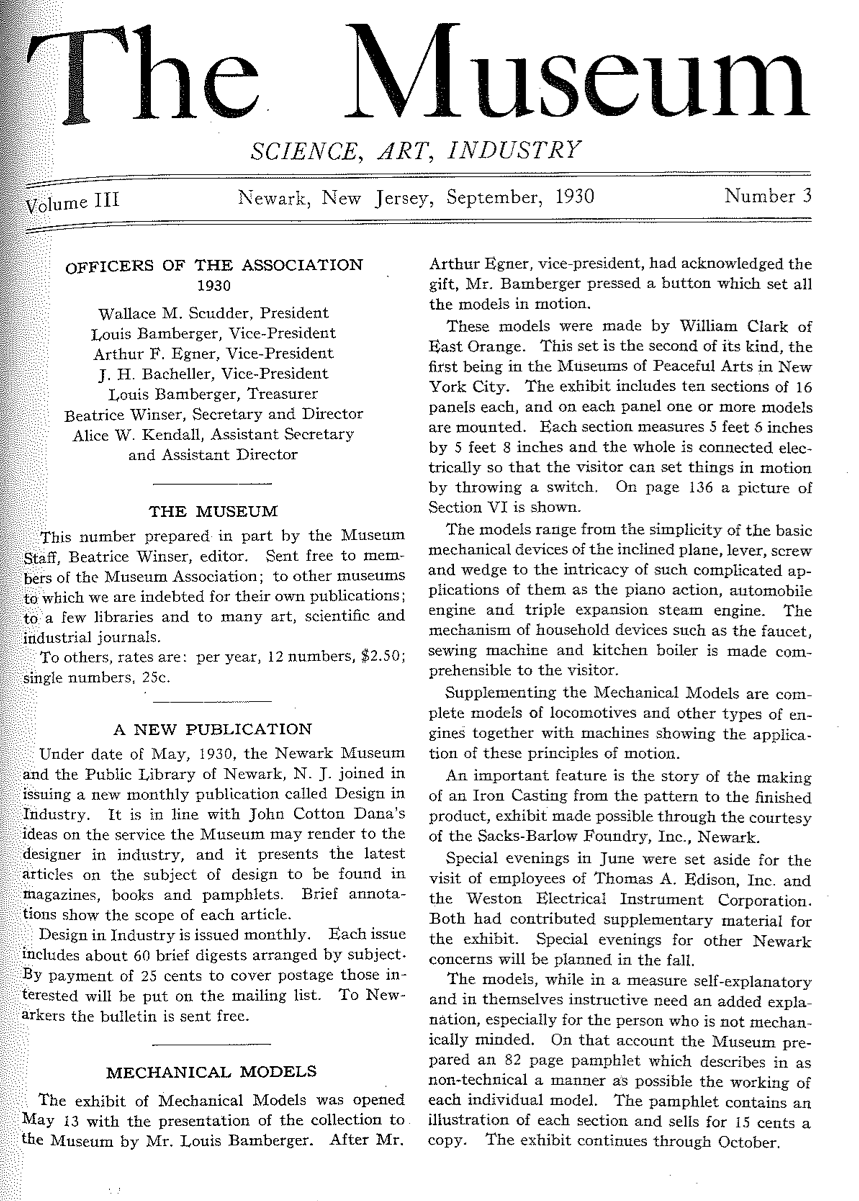
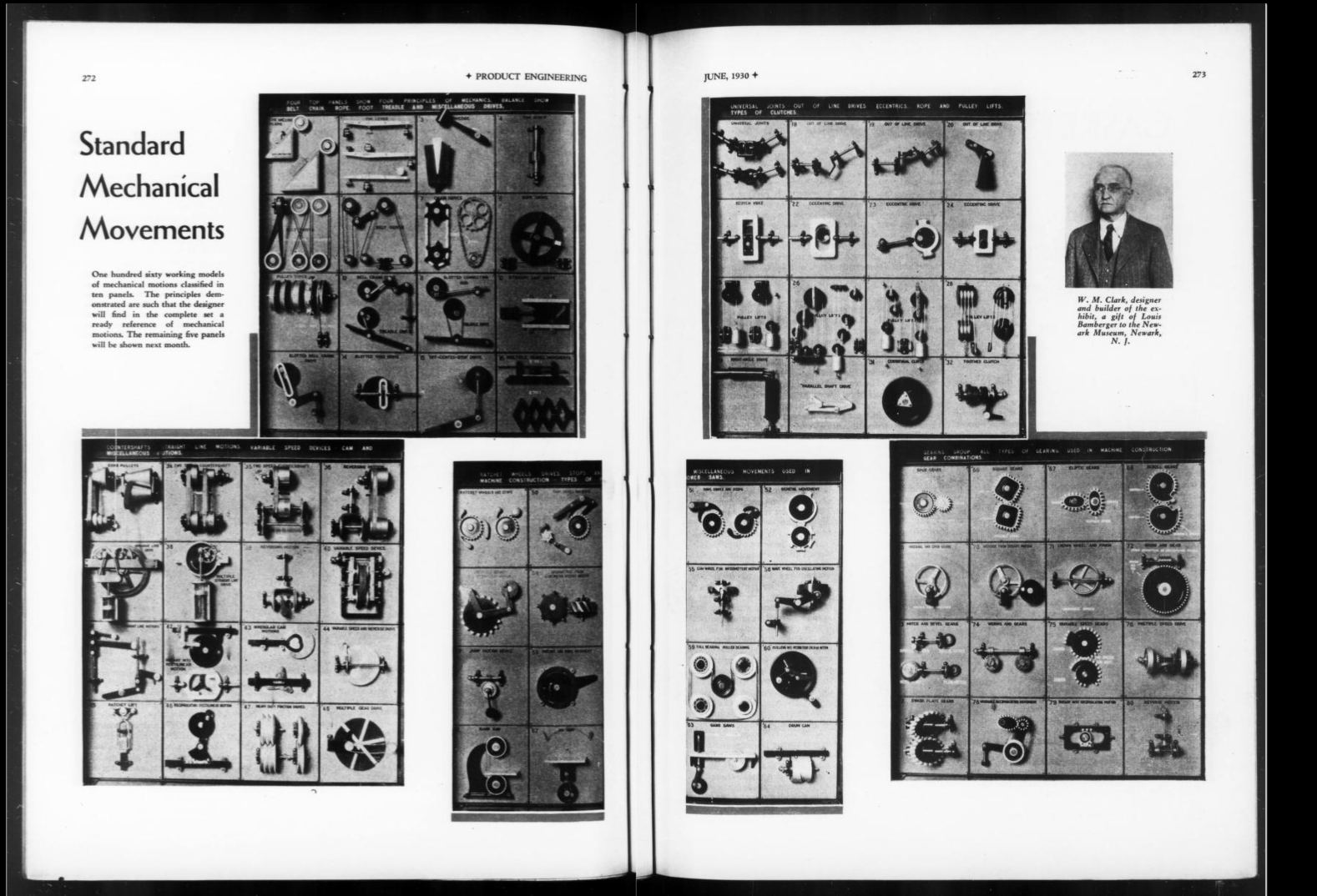
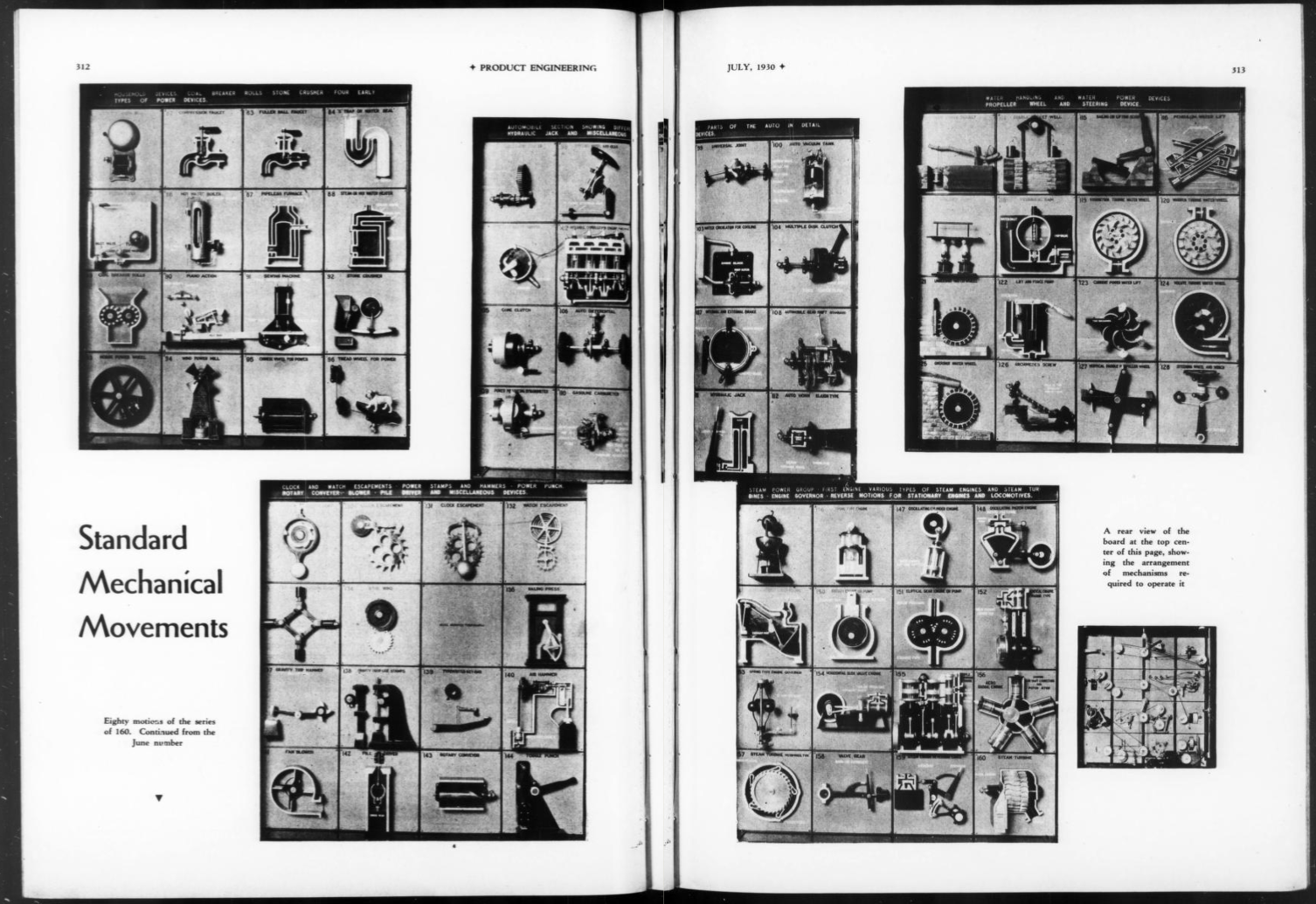
In 1930, a second exhibit was constructed by W.M. Clark and donated to the Newark Museum by Louis Bamberger. The museum displayed a collection of 160 models of mechanical contrivances which demonstrate 200 standard movements upon which modern industry is founded.16
In 1934, Newark Museum collection of "Mechanical Wonderland" was exhibited at the Chicago World's Fair, 'A Century of Progress' and returned to Newark Museum. In 1937, Newark Museum collection was exhibited at the Massachusetts Institute of Technology during the Annual Meeting of the Society for the Promotion of Engineering Education and later returned to Newark Museum. In 1954, The Newark Museum published a review of the exhibit.16 At some later time, The Newark Museum of Art placed the collection in storage, where it remains.21
The Interactive Mechanical Wonderland Exhibit
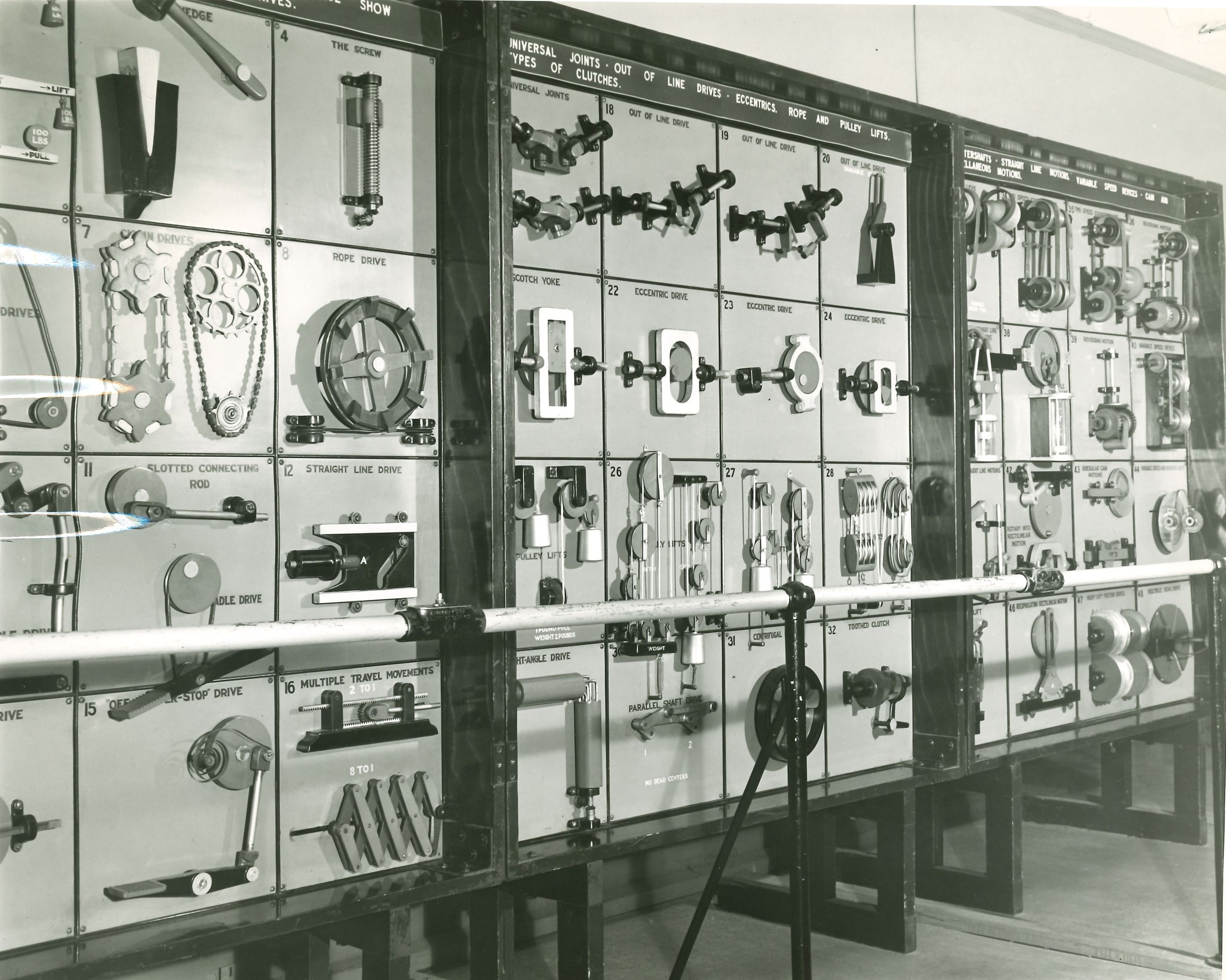
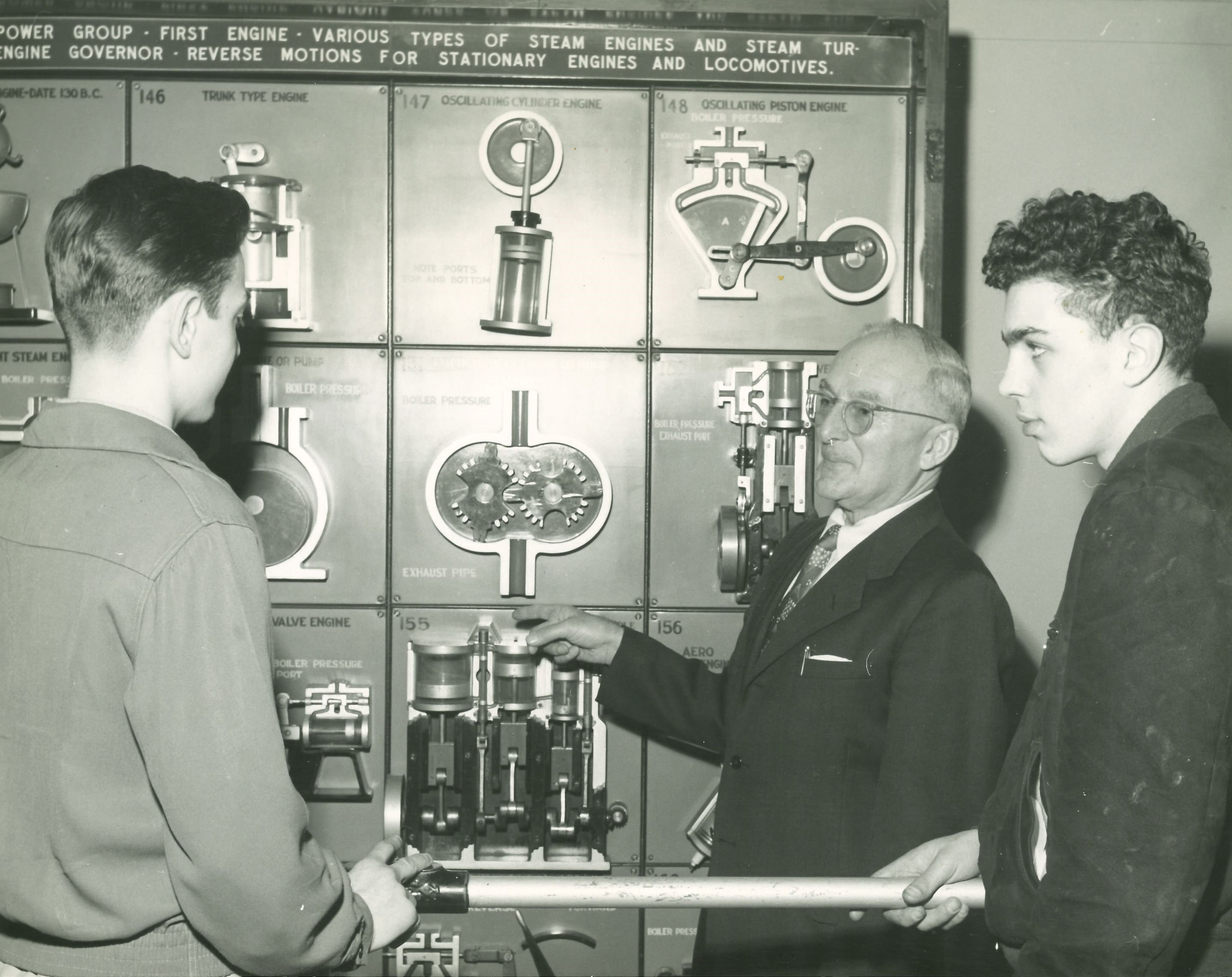
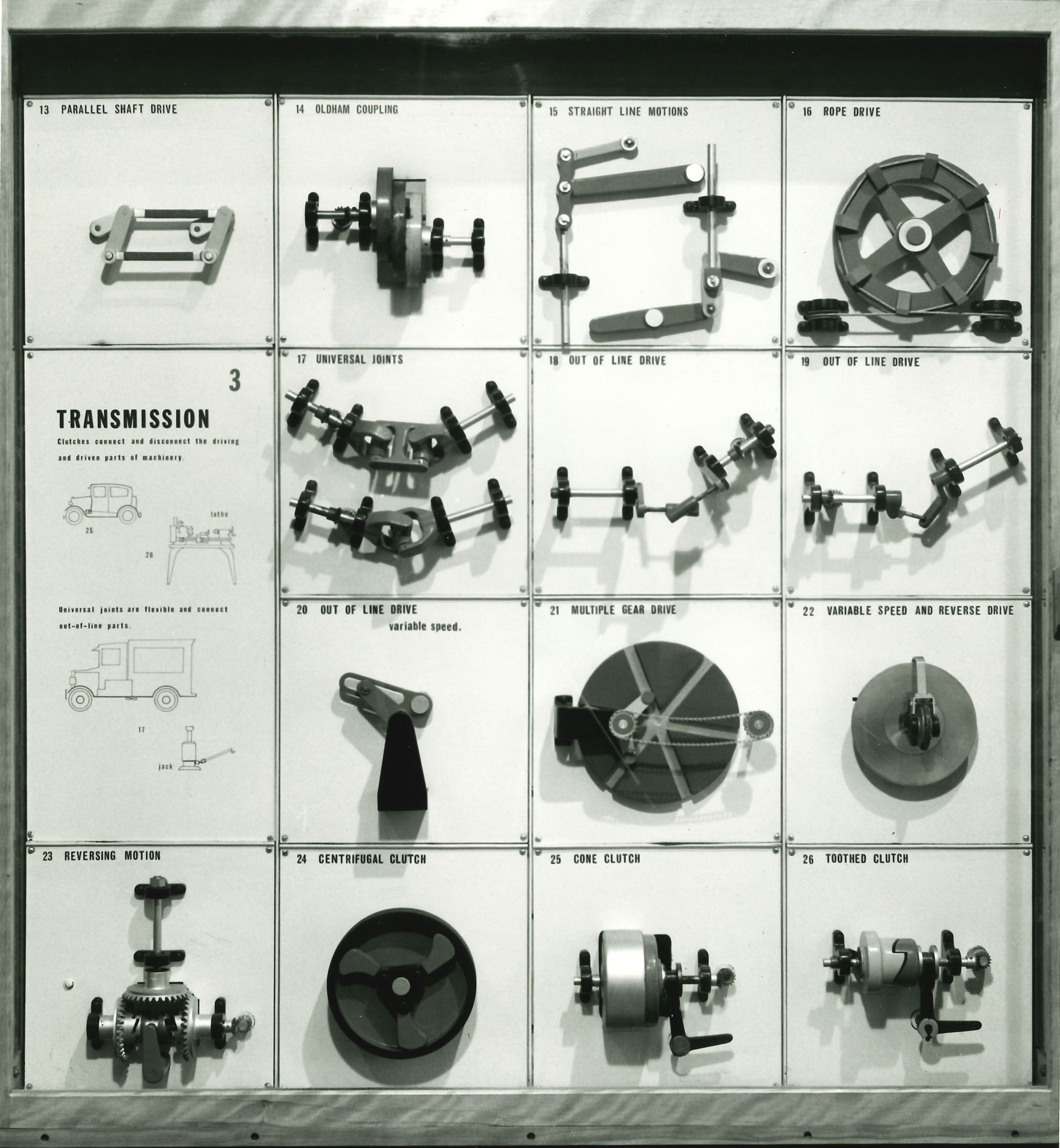
This collects, for the first time, the photos of the Boston Museum of Science Clark Collection, by way of Cornell University KMODDL17, with photos and museum exhibit texts from Newark Museum publications16. This information and files are collected here for the convenience of future readers, no copyright claim is implied.
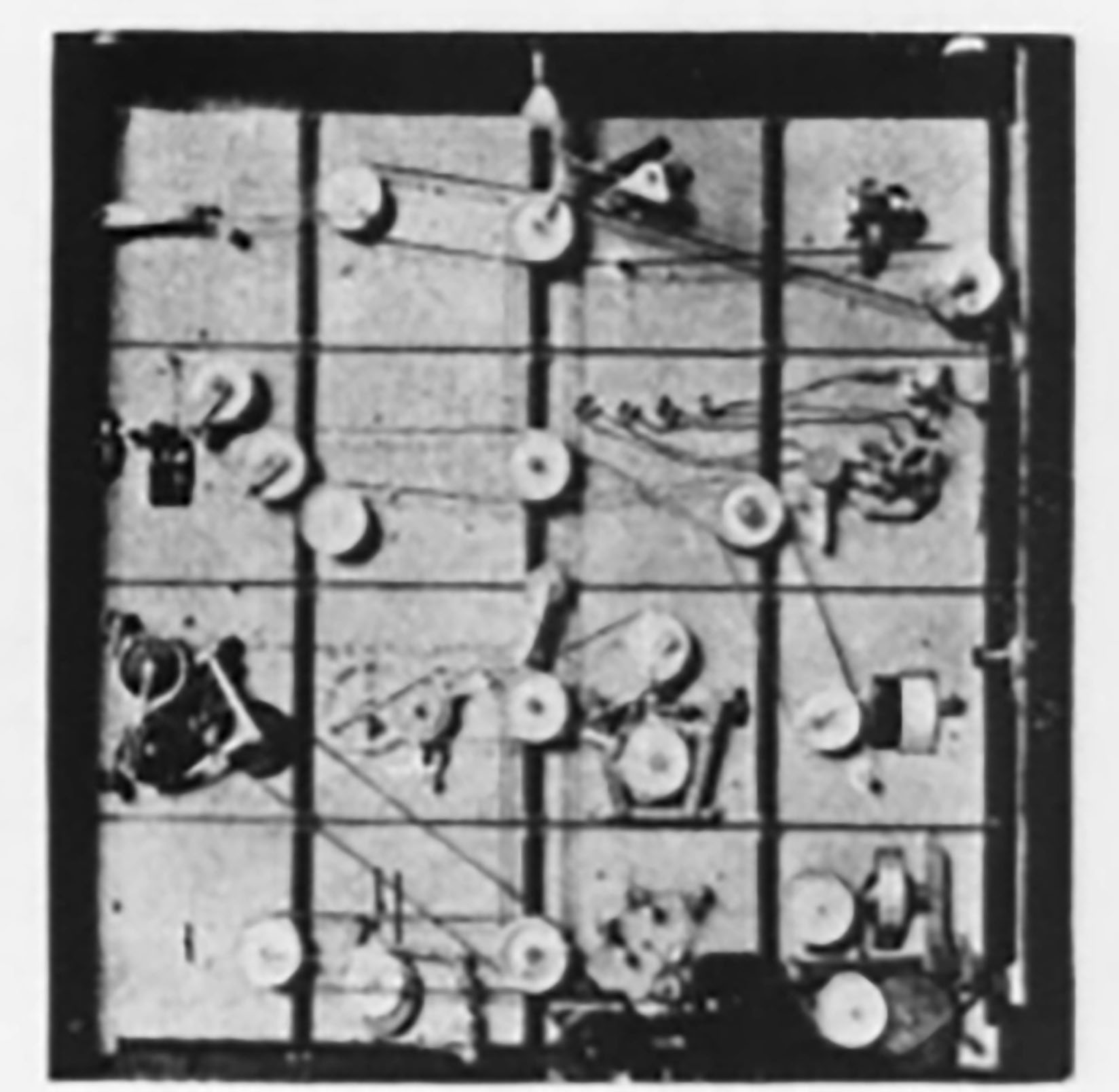
The original exhibit consisted of ten sections, each with 16 square panels of mechanical movements or devices. Each individual panel is connected electrically so that the visitor could set a section in motion by pressing a button. The exhibit sections each measure 5 feet 6 inches square, and weigh from 475 to 550 pounds apiece. In each section are sixteen small panels 15¼ inches square, each containing one or more movements. "The exhibit could be set up or taken down in a few hours."
Photos


Text excerpts from source materials
The source material is primarily pictures and diagrams, the historical information is located in the foreword, collected here.
Prospectus of the American Artisan and Patent Record (1865) 23
The AMERICAN ARTISAN is a journal devoted to fostering the interests of Artisans and Manufacturers, encouraging the genius of inventors, and protecting the rights of Patentees. It is published every Wednesday morning, at No. 212 BROADWAY (corner of Fulton street), New York, by BROWN, COOMBS & CO., Solicitors of American and Foreign Patents.
The Proprietors of the AMERICAN ARTISAN believe that its varied and valuable contents are more instructive and interesting than those of any other weekly periodical of similar character published in either the United States or Europe. The AMERICAN ARTISAN contains numerous Original Engravings and Descriptions of New Machinery, etc., both American and Foreign-Histories of Inventions and Discoveries-Letters from Working-men in all parts of the World-Instructions in various Arts and Trades-Reliable Recipes for use in the Field, the Workshop, and the Household-News-items for Manufacturers-Practical Rules for Mechanics and Advice to Farmers-Illustrated Details of Useful and Ingenious "Mechanical Movements" and other Lessons for Young Artisans-the OFFICIAL List of "Claims " of all Patents issued weekly from the United States Patent Office-Reports of Law Cases relating to Patents; the whole forming an Encyclopedia of General Information on a variety of topics connected with the Industrial Arts, the Progress of Invention, etc.
Each number of the new series of the AMERICAN ARTISAN will contain sixteen pages of instructive and interesting reading matter, in which the progress of the arts and sciences will be recorded in familiar language, divested of dry technicalities and abstruse words and phrases. The columns of the AMERICAN ARTISAN will be rendered attractive by articles from the pens of many talented American writers upon scientific and mechanical subjects. In this journal is published regularly the OFFICIAL list of "claims" of all patents issued weekly from the United States Patent Office. Legal decisions in patent cases, tried in the United States Courts, will be periodically presented in the AMERICAN ARTISAN, together with descriptions of remarkable inventions recently patented at home or abroad.
507 Mechanical Movements by Henry T. Brown 3
The want of a comprehensive collection of illustrations and descriptions of MECHANICAL MOVEMENTS has long been seriously felt by artisans, inventors, and students of the mechanic arts. It was the knowledge of this want which induced the compilation of the collection here presented. The movements which it contains have been already illustrated and described in occasional installments scattered through five volumes of the AMERICAN ARTISAN, by the readers of which their publication was received with so much favor as was believed to warrant the expense of their reproduction with some revision in a separate volume.
The selection of the movements embraced in this collection has been made from many and various sources. The English works of Johnson, Willcock, Wylson, and Denison have been drawn upon to a considerable extent, and many other works—American and foreign—have been laid under contribution ; but more than one-fourth of the movements—many of purely American origin—have never previously appeared in any published collection. Although the collection embraces about three times as many movements as have ever been contained in any previous American publication, and a considerably larger number than has ever been contained in any foreign one, it has not been the object of the compiler to merely swell the number, but he has endeavored to select only such as may be of really practical value ; and with this end in view, he has rejected many which are found in nearly all the previously published collections, but which he has considered only applicable to some exceptional want.
Owing to the selection of these movements at such intervals as could be snatched from professional duties, which admitted of no postponement, and to the engravings having been made from time to time for immediate publication, the classification of the movements is not as perfect as the compiler could have desired; yet it is believed that this deficiency is more than compensated for by the copiousness of the Index and the entirely novel arrangement of the illustrations and the descriptive letter-press on opposite pages, which make the collection—large and comprehensive as it is—more convenient for reference than any previous one.
foreword to Mechanical Models book (1930) 8
Given to the Newark Museum by Louis Bamberger and Exhibited May-October, 1930
NOTE
In the spring of 1928 a pamphlet telling of an exhibit of working mechanical models to be seen in New York in the Boys' Department of a department store, came to Mr. Dana's attention. The maker of the exhibition, Mr. W. M. Clark, was interviewed and asked to lend the exhibit to the Museum, but it was found it would cost several hundred dollars for transportation and installation, and the exhibit was given up.
More than a year later Mr. Louis Bamberger talked with Mr. Dana about this same exhibit of Mechanical Models and Mr. Dana told Mr. Bamberger of his desire to show this exhibit in the Museum. Mr. Bamberger then decided to present these models, appropriately mounted and labeled, to the Museum.
The exhibit consists of ten sections, each measuring 5 feet 6 inches by 5 feet 8 inches, and weighing from 475 to 550 pounds apiece. In each section are sixteen small panels 15¼ inches square, each containing one or more movements. The sections are mounted on legs 16 inches high and are provided with covers both back and front so arranged that they can be handled exactly like a piano. The exhibit can be set up or taken down in a few hours. Each individual panel is connected electrically so that the visitor may set things in motion by pressing a button.
The Museum plans to lend the exhibit under certain conditions, to museums and other institutions which are equipped to set it up with the care required and to transport it.
Mr. W. M. Clark of South Orange is the inventor and maker of the Mechanical Exhibit.
From his early youth Mr. Clark has been interested in machines and has always had a great desire to visualize the science of mechanics. His work of twenty years or more in perfecting the exhibit was inspired by a wish to give to inventors and to all who deal in machine technique a short cut to their various ends. The first exhibit made by Mr. Clark is now in the Museum of the Peaceful Arts in New York City. The second set is a gift to the Newark Museum by Mr. Louis Bamberger.
Miss Virginia Downward, Head of the Science Department, aided by Mr. Clark, wrote the labels which present the story of each movement to the visitor.
This exhibit will be of tremendous interest not only to a city like Newark with its many industries, but to the State as well.
In connection with this exhibition the Public Library has an alcove of books, pamphlets and periodicals devoted to the subject.
BEATRICE WINSER
June 3, 1930
foreword to Manual of Mechanical Movements (1933 edition has different foreword) 25
This collection of illustrations and descriptions of "Mechanical Movements" was originally published in the "American Artisan," a publication edited by Mr. Henry T. Brown, deceased, a prominent patent attorney, nationally known.
Mr. Brown was the senior member of Brown & Seward, patent attorneys, at 270 Broadway, New York City, enjoying an enviable reputation in the prosecuting of patent applications and all the work relative thereto.
A copy of this book, as originally published, was purchased, years ago, by the creator of "Mechanical Wonderland," Mr. W. M. Clark, of South Orange, New Jersey, a lover of mechanics who used it as a text book in his study of mechanics, which was his natural "Hobby."
Mr. Clark, through its help, acquired the foundation for a mechanical education, without schooling in the regular way, which inspired the conception, designing and building of a large exhibit, nationally known as "Mechanical Wonderland."
This exhibit visualizes the art and science of mechanics, so that those, like himself, who had no opportunity to get this education in the schools, can now get a quick grasp of it.
The Exhibit, "Mechanical Wonderland," is a collection of over 200 mechanical movements, devices and combinations of movements, showing every movement used in this art, either separately or in combination.
Several of these exhibits have been built, the first one being in the Science Museum of New York City, the last one being purchased by Mr. Louis Bamberger of Newark, New Jersey, and presented to the Newark Museum for permanent installation, where it has been viewed and studied by thousands of craftsmen, scientists, inventors, teachers and educational bodies, schools and colleges, together with those prominent in industries in the metropolitan area.
Over 135,000 people saw it in the "Grand Central Palace" in New York City in one week's period, when exhibited there. Inquiries were received from all parts of the United States, as well as from other countries concerning its installation in museums, educational institutions and industrial centers.
It has the endorsement of leading educators, colleges, industrial men and technical organizations throughout the country.
The Exposition, "A Century of Progress," affords a splendid opportunity to bring to the attention of all those interested in visual education, the application of this method in their own centers.
The inspiration gotten from "Mechanical Wonderland" will prove the worth of this volume, which inspired its building.
This edition is dedicated to "A Century of Progress." W. M. CLARK.
"The Museum" Volume 6, Number 3 Introduction by Katherine Coffey Published by The Newark Museum Summer 1954 16
John Cotton Dana's concept that a museum "should reflect our industries, be stimulating and helpful to our workers; promote an interest in the products of our shops," and his desire "to make adult Americans more pleased and proud of the mechanical achievements of their countrymen; and to arouse in the young an interest to do all kinds of things from the driving of a nail with a hammer to the construction of a motor car," lead him in 1926 to inquire about an exhibition of mechanical models on display in a New York department store. This exhibition, the life work of a New Jersey inventor, Mr. William M. Clark, consisted of panels on which were mounted one hundred-sixty working models, showing the fundamentals of mechanical movement, beginning with the first principles and covering the development, both practical and experimental, in a more or less natural sequence. What Mr. Clark had succeeded in doing was to condense into simple, compact, and easily operated models all the movements or combinations of movements used in mechanics. The first set he designed and constructed went to the New York Museum of Science and Industry, known at that time, in 1929, as The Museum of Peaceful Arts. This set now belongs to the Museum of Science, Boston. After Mr. Dana's death in 1929, Mr. Louis Bamberger ordered a second set of this "dictionary of mechanical movements" for the Newark Museum.
The models have been on exhibition continuously since 1930 with a few interruptions when they were lent to Mr. Clark for the Chicago World's Fairs of 1933 and 1934, and to the Massachusetts Institute of Technology in 1937 for display during the Annual Meeting of the Society for the Promotion of Engineering Education.
The thousands of people who have viewed this exhibition in the past twenty-four years have found considerable enjoyment in studying the mechanical operations presented effectively in it. It gives us pleasure to bring to our members and friends the following history of the principles of mechanical movements prepared by Kenneth Gosner of our Science Department Staff.
KATHERINE COFFEY, Director
Mechanical Models: A Collection of the Newark Museum By Kenneth L. Gosner 16
For most of us who are not trained engineers, the insides of a clock, a typewriter, or the mysteries hidden under the hood of a modern automobile present a picture of baffling complexity and even confusion. It is usually enough if the machine does what it is intended to, if its parts move according to the engineer's design. When this does not occur, when the machine fails, we are lost, frustrated, and usually annoyed. Then we anxiously call for the mechanic. Constantly we are confronted by the latest marvels of a highly technological era. If we are not familiar with the machines themselves we are at least familiar with their resulting product. Surprising then that an understanding of the principles of mechanical movements, which are so important in our civilization, has become more and more the province of engineers and mechanics alone.
The mechanical fittings of our culture result from the application of but a few principles, a few compared to the multitude of devices based on them. The inclined plane, lever, wedge, and pulley, together with the wheel and axle and the screw, are often called the six elements of mechanical movement—the six "simple machines." They provide the basis for mechanical invention. Nor are these the exclusive property of mankind or the product of his imagination alone. Simple machines may be found in the animal kingdom and elsewhere in nature. To take a familiar example—the mosquito. The mosquito flies and walks by manipulating the levers that make up her leg and wing attachments. The same mosquito, if she has the opportunity, makes effective use of a wedge when she punctures the skin in search of nourishment. Birds, which have been flying since Jurassic times or more than a hundred million years before man's labored efforts to get off the ground were successful, raise their wings by an arrangement of bone, muscle, and tendon which approximates the pulley in principle. When animals first climbed up out of the sea to conquer land habitats they very probably used the principle of the inclined plane.
Elementary machines, as well as fundamental mechanical movements and such complex pieces of machinery as an automobile engine, are shown in an operating exhibit of Mechanical Models in the Museum. One hundred-sixty movements and inventions are shown, and the photographs illustrating this text are taken from the exhibition. Historically the exhibit may be said to cover the period from man's earliest use of tools other than his own hands to the present age of internal combustion engines, turbines, and steam locomotives.
Examples of the use of the inclined plane, lever, and wedge are found abundantly in nature, and these few simple machines were employed by early man in the fashioning of tools. The use of mechanical devices goes back far beyond the limits of recorded history. The inclined plane and the lever were perhaps the first mechanical elements put to work. The principle of the wedge, which is really a form of the inclined plane, came into use when early human hunters and fishermen sharpened sticks to make the first spears. Later the wedge formed the basis of the sharp cutting edges of stone knives and projectile points.
As long as man followed a meager existence gathering the roots, nuts, berries, and fruits that grew around him, or was satisfied to fill out this vegetable diet with game and fish, his technology remained a relatively simple one. Later he began to perfect the techniques of agriculture, growing his own crops of corn and rice and domesticating dogs, pigs, and horses. But man's progress in improving the tools with which he worked went slowly. The discovery of fire gave him a means of improving the qualities of some of the tools that he already had and of using previously untried raw materials in perfecting new implements. The use of metals began with the smelting of simple ores and the pounding into useful shapes of native metals. The inclined plane, lever, and wedge, unassisted by other mechanical elements, continued to serve as the foundation of applied mechanics even into the period of ancient civilization. With simple mechanisms the Egyptian architects of 5000 years ago built the pyramids. During most of this long struggle, muscle power provided the force to accomplish human undertakings. Manpower alone raised tons of granite and limestone blocks into the fantastic pyramids of ancient Egypt, hundreds of thousands of men laboring for twenty years or more to accomplish this.
Special thanks
- William A. Peniston, Librarian/Archivist (retired), The Newark Museum of Art, New Jersey
- Katherine Barrett, Assistant Curator, Collections, Museum of Science, Boston
- South Orange Historical Preservation Society, South Orange, NJ
Open Questions
- Were there more than 2 collections made? or other related items?
- What did W. M. Clark do professionally? We lack most biographical details.
Bibliography
This information and files are presented for the convenience of future readers. All materials are believed to be in public domain, and no copyright is implied. Please contact the site author if you feel it should be removed.
1 Millar, W. (1858) Patent 21800, IMPROVEMENT IN SEWING-MACHINES US Patent Office (Lists Henry T. Brown as witness, demonstrating his involvement in patent trade)
2 Brown, Henry T (editor) (1864) Table of Mechanical Movements American Artisan and Illustrated Journal of Popular Science p56, Brown, Coombs & Co.
First appearance of Mechanical Movements
3 Brown, Henry T (1868) Five Hundred and Seven Mechanical Movements Published by Brown, Coombs & Co, Office of the "American Artisan" archive.org
4 (1928) Puzzles of Modern Machinery Are Shown at Museum Exhibit New York Times
5 (1928) Moving Models Show How Autos Operate New York Times
6 (1930) Machine Models Shown in Newark New York Times
7 (1930) Collection of reports, photographs, and other materials related to the Museums of the Peaceful Arts, 1912-1930. Smithsonian Libraries
8 Clark, William M., and Virginia Downward, (1930) Mechanical Models: A Series of Working Models on the Art and Science of Mechanics. The Newark Museum
9 (1930) Standard Mechanical Movements Product Engineering Magazine p272
10 (1930) Standard Mechanical Movements Product Engineering Magazine p312
11 (1933) Ad in magazine promoting Mechanical Wonderland exhibit in 1934 Chicago World Fair Popular Science Magazine
12 DUFFUS, R.L. (1933) The Fair: A World of Tomorrow New York Times
NY Times Magazine article on Century of Progress World's Fair, 1933-1934
13 (1930-1942) A collection of materials relating to the New York Museum of Science and Industry New York Historical Society
14 Clark, William M. (1943) A Manual of Mechanical Movements Garden City Publishing
Note the content of the book is Five Hundred and Seven Mechanical Movements, with title pages removed and a foreword added. 2
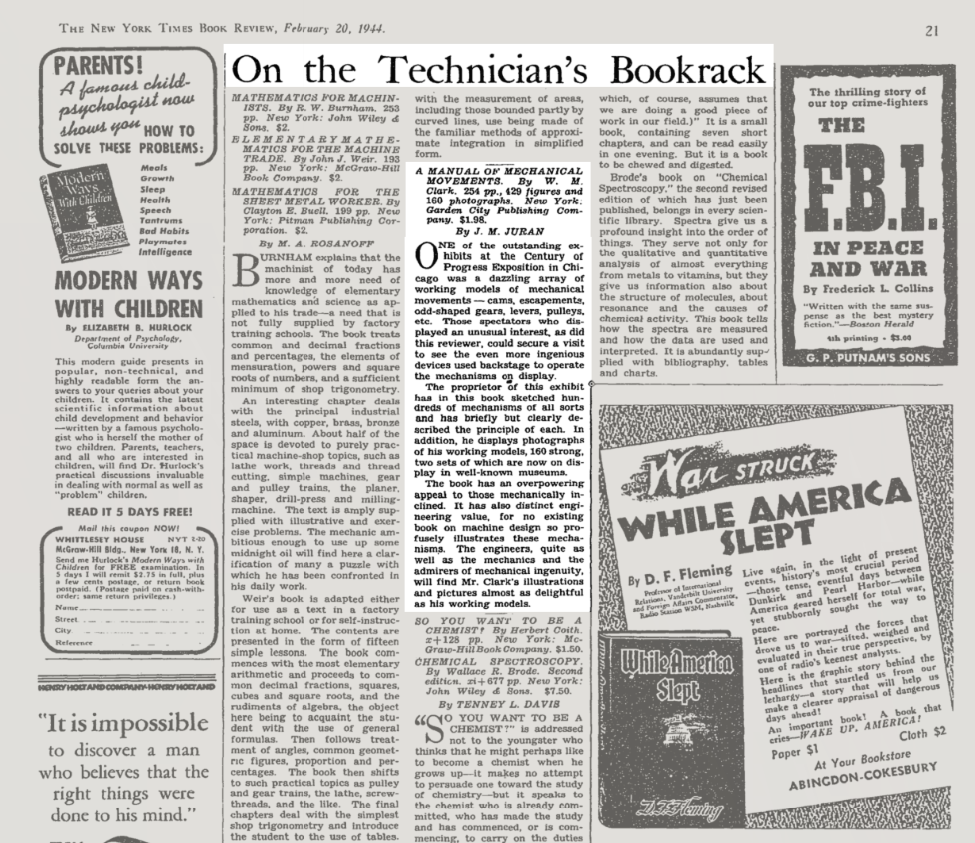
15 Juran, J.M. (1944) On The Technician's Bookrack New York Times (Book Review of A 'A Manual of Mechanical Movements')
16 Gosner, Kenneth L. (1954) "THE MUSEUM" Volume 6, Number 3 The Newark Museum Cornell , Newark Library
17 Cornell University & Boston Museum of Science (2005) Photos of partial Clark Collection and KMODDL (Kinematic Models for Design Digital Library)
18 Holden, Sarah (2009) Best-available video showing Clark Collection of Mechanical Movement at Boston Museum of Science
19 Eckstein, L. Blog page on history of William M. Clark's series of mechanical models
20 automatablog.com (2008) Article on Clark Collection
21 Peniston, William A. (2024) Private email correspondence
22 John Cotton Dana Wikipedia, retrieved 2024
23 Brown, Henry T (1865) Prospectus of the American Artisan American Artisan, Page 16 (p24 in record), retrieved 2024
24 "Scientific Items Gleam in New Home" New York Times (1936)
Article text suggests the Clark exhibits are included: "... beneath them is an array of levers, pulleys, inclined planes, ratchets, hydraulic devices and gears which work at the push of a button."
25 Clark, William M. (1933) A Manual of Mechanical Movements Garden City Publishing
Note the content of the book is Five Hundred and Seven Mechanical Movements, with title pages removed and a foreword added. This foreword has more historical details than 1943 edition. 2