The Sound of Silence is Unbearable
Today we take another pass at research looking at sound. This was a hard one. My brain really got stretched with understanding sound and frequency. I can see why music people get all into math!
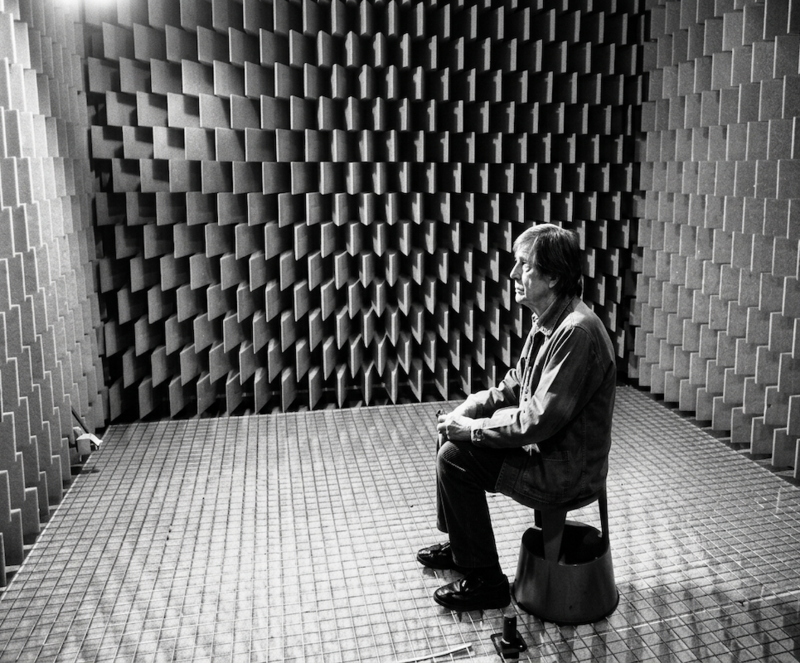 Image: Public Domain via Wikimedia Commons
One More Weird Thing
Since we spent the last two weeks on taste and smell: The chorda tympani — the nerve that carries taste from the front of the tongue — passes directly through the middle ear on its way to the brain. Airline food tastes worse partly because the ambient noise dampens your perception of sweet flavors. Umami, however, is immune to noise, and may even be enhanced by it. Loud environments are apparently ideal for savory.
In 1951, the composer John Cage spent time in an anechoic chamber at Harvard, a special room that reduces noise below human hearing. He expected silence, yet heard two sounds, a high tone and a low rumble. The engineers told him the high tone was his nervous system and the low tone was his blood circulating. The experience became one of the best-known episodes in his thinking about silence and is often linked to his composition of 4’33”, the infamous three-movement composition in which the performer sits at the piano but does not play any notes for the length of time in the title, shifting attention to the unintended sounds of the audience and performance environment.
Sound surrounds us so naturally it can be hard to notice it. Understanding sound and hearing starts with silence; how truly rare silence is. The unbearable quality of silence is real and measurable. Microsoft’s anechoic chamber held the Guinness record for quietest place; people report being unable to stay in it for minutes. Some reported hallucinations.
In true acoustic silence, your auditory system turns up its own gain (sensitivity). It’s hunting for signal, but in silence people hear:
- Tinnitus — some people suffer from tinnitus, but most people have it mildly all the time masked by ambient noise, commonly described as high-pitched electronic tone.
- Your own body — heartbeat, blood flow, the sound of your own breathing, joint movements, you can even “hear” the tensor tympani muscle in your ear, said to sound like a low rumble.
- Neural noise — the auditory cortex generates spontaneous activity which you can “hear” as a kind of static.
Sound waves reach our ears not as clear single frequencies, but as thousands or millions of pulses, randomly overlapping, all of which could be potential frequencies. Silence teaches that sound perception is not a natural stimulus, like light, but is highly processed even before it gets to the brain. Because the brain refuses to process absolute randomness, it organizes that static into sounds, usually with amazing fidelity, but it can also recognize phantom sounds in static.
Luckily, in the real world, silence is almost nonexistent. In a sense, air is the physical extension of the hearing system of animals (and some plants). Hearing is the always-on, fast, omnidirectional, low-spatial-resolution sense, in many ways the opposite and complement to vision. Human hearing is weirdly overbuilt:
-
Human ears can detect an enormous range of loudness. The cochlea, the fluid filled “inner ear” isn’t just a microphone; its outer hair cells actively pump energy back into the basilar membrane’s vibration, sharpening frequency tuning and boosting sensitivity by orders of magnitude. As a side effect, they emit sound, which is used to screen newborn babies for hearing loss.
-
Hearing is the fastest sense. Auditory reaction time (~140–160ms) beats visual (~190–200ms). Part of why alarms and warnings are sound, not light — and a design argument for tactile/audio feedback on controls.
-
Hearing never turns off; humans don’t have “earlids.” Evolutionarily, it’s the threat-detection sense; the brain is always doing low-level auditory analysis and flags what’s relevant: a parent wakes to their own infant’s cry and sleeps through others’. Relatedly, the “cocktail party effect” aka auditory scene analysis, shows how your brain can pick out your own name in the scrum of a busy party.
-
Earfolds (pinna) solve a problem stereo can’t: front/back and up/down. Two ears give you left/right, the pinna’s ridges filter incoming sound differently by elevation and front/back angle, and the brain infers the sound’s location from the missing frequencies. But this is not its only trick for sound localization; below ~1500 Hz the brain uses the fact that sound hits one ear slightly before the other. Above that, wavelengths are too short for timing to be unambiguous, so it uses that your head shadows the far ear. Very low-frequency sources are hard to localize, which is why you can put a subwoofer anywhere in a room.
-
Hearing and taste interact in perception, both psychologically, but also anatomically. The chorda tympani carries taste information from the front of the tongue and passes through the middle ear. A study indicated that ‘Taste Perception is Influenced by Extreme Noise Conditions’^[“Taste Perception Is Influenced by Extreme Noise Conditions,” APA Spotlight, Issue 46, https://www.apa.org/pubs/highlights/spotlight/issue-46.] “… Suggesting that enjoyment of airline food may be rated consistently lower than would be expected because the loud ambient noise dampens perception of pleasurable sweet flavors… but that this could be ameliorated by focusing on the sought-after taste quality of umami, which was not just immune to the effects of loud noise, but enhanced by it.”
That Sounds Loud!
Sound waves are patterns of air pressure increasing and decreasing. The pressure change happens from an event (hand hitting a drum, guitar string) pushing air molecules away and then moving back into the tiny vacuum. It’s a bit like AC electricity — the molecules don’t move much. At 0 dB, the threshold of hearing the molecules hit your ears moving ~10 picometers (10⁻¹¹ m) — 10,000× smaller than visible light wavelength. At 140 dB, the painful volume of a gunshot or rocket launch, the molecules hit your ears moving ~0.5 millimeters.
Wind is not sound; the air molecules are moving in the same direction, but wind causes vortexes of sound you may have heard, like whistles from a telephone wire. On the other hand, earthquakes are sound, just not in air. Seismologists study earthquake P-waves (primary/pressure), acoustically equivalent to sound waves in rock. Earthquake frequencies are well below the 20 Hz range of human hearing, but can be felt. Famously, animals detect these pre-earthquake infrasound vibrations.
There are two key concepts of loudness to disentangle:
The “inverse square law” The same sound volume decreases as you get further away, but it is important to understand why. If you measure sound in an open field with no reflections from 1 meter away, then move another meter away, the sound energy drops to 25%. This is because sound expands as a sphere, reducing the amount of energy hitting your ear as it expands. If you imagine sticking a googly eye on a balloon with 1 inch diameter, then doubling the diameter, the googly eye covers 1/4 as much of the balloon as it used to. The balloon’s skin is the sound wave; the googly eye is your ear. This metaphor would be easier if someone invents the “googly ear.”
The Decibel Scale
Decibels were invented by telephone engineers, not sound scientists, Bell Labs invented the logarithmic “Transmission Unit” in 1924, later renamed the “bel,” a tribute (and pun) on Alexander Graham Bell. Unfortunately, the standard measurement was too big for practical use, so engineers use 1/10 of a bel, or 1 decibel (like a centimeter). dB measures a ratio; a change of 6 dB is a doubling of sound pressure; the human ear perceives loudness logarithmically, meaning it takes a 10 dB increase for a sound to actually feel twice as loud to us.
The decibel scale is used because it matches human perception, not raw physics. Our ears need to handle 10 trillion times intensity range (whisper to jet engine). To do this without damage, outer hair cells amplify weak sounds but stop amplifying when sounds get loud.
Pitch and loudness are independent. A whispered middle C and a shouted middle C are the same frequency — 262 oscillations per second either way. Loudness is the size of each swing; frequency is how often the swing happens. The distinction seems obvious once stated, but it matters for detecting tones: measuring timing between pressure crossings gives you frequency, not loudness. The two dimensions don’t interfere with each other.
Loudness is also, confusingly, measured in time. The ear doesn’t hear instantaneous pressure peaks; it averages energy over roughly 200ms. A brief loud click sounds quieter than a sustained tone at the same peak decibel level, because the click doesn’t fill the integration window. A whisper sustained for two seconds feels louder than a shout that lasts 50ms.
Human hearing is not perfect math, but it has many surprising similarities. People hear ratios (100→200 Hz, 1000→2000 Hz) as similar pitch steps. (Remember these are averages, every person is slightly different.)
The Elephant in the Room
Elephants’ large ears are the least interesting way they communicate with sound. Katy Payne discovered elephant infrasound communication at the Zoo in Portland, Oregon, in the 1980s — the throbbing in the air reminded her of singing in a chorus accompanied by a pipe organ. She had previously contributed to the research for landmark paper “Songs of Humpback Whales” (Roger S. Payne and Scott McVay, Science, 1971) that documented the hierarchical structure of humpback whale song communication.
Their massive calls create low-frequency infrasound rumbles that travel vast distances through the ground; elephants hear both with their ears and unique Pacinian corpuscles in feet and trunk tip. They make a characteristic freeze posture when listening, shifting their weight forward to better listen and will also raise individual feet to triangulate the sound’s direction.
That a channel of communication so powerful went unnoticed until so recently is both humbling and an invitation to keep looking. It also encourages designers to remember sound is more than what comes through the air; people should take care not to poison the audio environment for our largest mammal relatives.
 Illustration: public domain
Tangible Tuesday will be taking a break for July for a research trip. See you in August