A Tangible Talk with Corey Vaughan of Kickr Design
Interview conducted September 23, 2026
“Let’s keep design weird. There are no tools that do everything, we’ve always had to hack everything will. And that’s the way I like it.”
For my forthcoming book, Designing the Tangible Interface, Corey Vaughan, a partner at Kickr Design in Atlanta, talked about the “messy middle” between an idea and a testable product, wiring up LEDs by hand for Delta, the analog-to-digital shift in pro audio, and being a climber.
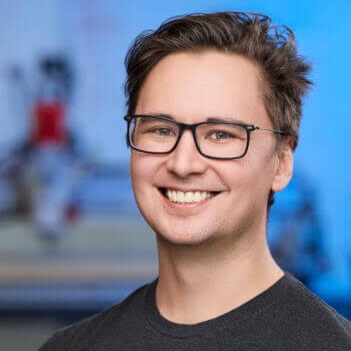 Corey Vaughan, Partner, Kickr Design. kickrdesign.com
Rhode Island isn’t exactly known for its mountains.
Notably boulderous Rhode Island, honestly. I started my career in New York, but it wasn’t until I was living in Rhode Island that I started climbing regularly, and then I ended up in the Pacific Northwest, where the Cascades and the Olympics do provide some challenge.
There’s a fascinating Instagram handle I follow called The Nuts Museum — nuts is a climbing term, a type of passive protection gear. It looks at hardware development in climbing throughout the decades. Climbers were the ultimate dirtbags: the gear was being made out of the back of trucks and cars for the first couple of decades climbing was around. It’s really interesting for product designers to look into the history of products in that field.
The book covers going from an idea to a working prototype, and just a little of what comes after. Making it work at all is an incredible accomplishment, but getting to mass production is almost a different process.
That’s perfect, because that’s right where we live. I’ve been at Kickr for 10 years now. When I first joined, it was a bunch of mechanical engineers from Georgia Tech helping people improve their ideas. My interview with the CEO was a lunch, and they’re like, “Well, what’s industrial design?”
It was about 6 years after that day where we really felt like we could plant our stake in the ground and say we specialize in helping clients get through that proof of concept stage. Going from their idea into what we now call the messy middle, which is just chaos, and coming out the other side — not with a finished product. It should not be ready for manufacturing at that point, but it should be ready for testing and collecting data.
Even getting clients to understand that that’s important is the hardest part of my day. The design, the engineering is all fairly straightforward. Once in a blue moon, I get the chance to go into the Pantone swatch book and pick something. But the most challenging and rewarding and truly financially valuable thing I can do is educate our clients through the process.
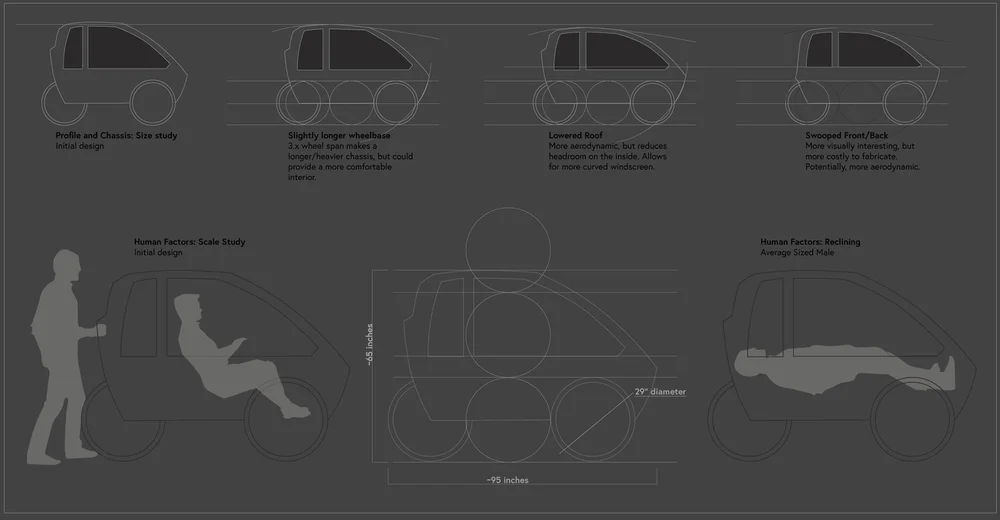 “What needs to be discussed? A quick sketch can allow for great conversations.” A human factors scale study. idhustle.com/portfolio-form-dev Image: Corey Vaughan
My students live in a world of Apple renderings, where everything is just perfect. You can’t learn anything from those.
What I’m seeing from students — I work closely with SCAD and Georgia Tech — is that the bullshit meter is pretty sensitive right now. With AI renders and the not-real stuff, they understand that something’s missing. And I’m really impressed with the students because they’re going out and looking for that thing, even if they don’t know what it is. And I think it’s exactly that. It’s the hands-on, it’s the tangible outputs, it’s the process. It’s the messy stuff that we have 60,000 square feet of here at Kickr.
Our front lobby is full of what we call partial prototypes. Most of them aren’t pretty, and that’s not the job. The job is to be able to test. I can show you a render of what it’s gonna look like eventually, but more important is to put something in your hands so you can see for yourself: does this fulfill the functions I’m looking to fulfill? Very rarely is something purely stylistic, at least for what we do. What we do is pretty utilitarian, not design with a capital D. I just want good design, like lowercase d.
Design, to me, is most effective as a tool between all the other disciplines — between mechanical engineers, electrical engineers, firmware, software, marketing. Design fills the gaps. We’re kind of like the mortar between these bricks that hold the wall together. That’s what I’ve made my career out of. It’s not about making the coolest-looking render. It’s more about: what’s the need that’s not being fulfilled that people are going to pay money for, and that we’re going to be able to sustain a business on?
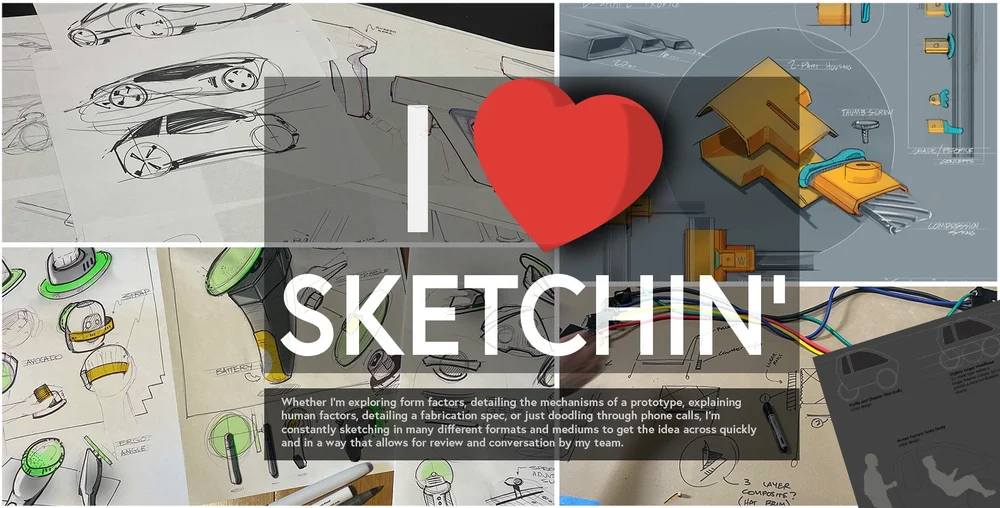 “Whether I’m exploring form factors, detailing the mechanisms of a prototype, explaining human factors, detailing a fabrication spec, or just doodling through phone calls, I’m constantly sketching.” idhustle.com/portfolio-form-dev Image: Corey Vaughan
Working at a consultancy, you get to work across many clients with many different types of problems. Designers at a company that makes one product get very deep.
I got my start in the music industry and eventually worked for a couple of heritage brands that had been around since the 70s. And it’s that exact problem. If you change it, you’re going to piss off your whole dedicated, loyal fan base. Ampeg was that way. But it was still very cool to develop new products inside of that fishbowl. We ended up reviving some old circuitry. I got to work with one of the original electrical engineers on a circuit called the Scrambler, which was part of what made Ampeg a big name back in the day. To me, the exciting design part was the heritage and the history behind it.
But as a consultant — I tell my friends a lot — I was never that good of a designer. I’ve just had a lot of opportunities to fail and try again. At the end of the day, we do our best, get closure, and move on to the next project, and we do that more than any other consulting firm I’ve talked to.
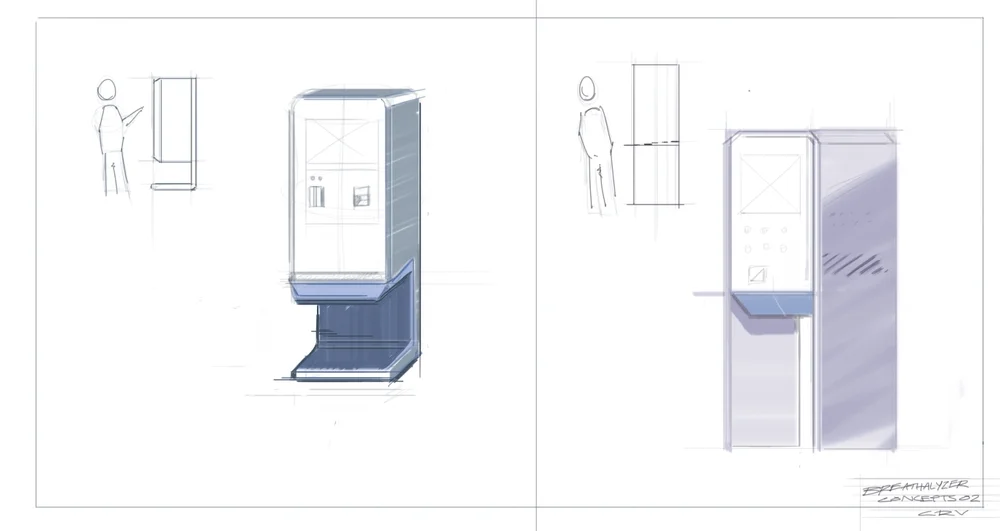 Exploring form and scale. idhustle.com/portfolio-form-dev Image: Corey Vaughan
Looking at your website, you really offer the full soup to nuts. Of course, I clicked on the prototyping section, because that’s what we’re interested in.
You’ve touched on my favorite and least favorite types of projects. The most challenging are the clients that come to us and say, “I’ve already designed it, I just need you to make it.” Most of the time they’re open to hearing our feedback, because we’ve got thousands of projects under our belt, and we can say, “Here’s some concerns we have. Do you know what you’re signing up for?” There are clients that ignore all of our best judgments, and we ultimately say, “It’s your money. If this is what you want to make, we’ll make it for you.” The majority of the time, we’re proven right.
My favorite projects are the ones that don’t really know what they need or want yet, but they have the problem, and they see the opportunity in the market. One of my favorites is the Delta fingerprint scanner.
The problem was: “Customers are coming to check in to our Sky Clubs, and all they have to do is scan their fingerprints. But they don’t even know it’s there, and even if we point at the fingerprint scanner, they don’t get it.” And then there was this opportunity in their product life cycle, where if they could make a change in 4 or 5 months, they could redesign it. They came to us, “That’s possible, right?” And we’re like, no, that’s not possible, but let’s figure out what is. Here’s the problem, here are the constraints, what can we do?
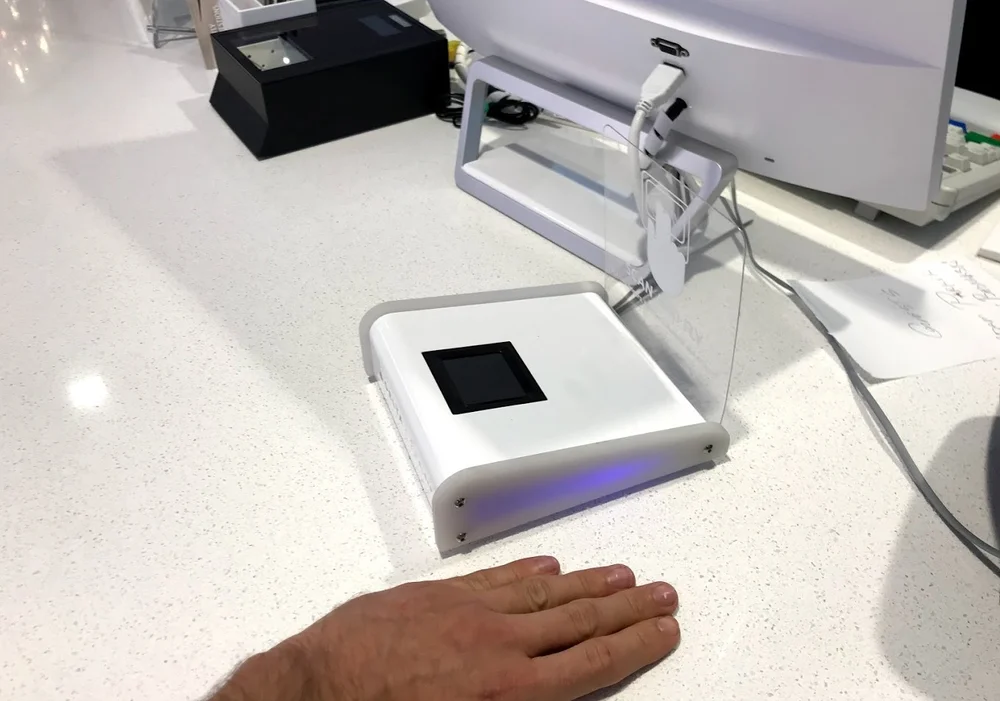 “It looks backwards.” The original scanner — users had a hard time figuring out how to interact with it. idhustle.com/fingerprint-scanner Image: Corey Vaughan
This is one of my favorite projects because the research was so fun. Honestly, it was such a chore to go around to all the different Sky Clubs in the Atlanta airport and try all the sushi and drink all the beer.
But truly, it allowed us to really understand the problem. We found a pathway that allowed us to not recertify the electronics, but to redesign and add on top of what already existed. And that requires an intense understanding of certification and compliance pathways. I can tell you right now, if you have to go through UL safety testing and FCC certification, you’re not going to hit a 3- or 4-month timeline.
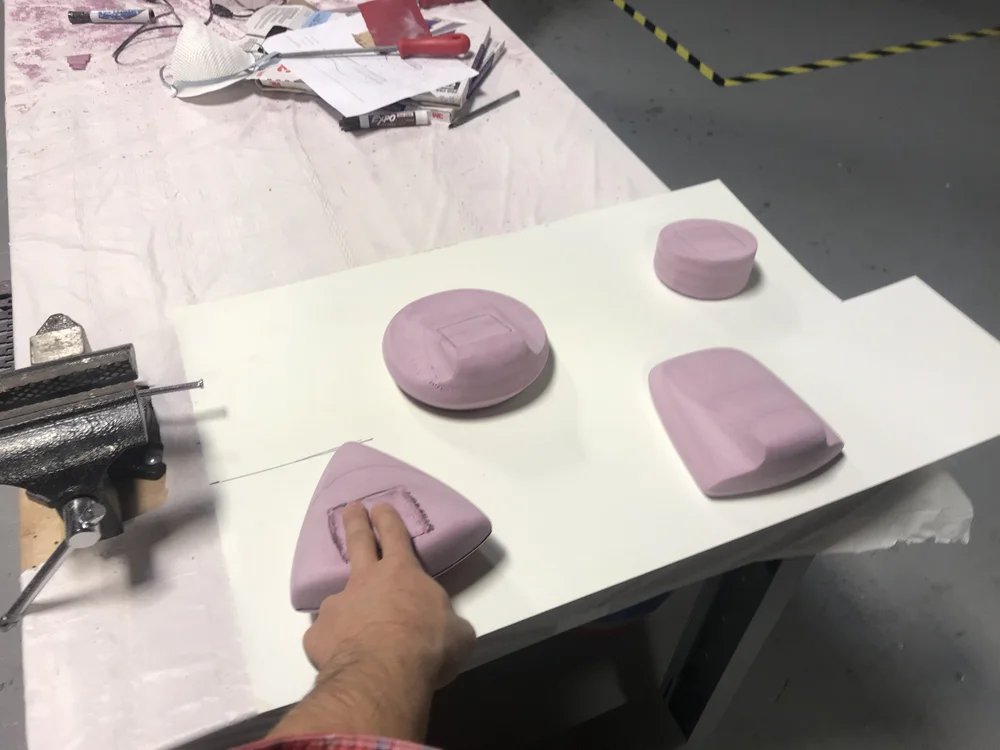 Foam mockups — quick, cheap, and effective for conversations about scale and user interactions. idhustle.com/fingerprint-scanner Image: Corey Vaughan
I see on your website you mention a supplemental PCB, which is another technique.
Exactly. If we just add on top of it and piggyback on the certification that’s already there, we’ve unlocked a product opportunity. And the design is simple enough — we just had to create something inviting, that someone wanted to reach out and touch.
When I was in Seattle, I grew an appreciation for code. It started with Python and grew into JavaScript and Arduino and C++. So I actually wired up our first LED board, which helped us think through the user interaction: when you’re not interacting with this thing, what happens? Right now, it actually breathes. There’s a PWM circuit that controls the LEDs so they fade on and fade off. It’s waiting for you to come by and interact with it.
And that needs to be designed. It doesn’t just breathe. There are multiple ways it could breathe.
So I took these WS2812s, wired them together by hand, hooked it up to an Arduino, and we went through probably half a dozen different concepts just in the lighting program. To me, that was a beautiful example of understanding the problem, understanding what’s possible, and then being able to move quickly through it.
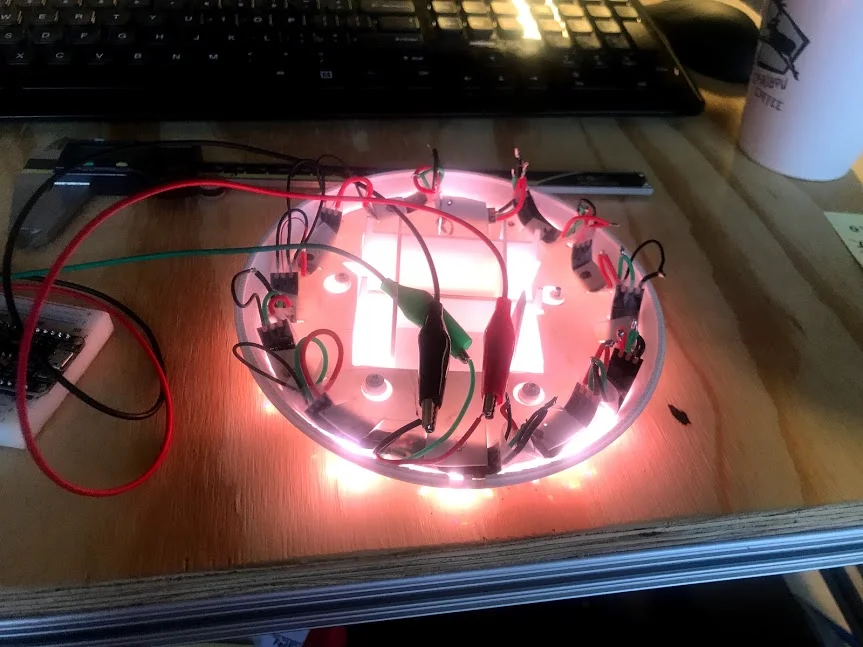 “How many RGB SMDs will it take for a smooth and enticing user experience? Sometimes, the quick and dirty solutions give the cleanest answers.” idhustle.com/fingerprint-scanner Image: Corey Vaughan
 Interactive elements concept animation. idhustle.com/fingerprint-scanner Image: Corey Vaughan
Other designers have made so much that you can build on. The NeoPixel-style LEDs come on ribbons, in circles, all kinds of shapes.
Truly, I was using the libraries straight from the tap that were built for these specific LEDs. I was doing nothing unique with the LEDs. It was just what they were being used in that was unique. It’s standing on the shoulders of giants a little bit. And learning to speak the language — even knowing what dev boards are and that they exist — was a game changer. When I started playing with wireless, it was the ESP8266, and now it’s the ESP32. What they can do on a little postage stamp–sized dev board is insane. And you don’t have to start from scratch. Get some wire and you’re off to the races. In half an hour, you can have something wired up. So yes, it’s collaboration with other designers, for sure.
How did you get to where you were comfortable with that? Were there projects along the way you learned from? Were you actually an engineer at SCAD?
My dad was an engineer and my mom was an artist, and that’s probably the genesis of something in the middle. At SCAD, I was just an average design student. I definitely wanted to be more on the artistic side of things.
I think working in the music industry at a pivotal time — when it was being proven out that you could go from analog to digital in a professional sense — was mind-blowing. That will never happen again, in audio at least. I absorbed a lot of information all at once. Then I went from Providence, Rhode Island, to Seattle, staying in the music industry for competing companies, and being in the neighborhood of Microsoft and Amazon, I made friends with a bunch of really smart firmware and software guys.
To me, it’s always been about cross-pollination. Learning one thing opens up the door to a bunch of other new things. Here’s an example: for the Global Sustainability Awards ceremony a couple of weeks ago, I had to teach everyone how to do paper molding out of plaster. It’s just not something that’s commonly done these days, but we needed something custom. And that’s something I learned as a ceramics artist back at SCAD. It’s something I can pull out of the toolbox.
Right now, across the room, I’ve got a coat prototype that I’m making. I made a mistake last night that cost me four hours of work. People say hardware is hard, and I agree, but soft goods make you question your sanity. I swear I did this the right way, and I look back and now it’s five layers deep, and I have to take it all apart and redo it. But it’s truly just learning new things. I think that’s the foundation.
So then you taught yourself? Industrial design is itself kind of a niche, and interactive electronics industrial design is a niche within a niche.
I say this all the time: let’s not try and define it. Let’s just keep it weird. There are no tools out there that exist for industrial designers. We’ve always had to hack everything to our own will. And that’s the way I like it. I think that’s what keeps us relevant. From the days of Raymond Loewy to where we are now, what other industry covers the same disparity of fields and disciplines and markets and trends? We just end up in some weird places.
Consulting is great because you get exposure to a lot of different things, and I’m surrounded by brilliant minds. I sit next to a guy who worked on missiles at Texas Instruments when they were first being developed. I’ve learned more just from overhearing him talk about electronics than people get in many hours of studying.
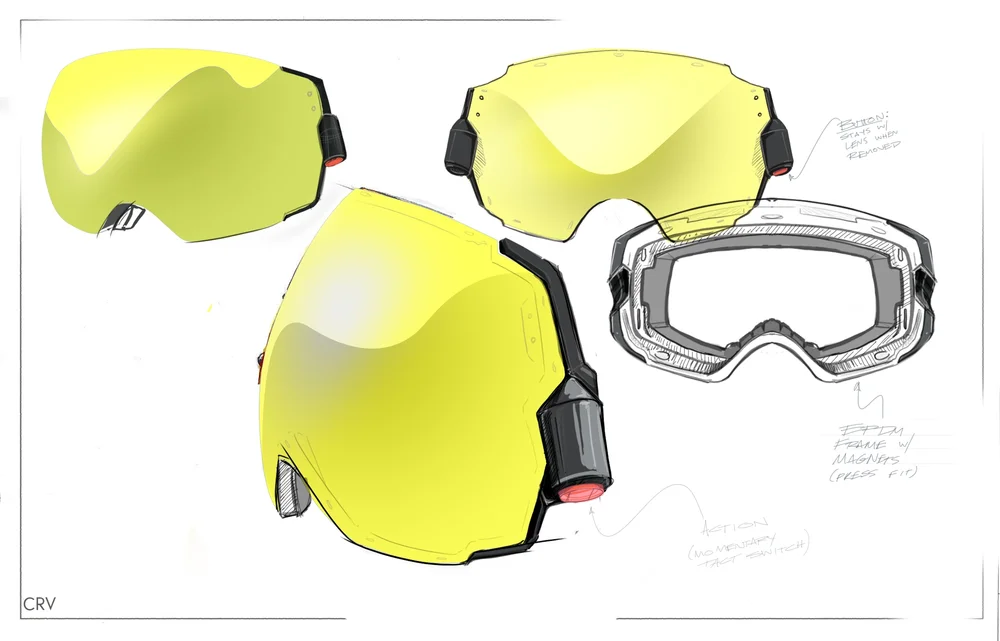 Exploring form, features, and assembly. idhustle.com/portfolio-form-dev Image: Corey Vaughan
I’ve observed that a lot of musicians get into electronics.
I’m not a musician. I’m terrible. I have all this gear from my time in the industry — the top of my shelf here is covered with products and prototypes. But I’ve always fed off of passion, and musicians, especially the more successful they are, truly are passionate. They’re music nerds at heart. Being a designer in a room full of designers is one of the most boring things to me. But put me in a room with a musician, an electrical engineer, and a mechanical engineer, and we’re gonna have a great time.
Where the ocean meets the shore is where the action is.
Exactly. Do you know permaculture? It has this idea of the edge effect: the most ecologically active area in any ecosystem is where two things meet. Where your lawn meets the trees, where your brick wall meets the ground. That’s where things are really happening. In audio, it was that transition from analog into digital professional recording, reproduction, and performing. And here, it’s combining a lot of things that maybe haven’t always touched into making something new. Always being open to learning new things has been where my nose has taken me.
A student brought in a potentiometer with a click that shorts out at the end of its travel. It’s a manufactured part, so someone had a need for it, but I can’t imagine why.
It could be for phantom power, or a mute button on a mixer. There are many possibilities that we’re separated from because so much has gone digital. When you press this button, there’s actually some really complex wizardry happening underneath the surface. A single button press might be replacing a patch cable job that used to take 5 minutes. Music and audio are so closely intertwined with the electrons. When things went electric back in the day, it developed a sound that people were very hesitant to leave behind. It was truly kicking and screaming, bringing some of these guys into the digital age.
In class today, we talked about potentiometers versus rotary encoders. They look the same, but it’s really about state management and where the state lives. It might be really nice to have multiple volume controls — there’s a Bang & Olufsen Beosound speaker, a beautiful sculptural object, where you can turn the volume on top of BOTH of them. Very hard to do this in analog controls, but studio engineers would record the fader positions, then mechanically set them back how the song was mixed, so they could mix it again.
Yeah, the flying faders. I was there for that. Flying faders were around before the digital age, so taking that same mental model people already had of motorized faders and bringing it into digital was a lot of fun. Even now, if you go backstage, this is another fascinating carryover. They used to tape it: they’d take a piece of tape and write, okay, this fader goes here. We had to carry that same idea into the digital world when things started being mixed on iPads and screens. What are the user considerations there? A piece of tape, I can stick it anywhere. That doesn’t work quite the same way when you’ve got a dedicated grid on an iPad.
It was a blast to be in that field at that time. I’d be bored to tears being a designer just trying to be a capital D designer, but working with these passionate people and giving them tools to elevate their art was a very cool experience.
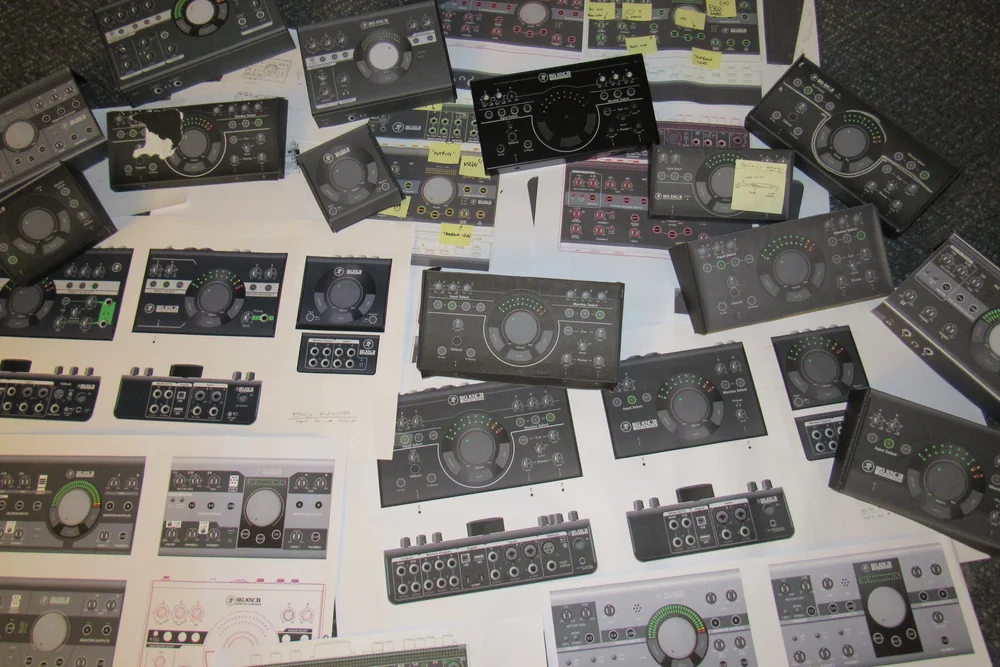 Corey’s work on the Mackie Big Knob studio monitor controller: “2D and 3D prototypes were created to quickly test the control interface, size constraints, and manufacturing concerns.” idhustle.com/portfolio-big-knob Image: Corey Vaughan
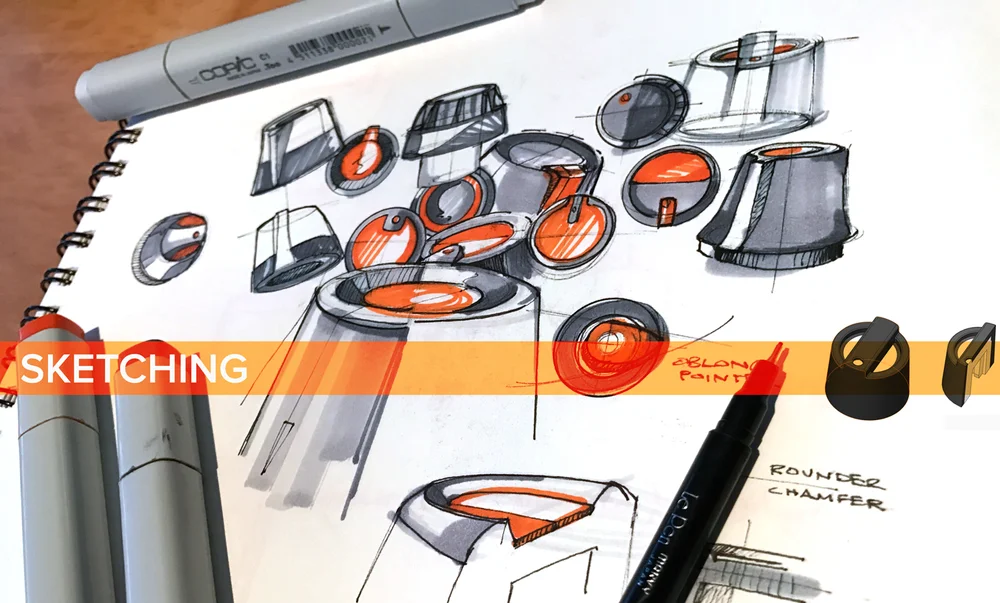 “I designed custom knobs to allow a better workflow and user experience. Working closely with manufacturers and engineers, a two-shot knob was created.” idhustle.com/portfolio-big-knob Image: Corey Vaughan
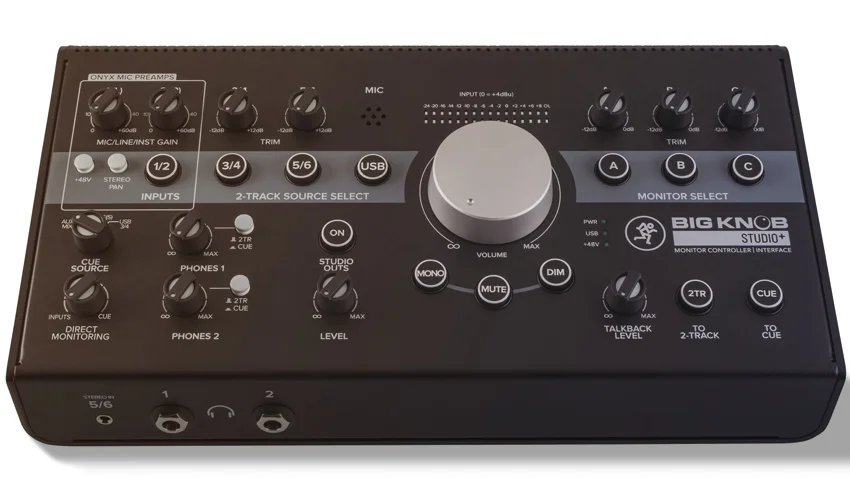 The final Big Knob: “refined and rugged. It will fit nicely into any studio setting without drawing much attention, but always be ready for action.” idhustle.com/portfolio-big-knob Image: Corey Vaughan
You have to think about the user’s mental model, what they’re used to. No one wants to completely switch over. So you end up with the little floppy disk save icon.
I had a moment of age when I volunteered introducing inner-city kids to rock climbing. The gym had these climbing holds shaped like telephones. And I said, “Reach for the telephone,” and they’re like, “What’s a telephone?” That was painful. But you do realize there are carryovers from previous ages, tons of them in our day-to-day that we don’t recognize. It’s fun to play in the realm of psychology a little bit.
Are there products where the physical form, the tangibleness of it, was essential to the way it was used?
I think anything without a touchscreen. My brain’s stuck in the music industry now, but at Alesis we redesigned the keytar. We also got to revamp the EWI, the electronic wind instrument, originally made by Akai in Japan. I think anything where you’re being expressive. The EWI has some accelerometer smarts built into it. Gesture, to me, is most interesting when it buys you something else.
For a few years, I teamed up with a buddy of mine, who went to graduate school at Pratt for ID, and we designed a headlamp with an accelerometer in it. We had this whole concept of catching the light: you could shake your head a certain way to dim the light or bring it back. That meant if your hands were busy, you were able to catch the light and reactivate it.
Any object, especially without a touchscreen, is going to need to be informative to your other senses. If you’re not navigating some topology on a digital screen, you need to be navigating the task through the actual size and shape of what you’re holding.
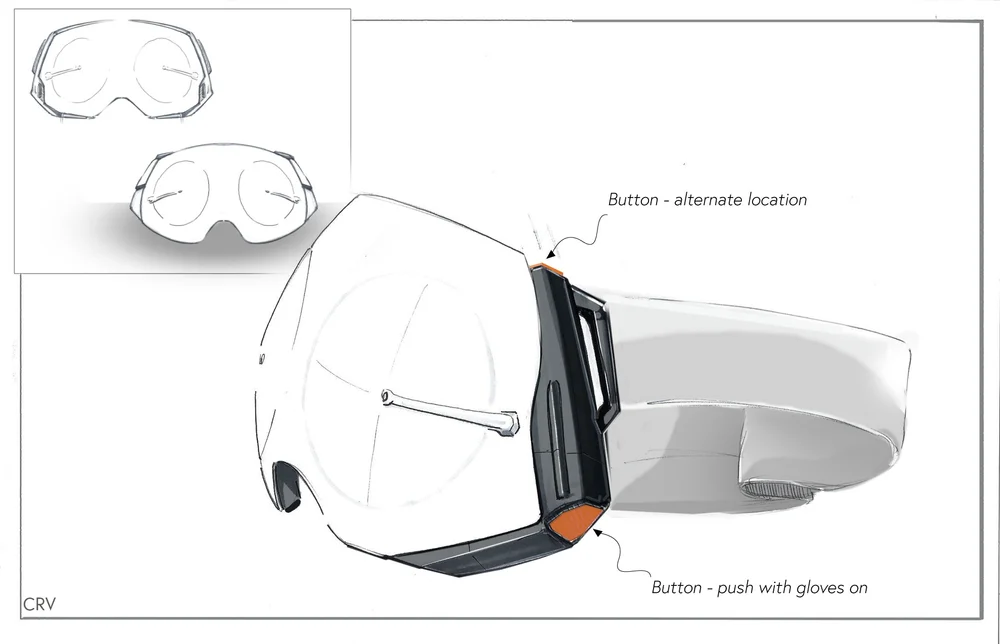 “What’s the ‘x’ factor? Let the design tell a story.” Note the button placed to be pushed with gloves on. idhustle.com/portfolio-form-dev Image: Corey Vaughan
A great example is the med device space, where every decision has to be literally proven out and documented. We helped the company now called Oxos develop what I colloquially call the X-ray gun. It’s literally a handheld X-ray. The amount of electricity running through that thing is scary, but also really cool. That’s something where the shape informs safety. You have to design things in a way where it’s going to be really, really hard to misuse, and even if it does get misused, it’s not going to create any sort of catastrophic domino effect.
Even the shape that you make something conveys meaning. We’re taking a lot of elements from hood scoops and automotive. What does that convey? A sense of power and speed. We use these visual cues as already being in the zeitgeist, and when you see that same visual cue on a different product, you subconsciously assume there’s some correlation.
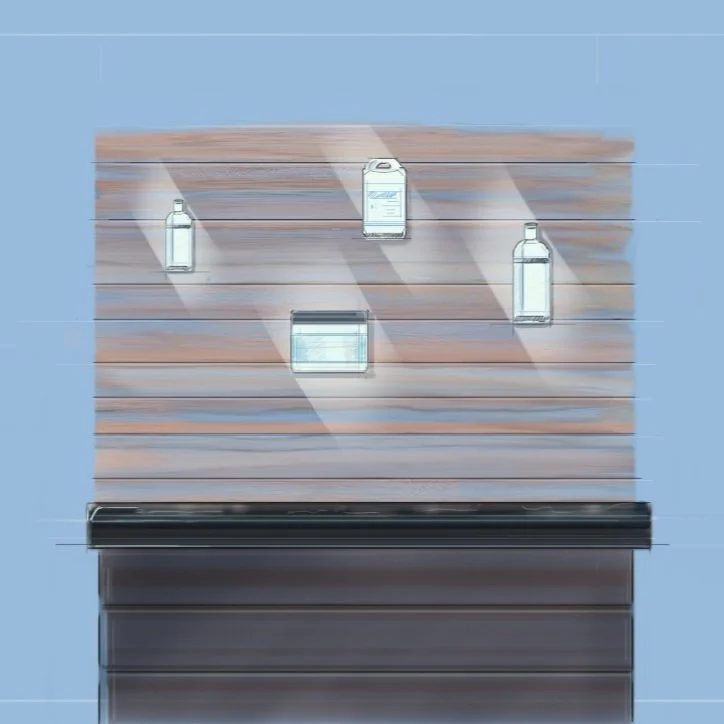 “What is the focus? Material, profile, depth, and light all interact to convey the message.” idhustle.com/portfolio-form-dev Image: Corey Vaughan
And because we’re monkeys that got good at using tools, we’re very apt to want to explore things with our hands. We’re always fidgeting with something. Fidgetability is something we look for as a good score for interaction.
What tools or techniques are underappreciated?
All of them, honestly. In design school, it’s very easy to gravitate towards injection molding, because it gives you the most freedom and that level of Class A surface control. But to me, it’s bending and forming.
We got our laser cutter pretty early on, and I’ve seen this happen at makerspaces too: they get a laser cutter, and all of a sudden it unlocks all these things. When COVID hit, we manufactured 70,000 face shields for a local hospital that had no other way of getting PPE. We only did that because we had this tool that was fast, scalable, and could be operated by anyone. It didn’t require certification to run like our CNCs do. Once I programmed it, I could hire one of my friends who got laid off from the film and TV industry because of the pandemic. They could come in, push a button, advance the roll of film, push the button — and at the end of the day, we’ve got 700 face shields.
Tools that buy you speed and accuracy are underappreciated. Our metal lathe is another one. Once we got it, it unlocked a whole bunch of things we couldn’t do before, because it allowed us to work in metal with high accuracy. If I ever have to set up my own shop, the laser cutter and metal lathe will be the first two splurges, after the bandsaw and table saw.
And then an industrial sewing machine. Soft goods is one of those underappreciated skills that, when I see it in a portfolio, does make me stop. I haven’t seen too many design programs cover it, but once you have that skill, you’re capable on a lot of projects, especially now that we’re going more and more towards mobile and wearable devices. Even conductive threads. Soft goods make you appreciate material properties in a way that other methods don’t. As designers, we get to spec out, “I want this ABS/polycarbonate 50/50 blend at Mold-Tech 11010.” But with soft goods, here’s this wool, and you can do something with it or you can’t. You don’t get to define the blend.
Last year I saw a lot of soft goods projects from students, and I don’t think it’s just because I keep talking about it at portfolio reviews. I think it’s because they realize: I can produce something of high quality. What does a Coach purse sell for? There are no 3D printed parts on that thing. It takes a high level of skill that is immediately noticeable and appreciated, in a way you can’t get with 3D printing.
What about things you send out? PCBs can now come back assembled, and services like OSH Cut or SendCutSend will make a bent sheet metal part, finished, deburred, and painted.
They’re fantastic. I’ve probably done just as many personal projects with SendCutSend as professional ones. To be honest, it behooves us and our clients to outsource as much as we can. If we’re making something in our shop, it’s usually because there’s a crazy deadline and we can’t afford the 2 or 3 days. It makes sense to go with a specialty vendor that’s already optimized and efficient at what they do. And we also like the excuse to go network in our region. Two years ago, it was all about machine shops. We toured every single machine shop that would talk to us, and that netted awesome relationships.
If I hear someone say we’re gonna mill and wave solder our own PCBs, I’m gonna poke my head up and be like, what are you talking about, and why are we doing this? PCBWay, OSH Cut, those kinds of houses are great, because they’re already streamlined for what they do. Even though we have the capability to mill our own in-house, it doesn’t make economic sense for our clients, unless they need it tomorrow. Even with 3D printing, especially for a MultiJet part, we’ll outsource that and let someone else deal with the cleaning and curing. If something goes wrong, they’re on the hook, and we can get back to designing. We have dedicated shop resources — we just hired another — but I like to put them on the things we can’t outsource. Even though we have a huge shop in the back, when we have the timeline, we’ll default to outsourcing.
Something I talk about with students is that you’re not the only designer here. Somebody designed that little breakout board. They had an idea.
I do wish more students got that reality check early on. I needed it, for sure. I still get it to this day.
Corey’s parting note: “My subversive goal was to try and direct the conversation towards DFM and productization after a proof of concept. I can talk for ages on that. It’s such a valuable and underappreciated step of the process.” Stay tuned.