A Tangible Talk with Patricia Moore
Interview conducted October 2, 2026
“Sadly, there are numerous companies which are comfortable saying, ‘We don’t design for those people.’”
For my forthcoming book, Designing the Tangible Interface, Patricia Moore was kind enough to answer my questions about designing for aging bodies, getting designers to feel a limitation instead of reading about it, and how OXO Good Grips came to be.
 Patricia Moore in her aging disguise. Image: Patricia Moore

Patricia Moore is an industrial designer and gerontologist. From 1979 to 1982, in her twenties, she traveled across the United States and Canada disguised as women in their eighties, using makeup, clouded glasses, earplugs and splints that limited her sight, hearing and movement, and wrote about it in Disguised (1985). She worked with Smart Design and OXO founders Sam and Betsy Farber on OXO Good Grips, and has spent her career advocating for universal and inclusive design.
What did wearing the aging disguise teach you that lab research or interviews could not?
Immersion provides the closest understanding of how people “feel.” By taking on the characteristics and lifestyles of Elder Women of a range of health and wealth, I was able to truly understand the cultural and emotional challenges that occur as we age, particularly in youth-oriented communities.
 Image: Patricia Moore
How do you get designers to feel a limitation in their own bodies instead of reading about it?
I use simple exercises when I am working with Design Students, to help them feel and understand the life situations of others:
- Using their non-dominant hand to perform tasks
- Plugging their ears and wearing cloudy goggles
- Using a wheelchair, walker or cane to navigate campus environments
It is always gratifying to see how enthusiastically Students respond after those experiences.
How do you think about designing tactile feedback (detents, clicks, resistance) and muscle memory across aging populations?
Any and all redundant cognitive cues are an excellent solution for enhancing appropriate responses.
After cataract surgery a few years ago, I attached some clear “pads” over the numbers 1, 3, 5, 7, 8 and zero on the touch panel of my kitchen microwave, so that I can make selections with “task lighting.” A simple fix eliminated the irritation of not being able to see the low-contrast numbers.
“Universal design” and “inclusive design” are sometimes used loosely. Are there good examples of recent products that live up to it, or has the term been diluted?
Universal Design launched in the USA. In the early days of its use, I would explain that Universality in Design provided for consumer Inclusivity. Roger Coleman, Director of DesignAge in London, was the first to simply use Inclusivity as the term that counters intentional and/or accidental Design Exclusion. Japan primarily uses Universal Design as the descriptor of exemplars that provide consumers with equity.
When I enter a public lavatory and the lights automatically turn on, bathing mitts that eliminate the need to hold soap or a washcloth, slip-on footwear and closure-free clothing are the examples that immediately come to mind when I look for Universally Inclusive Design Solutions.
Is there a product you’ve seen succeed because it was designed for the extremes of ability first? What made the team, company or designer embrace that?
OXO Good Grips is the exemplar of the Design community focused on providing ease of use, safety, and satisfaction for consumers of all levels of ability. Smart Design and I were focused on creating a tipping point in Design with the strong support and directive of founders Sam and Betsy Farber.
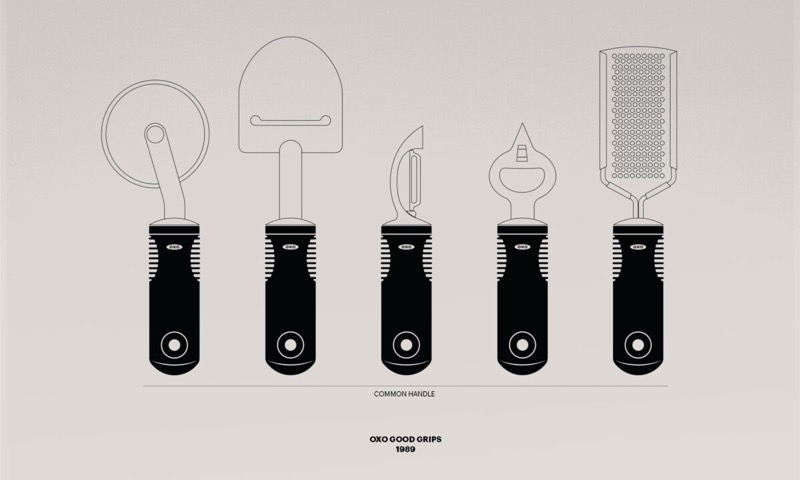 OXO Good Grips, 1989: one common handle across the whole line.
What has changed in how companies research older users since you began? What has not?
The major change in corporate attitude is a global recognition of the buying power of Elders and the sensibility of Design For ALL!
Sadly, there are numerous companies which are comfortable saying, “We don’t design for those people.”
What should the next generation of designers think about physical interfaces do that today’s don’t?
Next Gen Designers are tasked with deliberate inclusion of more and more AI and robotic influences in their efforts to create innovation. I believe the majority of all Designers at work today are aware of their responsibility to be inclusive in all things.
If you happened to meet yourself at 20, before everything you’ve learned in your career, what would you tell her about design, career, and life?
I would tell her that change doesn’t come easily, but it is the only outcome worthy of her focus and dedication.